
How To Wholesale Real Estate In Texas: Step-By-Step (2026)
Sep 07, 2026

Written by
Alex Martinez, Founder & CEO, Real Estate Skills. Has wholesaled and flipped houses for over 14 years, been part of 1,000+ real estate transactions, and personally acquired 33+ residential investment properties. Has trained 6,000+ investors nationwide.
Reviewed by
Ryan Zomorodi, Co-Founder & COO, Real Estate Skills. Reviewed and verified the market data, deal figures, and Texas contract process in this guide before publication.
Publication history: Originally published June 23, 2022. Updated September 7, 2026 with a rebuilt nine step process, three Texas student deal breakdowns with full numbers, a city level assignment fee table, a line by line contract walkthrough, and current market data. Licensing and disclosure guidance moved to our dedicated Texas legal guide. Market data and deal figures verified by Ryan Zomorodi, Co-Founder & COO, Real Estate Skills.
To wholesale real estate in Texas, you put a distressed property under contract, find a cash buyer during your option period, and assign that contract for a fee. Fees run about $5,000 to $30,000 depending on the metro. You never take title, and your cash at risk can be as low as $100.
Three of our students closed Texas deals recently and not one of them did it the same way. Nathan closed two San Antonio houses inside a single month, both of them coming from one agent he had kept in touch with for a year. Sabbir talked a Dallas listing down from $315,000 to $245,000 and made $5,000. Jesse did a deal in Cedar Hill from Canada and never saw the property. Same nine steps. Three completely different routes through them.
What all three had to solve first is the thing that makes Texas different from almost anywhere else you have read about. Texas is a non-disclosure state. Sale prices are not in the public record here, so Zillow and Redfin sold data will not give you an accurate after repair value. Every offer you make has to be priced off real MLS comps. That means an agent relationship, a data platform, or a buyer network deep enough that people share their numbers with you. Solve it before you write your first offer. Most beginners find out about it the hard way, after they have already overpaid on something.
The second thing worth knowing up front is that not all of Texas is equally hard. Houston, Dallas, and Austin have institutional money and operators who have been working the same zip codes for years. San Antonio, El Paso, Lubbock, and the Rio Grande Valley are a different situation, and that is where our students are actually closing. This guide covers the nine steps with Texas numbers on every one, the deal math, a metro by metro breakdown, and a walkthrough of the paperwork. You can download the attorney drafted Texas contract bundle here and follow along with it open.
What Is Wholesaling Real Estate In Texas?
Wholesaling real estate in Texas means putting a property under contract as the buyer, then selling your rights under that contract to a cash buyer for a fee. You never own the house. In Texas you get an option period to find that buyer, and your cash at risk during it can be as little as $100.
You are not selling a house. You are selling your position in a contract. That distinction sounds like a technicality and it is actually the whole thing, because it is what lets you get paid on a property you never bought.
Here is the shape of it. You find a seller who needs out fast, usually because the house needs work or their timeline is tight. You agree on a price that leaves room for a cash buyer to renovate and still profit. You sign a Texas purchase and sale agreement, which gives you equitable interest, meaning a real contractual right to buy that property. Then you find an investor who wants the deal, sign an assignment of contract handing them your position, and the title company pays you at closing. The buyer closes with the seller. You never take title and you never fund the purchase.
The Texas version has one feature worth knowing on day one. Most Texas contracts include an option period, a set number of days where you can walk away for the cost of a small option fee. Sabbir used seven days on his Dallas deal and paid $100 for it. Jesse gave himself three days on a Cedar Hill deal and heard from multiple buyers afterward that they would have paid more with a longer window. That window is the whole game. It is when you find your buyer.
💡 A Real Texas Deal: Sabbir In Dallas
- Listed at $315,000. Sabbir opened at $230,000 and settled at $245,000 after following up with the agent repeatedly.
- ARV around $385,000. Repairs came in under $50,000, mostly cosmetic on a 35 to 40 year old house that had been well maintained.
- He put down a $100 option fee. His buyer covered the earnest money deposit.
- He assigned the contract to a wholesaler with an established buyer network, who double closed with the end buyer.
- $5,000 assignment fee, paid the day it closed. Two weeks start to finish. The $100 came back with the check.
That is a first deal. Not a home run, and Sabbir will tell you why. He pushed his ARV higher than his deal review said he should, which won him the contract and squeezed his own spread. More on that when we get to the numbers.
Read Also: Wholesaling Real Estate: The Complete Guide
Where The Texas Deals Are In 2026
Texas has more wholesale deal volume than almost any state, and the four biggest metros are also the most competitive in the country. As of mid 2026 the statewide median sits around $344,000, roughly 1% above last year, with homes taking about 66 days to sell. San Antonio, El Paso, Lubbock, and the Rio Grande Valley are where a beginner's numbers work.
Dallas-Fort Worth was named the number one U.S. market to watch in PwC and ULI's Emerging Trends in Real Estate 2026, its second year at the top. Houston came in fifth. Austin did not make the top ten, for the second year running.
That tells you where the capital is going. It does not tell you where your first deal is.
The market also flipped on people this year, and if you read a Texas wholesaling guide written in early 2026 you got the wrong story. The story back then was that prices were falling and sellers were finally giving in. That was true for about thirteen months. It stopped being true. Texas closed 34,956 sales in June, up 8.6% over last year, with year to date volume running 3.2% ahead of 2025, according to the Texas Real Estate Research Center. The statewide median came in at $344,261 in July, up 1.3% year over year per Redfin. Days on market landed at 66, down from a year ago rather than up.
So this is not a collapsing market and you should stop looking for one. What it is instead is a slow market with a lot of inventory in it. The median seller price cut is running $12,000, about 3.3% off the original ask. Roughly one in five listings has taken a reduction. Sellers are sitting longer and adjusting, which is a different kind of opportunity than desperation but it is still an opportunity, and it is the one you actually have.
Which Texas metros are worth your time
Here is the tension, and I am going to be straight about it rather than pretend it away. The metros with the most transactions are the hardest places to close your first deal. Every institutional buyer in the country knows Dallas-Fort Worth topped that list two years running. A distressed listing in Houston gets multiple cash offers in days, not weeks.
Both things are true at once. More activity means more buyers on the other side of your deal, which makes contracts easier to move. More activity also means more people competing for the same listing. There is a real case for starting where the volume is. I would rather a beginner win a contract first, then move up.
Look at where our students actually closed. Nathan did two in San Antonio. Sabbir did his in Dallas, but it took four to five offers a week for three straight months and two cancelled contracts before one stuck. Jesse closed in Cedar Hill, a suburb, not Dallas proper.
| 📍 Market | Median Price (2026) | Typical Assignment Fee | Deal Volume | Competition |
|---|---|---|---|---|
| Houston | ~$360,000 | $8,000 to $25,000 | ⭐⭐⭐⭐⭐ Very High | 🔴 Very High |
| Dallas | ~$375,000 | $10,000 to $30,000 | ⭐⭐⭐⭐⭐ Very High | 🔴 Very High |
| Fort Worth | ~$335,000 | $8,000 to $22,000 | ⭐⭐⭐⭐ High | 🟡 Moderate |
| Austin | ~$562,000 | $15,000 to $40,000 | ⭐⭐⭐⭐ High | 🔴 Very High |
| San Antonio | ~$270,000 | $7,000 to $20,000 | ⭐⭐⭐⭐ High | 🟡 Moderate |
| El Paso | ~$231,000 | $5,000 to $15,000 | ⭐⭐⭐ Moderate | 🟢 Lower |
| Lubbock | ~$207,000 | $4,000 to $12,000 | ⭐⭐⭐ Moderate | 🟢 Lower |
| Rio Grande Valley | ~$137,000 | $4,000 to $10,000 | ⭐⭐ Developing | 🟢 Lower |
Median prices from Redfin and Zillow, verified September 2026. Austin reflects city proper, which runs well above the metro figure. Assignment fee ranges are estimates based on a 5 to 10% spread on a discounted contract, not guarantees. Competition reflects active investor density.
These are the metros with enough transaction volume to price reliably. Smaller Texas markets like Conroe, Waco, College Station, Galveston, and Corpus Christi run on the same math at lower price points, which usually means fees in the $5,000 to $15,000 range. Pull current comps before you price anything in a market that size, because a single sale moves the median.
Distressed inventory has also been building since pandemic era forbearance programs ended. The homeowners who held on through 2021 to 2023 are running out of room, and that pipeline feeds the MLS. Verify current foreclosure filings in your target county before you build a strategy on them, because those numbers move fast.
How To Wholesale Real Estate In Texas (9 Steps)
Nine steps to wholesale real estate in Texas: pick your market, build a cash buyer list, learn the Texas contracts, find distressed property, run your ARV and MAO, submit written offers, get it under contract, assign to a cash buyer, and collect at closing. Most Texas deals run 21 to 30 days.
Every step below has a Texas specific version. That is not filler. The comps work differently here because sale prices are not public, the option period changes how you buy time, closings run through title companies rather than attorneys, and the metro you pick decides whether you are competing against three people or thirty.
The order matters too. Buyers before deals. Almost every beginner does it backwards, finds a property first, and then discovers their contract clock is running while they cold call strangers hoping someone bites.
- Pick Your Texas Market
- Build Your Cash Buyer List First
- Learn The Texas Contracts
- Find Distressed Property In Texas
- Run The Numbers
- Submit Written Offers
- Get It Under Contract
- Assign The Contract To A Cash Buyer
- Close And Collect Your Assignment Fee
How To Wholesale Real Estate In Texas (STEP-BY-STEP)!
Alex Martinez walks through the Texas process end to end, including how to find distressed listings on the MLS, what to ask the listing agent, and how to structure an offer that gets accepted.

Step 1: Pick Your Texas Market
Start where you can win a contract, not where the most deals are. Houston, Dallas, and Austin have the highest volume and the deepest competition. San Antonio, El Paso, Lubbock, and the Rio Grande Valley have price points where the deal math still leaves room. If you live in Texas, start local.
If you are in Texas already, work your own city. You know which streets are fine and which ones your buyer will refuse. You know where the new construction is going. That knowledge is worth more than it sounds, and you cannot buy it.
If you are picking a market from scratch, pick one and stay in it. New wholesalers scatter across four metros because more markets feels like more chances. It is the opposite. Your comps get worse, your buyer relationships stay shallow, and you never learn any single market well enough to move fast on a listing.
There is a real case for the big metros. More transactions means more buyers, which makes contracts easier to move. I would rather a beginner win a contract first. San Antonio at a $270,000 median gives you room the 70% rule can actually work with. Austin at $562,000 does not, unless you already have buyers waiting.
Nathan worked San Antonio. Sabbir worked Dallas and it took three months of consistent offers plus two dead contracts. Jesse worked Cedar Hill, a suburb, from Canada.
Step 2: Build Your Cash Buyer List First
Build the buyer list before you find a deal. Once you go under contract your option period is running, usually seven days or less. Three to five buyers who answer the phone and have closed in your target zip codes beat five hundred names that do nothing.
Do this before anything else. Not because it is the most interesting step but because doing it late is how people lose money.
Nathan's two San Antonio deals came from one agent he had checked in with for about a year. No pressure, just letting her know he was around and had buyers. He called her one morning in June and she said, roughly, thank God you called, I need help. She had two sellers, a mother and daughter selling two houses so they could move in together. He put both under contract.
That is a year of low intensity follow up producing two deals in a morning. There is no shortcut version.
How to find Texas cash buyers
Search "sell my house fast Houston" or "we buy houses San Antonio" and skip the ads. The organic results are investors who spent real money to rank for motivated seller traffic. They are buying. Call them.
There is a compliance angle here that most beginners miss. When you call a homeowner off a foreclosure list, that is a cold call to someone who did not ask to hear from you, and it falls under the Telephone Consumer Protection Act. Fines run per violation. A cash buyer who paid to rank for "we buy houses" is a business advertising for inbound calls. A listing agent publishes their number on the MLS because taking calls is the job. Neither is a cold call. The marketing rules that apply in Texas are covered in our Texas wholesaling legal guide.
Texas courthouse foreclosure auctions are the other source worth your time. They run the first Tuesday of every month at the county courthouse, and every person bidding is a cash buyer standing in one room.
What Texas buyers actually want
Know their zip codes, price ceiling, property type, and timeline before you bring them anything.
Nathan learned this the hard way. He assumed his buy and hold buyers would price a 2016 turnkey house differently than a flipper would. They did not. They still wanted it at 70 to 75% so they had the option to resell fast. That mismatch cost him time on the Purple Creek house.
Also worth knowing: a buyer who does high volume can pay more. Sabbir put it plainly, that a buyer who only needs $30,000 to $40,000 per deal but does a lot of them can accept a higher price from you than a buyer squeezing every deal for maximum margin.
And buyers flake. Nathan had two walk after verbally committing on Green Valley. Both went quiet when the earnest money was due. The third one closed. Verbal commitment is not commitment. Money in escrow is.
Know What Your Texas Buyers Want Before You Call
Nathan had buy and hold buyers lined up in San Antonio and still got pushback, because they wanted a 2016 turnkey house at 70 to 75% so they could resell it fast if they needed to. He found that out after he was under contract. A serious Texas cash buyer can tell in thirty seconds whether you know what you are doing, and the first call decides whether you get a second one. Download our Cash Buyer Script to get their exact buy box, their price ceiling, and their zip codes before you tie up a property.
Step 3: Learn The Texas Contracts
Texas wholesale deals run on a purchase agreement and an assignment contract. The standard TREC One to Four Family Residential Contract is assignable by default, so no separate addendum is required. Texas also requires written disclosure of your equitable interest before you assign.
Two documents do the work. The purchase agreement between you and the seller, and the assignment contract between you and your cash buyer.
Most Texas residential deals use the TREC One to Four Family Residential Contract, the same form licensed agents use statewide. It is assignable unless something in it says otherwise, which is a genuine advantage over states where you need a separate addendum to make assignment work.
Texas also requires you to disclose in writing that you hold equitable interest and do not own the property, to both the seller and your end buyer. What that disclosure says, when it is due, and who signs it is covered in full in our Texas wholesaling legal guide. Read it before your first deal.
Do not use a national template. Ryan paid a Texas real estate attorney over $1,700 to draft the four documents a Texas deal actually needs: a purchase agreement built for wholesaling, an assignment contract, a seller disclosure, and a buyer disclosure. Generic packs are missing the last two entirely. The contract walkthrough further down covers what goes in each blank.
This section explains how these documents generally work. It is not legal advice. Have a licensed Texas real estate attorney review anything before you sign it.
Step 4: Find Distressed Property In Texas
Most Texas distressed property is on the MLS, not hiding off market. Pull new listings daily and filter for condition. Watch listings sitting past 90 days, price reductions, and confidential remarks that say cash only. This works from a laptop and costs almost nothing.
A lot of wholesalers write off the MLS. They assume anything listed is priced for retail and there is nothing left. That is wrong, and it is convenient for you that people believe it.
Most distressed property gets listed. The seller needs exposure, the agent needs to do their job, and it ends up in the same database you can search. Your job is filtering.
Getting MLS access
Assistant access through a brokerage runs about $24 a quarter in some markets and does not require a license. If that stalls, use Redfin, Realtor.com, or Zillow, which carry syndicated MLS listings. You lose the confidential remarks and comping is harder, but it works. One Real Estate Skills student closed his first wholesale deal on Redfin alone for a $7,000 fee. Do not let MLS access become the reason you never start.
The confidential remarks are the real reason to want direct access. That is where the agent writes what is actually going on, and the syndication sites do not carry it.
The Day Zero strategy
Pull everything listed in the last 24 hours in your market. Say fifty come back. Find the eight or ten that are distressed. Those are your calls for the day.
Speed is most of the advantage. Being the first investor to call on a new distressed listing is how deals get locked up the same week.
What distress looks like on a listing sheet
- Description language: fixer, investor opportunity, great bones, handyman special. The agent is telling you directly.
- Confidential remarks: cash only due to condition. A bank will not lend on it, so a homeowner cannot buy it. Your buyer is the only exit.
- Photos: missing cabinet doors, boarded windows, water stains, graffiti, dirty floors.
- Agent notes: requests for proof of funds or articles of organization. They are expecting an investor, not a family.
- No photos at all: often means the agent has not been out there yet. Everyone else scrolls past. Call anyway and ask them to text you photos. Now you have twenty images nobody else has.
Four more filters worth running
- Old listings. Anything past 90 days has a problem. Overpriced, condition, litigation, or a seller whose expectations have not caught up. Texas median days on market is around 66, so 90 days means genuinely stuck. This is detective work rather than a race. Call the agent, find out what is wrong, see if you can solve it.
- Price reductions. About one in five Texas listings has taken a cut. A seller who has already dropped their price has admitted the first number was wrong. Different conversation than calling someone who listed Tuesday.
- Coming soon. Most MLS platforms have this filter and almost nobody uses it. Properties not off market and not publicly active yet. Competition is close to zero in that window.
- Two bed one baths that can become three bed two baths. With the right buyer these carry the biggest fees on the list. Look for square footage and a floor plan that supports the conversion.
Keyword searches
Hoarder, cash only, needs TLC, fire damage, as-is, investor special, needs major repairs, lost job. In Texas, "cash only due to condition" in the confidential remarks is the strongest single signal you will find. The agent has already filtered for you.
📓 From The Field
Nathan's two San Antonio deals did not come from a filter. They came from an agent he had called a year earlier about a listing that went nowhere, then stayed in touch with every few weeks. When she finally had two motivated sellers on the same morning, he was the person she called. Filters find you listings. Relationships get you called first. Individual results vary.
How He Made $8,000 Wholesaling In Texas
Nathan, a Real Estate Skills student in San Antonio, closed two wholesale deals in the same month from one agent relationship, with no marketing spend. He walks through both deals including the two buyers who backed out and the closing day problem that nearly killed the second one.

Step 5: Run The Numbers
Texas does not publish sale prices, so Zillow and Redfin sold data will not give you a reliable ARV here. Pull three to five closed comps from the MLS within a half mile, matched on bed and bath count and square footage. Get your repair number from what your cash buyers actually pay per square foot. Then work backward to your offer.
This is the step Texas changes most, and it is where deals get won or lost before anyone signs anything.
Why ARV is harder here
In most states you pull sold data off Zillow, filter for similar houses nearby in the last six months, and you have a working number. Texas does not work that way. Sale prices are not in the public record, so what Zillow shows you is an estimate built from tax assessments and an algorithm rather than from transactions.
Your options are an agent who will pull MLS comps, a PropStream or Privy subscription, or buyers who share their numbers with you. The Texas Real Estate Research Center at Texas A&M publishes free monthly metro data pulled from MLS, which is better than what most of your competition is working from.
Comp apples to apples
Match the property, not the neighborhood. Same detached single family, same bed and bath count, similar livable square footage, similar lot, same zip code, ideally the same subdivision, sold in the last six months.
What goes wrong is comparing a 750 square foot one bedroom against a 1,200 square foot three bedroom because they happen to sit close together. One sold at $150,000, one at $480,000, and now you have no ARV at all.
Then check every comp on Google Maps before you trust it. If one sold $50,000 under the others, find out why. Backs onto a rail line, faces a commercial lot, or sits on the far side of a road that divides two different markets.
Nathan lost a San Antonio contract to exactly this. His comps inside a half mile radius included both a newer build area and a historic area, and those price completely differently. A radius on a map is not a market.
ARV = Current Value + Value Of The Renovation
Repairs: ask your buyers what they pay
Here is the fast method, and it comes from the people who actually do the work.
Every fix and flipper has a dollar per square foot number for a cosmetic renovation. Ask yours. Then multiply by the square footage. A 1,200 square foot house at $40 per square foot is $48,000 in repairs, and you got there in about ten seconds.
Forty dollars is a reasonable starting point, but treat it as a placeholder until your own Texas buyers give you their number. Get it from three or four of them and you will have a range you can trust in your market.
Jesse's Cedar Hill house is the check on this. It was 1,264 square feet and the contractor came back at $45,000 to $55,000, which is roughly $36 to $44 per square foot in a Dallas suburb. He got that estimate on July 3rd by calling contractors until one answered, giving them the lockbox code, and asking for an itemized number. It arrived the same day and became the document he showed every buyer.
📍 Two Texas Condition Problems Worth Pricing Carefully
The first is foundation movement. Texas sits on some of the most expansive clay soil in the country, running through the Blackland Prairie corridor from San Antonio up through Austin, Waco, and Dallas. The soil swells when it rains and contracts in drought, and the slab on top of it moves. Residential foundation repair commonly runs $8,000 to $30,000, which is enough to turn a clean cosmetic flip into a deal your buyer walks away from.
The second is age and deferred maintenance on roofs and HVAC, both of which get punished by Texas summers.
That is why Sabbir asked about foundation, structural, and plumbing issues on every discovery call, and why he asked when the roof and HVAC were last replaced. Those four questions cover most of what turns a $40 per square foot job into something else. His Dallas house came back clean: 35 to 40 years old, maintained, under $50,000 in cosmetic work. That is why the deal held at $245,000.
Work backward to your offer
You are not guessing at a price. You are reverse engineering it. Start with ARV. Subtract repairs. Subtract what your cash buyer needs to make, which you already know because you asked them in Step 2. Subtract your fee. What is left is your offer.
(ARV × 70%) − Repairs − Your Fee = Maximum Allowable Offer
The 70 or 80 question
Seventy percent is the standard starting point and what most buyers price against.
But 70% will lose you contracts in Houston, Dallas, or Austin. When you need a stronger offer, running at 80% lets you bid higher and still leave your buyer room. Make it a decision, because every dollar you add comes out of your spread.
Sabbir did this deliberately. His deal review said not to go above a certain number and he went higher anyway, pushing his ARV up. It won him a $245,000 contract on a $315,000 listing. It also explains his fee. In his words, they went higher than expected, so there was not a lot of room left for the assignment fee. Five thousand dollars.
That is the trade, stated plainly by someone who made it.
A 5% ARV error on a $280,000 San Antonio house is $14,000. That is a whole assignment fee, gone, on a number you estimated instead of verified.
Run Your Texas Numbers Before You Send The Offer
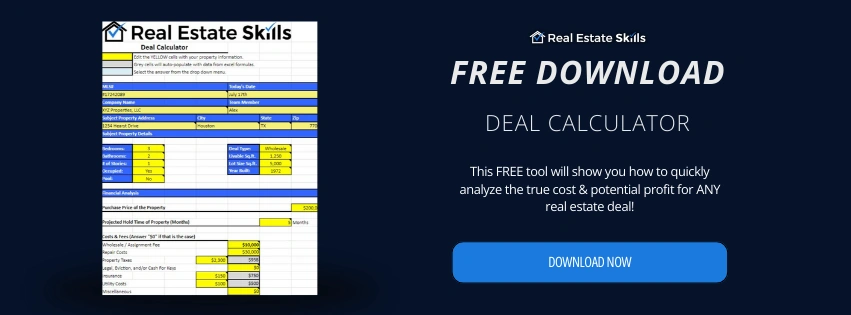
Your ARV is the number every other number depends on, and in a non-disclosure state you are working from MLS comps rather than public sold data. Get it wrong on a $280,000 San Antonio house and a 5% error costs you $14,000, which is your whole fee. Download our Deal Calculator to run your ARV, repair estimate, and maximum allowable offer at both 70% and 80% before a number ever reaches the seller.
Step 6: Submit Written Offers
An offer is not real until it is in writing. Before you send one, ask the listing agent to represent you as the buyer. They collect both commissions instead of one, which makes your offer the one they push. Then run your numbers, call back the same day, and get the contract signed and returned.
Most people fail this step while believing they are working, and they fail in two specific ways. They count a text as an offer. And they name a price on the first phone call.
Ask the agent to represent you
Do this on the first call, before anything else.
In a normal Texas transaction the listing agent earns a selling commission and a separate buyer's agent earns theirs. Say roughly $6,000 each on a $200,000 house. You do not have a buyer's agent. So when you ask the listing agent to represent you, that second commission goes to them instead. Same house, same price, roughly $12,000 to them rather than $6,000.
Now put two identical offers in front of that agent. One where they earn $12,000 and one where they earn $6,000. Alex has been asking this question for fourteen years and gets a yes about 80% of the time.
If they cannot represent you, ask for a referral to a buyer's agent at their brokerage. Referring agents typically take about 25% of that commission, so they are still better off sending your offer through than watching it go elsewhere. If neither works, any agent in your network can write it up, since they only get paid if it closes.
Jesse's Cedar Hill deal is what this looks like when it collapses into one person. His seller was a licensed broker selling a property he had inherited, so Jesse was negotiating directly with the person who both owned the house and controlled the listing.
Do not make an offer on the first call
The first call is for information. That is the whole job.
You just learned the seller's situation, the condition, what the agent thinks it is worth, how many offers are in, and what price gets it done. Naming a number thirty seconds later tells that agent you did not analyze anything, because you did not. And an offer made before analysis is an offer you have to walk back later, which is how you burn an agent for good.
What you say instead is that you are meeting with your team to analyze the property and will come back today with a number your research supports. Then you actually do it, and you actually call back.
Two questions worth real money
When the agent gives you a price, ask how flexible is that price? Alex has had agents come back $20,000 below what they had just said.
Then ask is the seller willing to review offers below that? Not the agent. The seller. Different question, different answer.
Sabbir ran this on his Dallas deal without a script. He kept following up and raising in $5,000 increments, asking each time what the seller's lowest number would be. $315,000 became $245,000.
Ask when the seller reviews offers
Get the date and time and put it in your calendar. Follow up daily until then, and call the morning of.
That last call is where you find out you need to come up $2,000, from an agent who would rather tell you than lose the deal. Alex credits this single question with dozens of closings.
What a clean Texas offer looks like
- Option period: seven days, long enough to find your buyer.
- Closing: fourteen days, or whatever the seller actually needs. Ask them.
- Option fee: $100 to $500. Sabbir and Jesse both paid $100.
- Earnest money: around 1% of purchase price, refundable inside the option period.
- Title: seller to deliver free and clear title.
- Buyer's agent: the listing agent, named.
- Proof of funds: attached, every single time.
Proof of funds is the fastest way to look like you have done this before. A bank letter works, or ask one of your cash buyers for theirs in exchange for first right of refusal on the deal. If you are offering in an LLC, attach your articles of organization too. Texas agents ask for this, and some listings say so directly in the confidential remarks.
Track written offers and nothing else
An offer is the listing agent's written contract, signed by you, back in their inbox. At that point one signature stands between you and a deal.
Roughly fifteen written offers produces one closed deal. Sabbir sent four to five a week for three months. Jesse sent four in a single night and one of them closed, which is luck stacked on top of volume rather than instead of it.
One warning on the option period. Jesse gave himself three days in Cedar Hill and heard afterward that buyers would have paid $165,000 with seven days instead of the $157,500 he took. Roughly $7,500 for four days he did not ask for.
The Call Where Most Texas Deals Are Won Or Lost
Sabbir asked the same four questions on every Dallas call: foundation or plumbing issues, when the roof was replaced, when the HVAC was replaced, and whether there is a seller's disclosure. Then he followed up until he got a counter. In a market where listing agents are fielding offers from operators who have done this for years, sounding like a beginner on the first call ends it. Download our Discovery Call Script for the full set of questions and how to handle what comes back.
Sending Offers Is The Job. Here Is How To Send Ones That Get Accepted.
Sabbir sent four to five written offers a week for three months in Dallas before one stuck. Jesse sent four in a single night and one of them closed. Volume is only half of it. The other half is knowing what a Texas listing agent needs to hear, what terms make a cash offer competitive, and how to price an offer in a state where sold data is not public. Our FREE Training walks through the full process our students use to find deals on the MLS and get paid at closing.
Watch The FREE Training →Step 7: Get It Under Contract
Signatures make the deal. Every owner on title has to sign, your option period starts the day the contract is executed, and your option fee is usually due within 72 hours. Confirm who actually owns the property before you write the offer, not after the seller accepts.
The moment the last signature lands, your clock starts. Everything from here is about the option period.
Check who owns it first. More than one name on title is common. Spouses, business partners, heirs who just inherited. Every one of them signs or you do not have a contract. Jesse's Cedar Hill deal was an inherited property, and he was talking to the seller's wife before the actual titleholder called him one morning to take over the negotiation. Call a title company and confirm before you write the offer.
Your option fee is due fast. Usually 72 hours. Sabbir and Jesse both paid $100. Jesse went out of option on his deal without the earnest money ever being paid, which meant that if he had not found a buyer he was the one closing on the house. He describes sitting at work thinking, what have I done. That is the real risk and it is worth feeling before you take it.
Get the walkthrough handled. Someone has to physically see the property. It does not have to be you. A local inspector runs $150 to $300. A contractor will often do it free if they think they might get the rehab.
Jesse got a contractor into a Cedar Hill house on July 3rd, going into the holiday weekend, from Canada. He called until somebody answered, gave them the lockbox code, and had an itemized estimate back the same day. That estimate became the thing he showed every buyer. It is what turned a maybe into a yes.
Step 8: Assign The Contract To A Cash Buyer
Send the deal to your buyer list the day the contract is executed. Lead with ARV, repair estimate, and your price in the first line. Collect a non-refundable deposit from whoever commits, and deliver your written disclosures before the assignment transfers.
Same day. Not the next week. A Texas buyer who is ready today may have spent their money by Friday.
Lead with three numbers
ARV, repairs, your asking price. First line of the email.
A buyer closing twenty to fifty deals a year scans those three numbers and decides in about two seconds. Bury them in paragraph three and you have lost them. Alex calls this the Platinum Platter email and says the format alone has generated well over seven figures in wholesaling fees, because it gives a buyer everything needed to say yes on one page.
After the numbers: the address, interior and exterior photos, comps supporting your ARV, showing instructions, your contract deadlines, and a brief non circumvention line. Condition photos help rather than hurt. They prove the deal is real and your repair number is grounded.
Send it to your top three to five buyers before it goes anywhere else. Protecting first look is how those relationships survive to deal two.
Then deliver your disclosures
Texas requires written disclosure of your equitable interest to both the seller and the end buyer before the assignment happens. What each has to say and when it is due is covered in our Texas wholesaling legal guide.
Buyers will flake, and offers will die
Nathan had two buyers commit verbally on Green Valley and disappear when earnest money came due. Three showings, three buyers, the third one closed.
Jesse had a disposition company tell him his deal was trash and send him a link on how to wholesale. He closed it and sent them back a photo of himself next to the settlement statement.
Here is the part almost nobody tells beginners. About half of Alex's deals over fourteen years came from a different buyer's offer being accepted first, then falling apart. When your offer loses, ask to be signed into first backup position. It is a real document, and if the accepted offer collapses the seller is obligated to yours.
Which reframes the whole thing. Fifteen offers does not mean fourteen rejections. It means fourteen deals still breathing, and the agent's first call when one dies goes to whoever actually submitted paperwork.
One more question before you hang up
Ask on every call: do you know of any other fixer properties I should look at, including anything not on the market yet?
Agents know about listings before they exist. Nathan's two San Antonio houses came from exactly this, a relationship maintained for a year with an agent who eventually called him first.
On price and relationships
Jesse had a buyer at $160,000 and took $157,500 because he got nervous. He calls it shooting himself in the foot.
He also took the lower number partly to protect the relationship with a broker who had two more inherited properties. That broker came back and told him to get both under contract. Sometimes the smaller check buys the next three deals. Make it a decision rather than a flinch.
How He Closed His First Virtual Wholesale Deal, From Canada To Texas
Jesse is 21, lives in Canada, and closed a Cedar Hill deal without ever seeing the property. He covers the buyer who called his deal trash, the three day option period he regrets, and the contractor he got in on July 3rd.

Step 9: Close And Collect Your Assignment Fee
Texas residential closings run through title companies, not attorneys. Your assignment fee appears as a line item on the settlement statement and gets wired or cut to you at closing. You do not attend. Find an investor friendly title company before you need one.
You do not sign anything on closing day. The buyer closes with the seller and your fee comes out at settlement.
The earnest money clock
Your earnest money is typically due within three business days of execution. The professional goal is to have the deal assigned before you ever fund it, which is exactly what happened on both the Dallas and Cedar Hill deals above. The end buyer covered the deposit when they took the assignment. That is the mechanic behind the $100 number, and it is why building your buyer list first matters more than anything else in this guide.
Finding an investor friendly Texas title company
Not every Texas title company handles assignments the same way. Ask before you commit:
- Have you closed an assignment of contract in the last 90 days?
- Do you handle same day double closings, and how much notice do you need?
- Do you have someone on staff who handles investor transactions?
- What is your typical turnaround from submission to clear to close?
- What are your fees for a standard assignment versus a double close?
Build relationships with two or three before your first deal. Your mentor, a local Texas REIA chapter, or an active investor will get you there faster than searching.
📓 From The Field: What Closing Day Can Actually Look Like
Nathan's Purple Creek buyer required their own title company, a national one on the East Coast. They used a third party vendor that quoted ten days just to return a municipal lien report. His JV partner drove to the office in downtown San Antonio and got it cleared herself.
Then the settlement statement came back showing the seller owing roughly $3,500 to close, because of an undisclosed loan modification stacked on top of solar panels being paid off. This was a family selling so they could move in with an aging parent, with a new house already lined up.
Nathan, his partner, and the broker each took less so that family could walk away at zero. The fee dropped from $11,000 to around $8,600. It closed on a Friday and did not fund until the following week because of a bank cutoff, and the sellers had to push their own purchase back a couple of days. That is a deal that worked. Individual results vary.
Timeline. Most Texas assignments run 21 to 30 days. Sabbir closed in two weeks with a buyer already lined up. Double closes add three to seven days. Probate, liens, or title problems can push you to 45 or 60.
How Sabbir Made Over $5,000 Wholesaling In Texas
Sabbir works full time in IT and closed his first deal in Dallas, negotiating a $315,000 listing down to $245,000 and collecting his fee two weeks later. He breaks down the discovery call questions, the follow up, and the $100 that was his entire out of pocket cost.

How To Find Distressed Property In Texas
The MLS is the fastest source of Texas distressed property, but it is not the only one. County appraisal district tax delinquency lists, notices of trustee sale filed before the first Tuesday auction, probate filings, and code violation records all produce motivated sellers. All four are public records in Texas and free to search.
Step 4 covered the MLS because it is where most people should start. Here is what sits underneath it.
Delinquent property tax lists. Every Texas county appraisal district publishes them. HCAD in Harris County, DCAD in Dallas, BCAD in Bexar, Travis CAD in Austin. An owner behind on taxes is facing a real deadline, and paying off that debt is a genuine solution rather than a pitch.
Pre-auction foreclosure notices. Texas is a non judicial foreclosure state, which makes it one of the fastest processes in the country. Auctions happen the first Tuesday of every month at the county courthouse, and notices of trustee sale get filed with the county clerk beforehand. That filing window is your window. After the first Tuesday, it is gone.
Probate filings. Public in Texas. Heirs who inherited a house they do not live in and do not want to maintain are among the most motivated sellers in any market. Jesse's Cedar Hill deal was exactly this, and the seller had two more he wanted moved.
Code violations. Texas cities publish these. An owner facing escalating daily fines on a property they cannot afford to fix is looking for a way out.
For sale by owner. Texas has an active FSBO market. Many are people avoiding commission on a house that needs work, which is the exact profile you want.
One warning on all of this. Pulling public records is fine. How you contact people afterward is the part with rules attached, and Texas cold calling and texting regulations have moved recently. That is covered in the Texas wholesaling legal guide.
The Texas Wholesale Contract, Line By Line
A Texas wholesale deal needs four documents: a purchase agreement, an assignment contract, a seller disclosure, and a buyer disclosure. National templates typically include the first two and skip the last two. Here is what goes in each blank.
Most contract guides tell you to download something and wish you luck. Here is what actually goes in each section.
The purchase agreement
Usually the TREC One to Four Family Residential Contract, the same form agents across Texas use every day.
- Parties. Every owner on title as seller. You or your LLC as buyer. Your mailing address, not the property address. Confirm ownership with a title company before you write anything.
- Property. Street address, city, county, zip, and the APN, which is the property's tax ID. You can find it on the county appraisal district site in about thirty seconds.
- Purchase price. Your total, marked cash. That is a selling point on a distressed property, because it means no lender, no appraisal, and no financing contingency to fall through.
- Option period. The most important number in the document. You are buying the right to walk away for a small fee. Seven days is standard. Three is too short, and Jesse can tell you what that costs.
- Option fee. $100 to $500, due within about 72 hours. This is your actual cash at risk. Sabbir and Jesse each put down $100 and both got it back at closing.
- Earnest money. Roughly 1% of purchase price, held by the title company, never by the seller. Refundable inside your option period. On both student deals here, the end buyer funded it.
- Closing date. Fourteen days if the seller wants speed. Ask them what they need. Accommodating their timeline is often worth more to them than money.
- Assignment language. The TREC contract is assignable by default. If a seller's agent hands you a modified form that prohibits assignment, negotiate that out before signing.
- Signatures. Every seller, plus initials on every page. One missing signature and you do not have a contract.
The assignment contract
One page, usually. It swaps you out as buyer and your cash buyer in.
- Assignor and assignee. You, then your buyer.
- Reference the original agreement. Date, seller names, property address. All of it has to match your purchase agreement exactly.
- Your fee. Written out in words and then in numbers. Five Thousand Dollars ($5,000).
- Non-refundable deposit. Optional, recommended. Money your buyer puts down at signing, credited toward your fee rather than added to it. Size it above whatever you have in the deal. If your buyer disappears, you keep it.
- Closing date. Same as the purchase agreement.
The two disclosures nobody's template includes
Texas requires written disclosure of your equitable interest to both the seller and the end buyer. Two separate documents, one for each party.
This is the piece missing from generic wholesale contract packs, and it is the reason Ryan paid a Texas attorney over $1,700 rather than adapting a national form. What each disclosure has to say, when it is due, and whether anyone signs it is covered in full in our Texas wholesaling legal guide.
This is a plain English walkthrough, not legal advice. Contract requirements change and vary by situation. Have a licensed Texas real estate attorney review your documents before you use them.
Read Also: The National Wholesale Contract Guide
The Four Documents A Texas Deal Actually Needs
Most wholesale contract packs give you a purchase agreement and an assignment contract. A Texas deal needs those plus two written disclosures, one for the seller and one for your end buyer. Ryan paid a Texas real estate attorney over $1,700 to draft all four. Download them free and use them alongside the walkthrough above.

How Much Do Wholesalers Make In Texas?
A typical Texas assignment fee runs $5,000 to $30,000 depending on the metro. First deals usually land between $2,500 and $8,000. Experienced wholesalers with a buyer network in Houston or Dallas regularly clear $15,000 to $40,000. Volume is what turns a fee into an income.
Here are three first deals from three of our students in Texas. None of them made $30,000.
| Student | Market | The Deal | Fee |
|---|---|---|---|
| Sabbir | Dallas | $315,000 list, contracted at $245,000, ARV around $385,000. Two weeks. Cost him $100. | $5,000 |
| Jesse | Cedar Hill | $190,000 list, contracted at $155,000, assigned at $157,500. Done from Canada. Cost him $100. | $2,500 |
| Nathan | San Antonio | Two houses in one month. Green Valley at $105,000 assigned at $112,000, Purple Creek marketed at $179,000 and assigned at $176,000. Split with a JV partner. | ~$8,000 total |
That is the honest range for a first deal. The version where somebody makes $30,000 out of the gate is real and it is not the median. Sabbir's $5,000 is closer to normal, and he is clear about why it was not bigger. He pushed his offer higher to win the contract, which won him the deal and cost him spread.
Where the income actually comes from is repetition. Two deals a month at a $10,000 average is $240,000 a year in gross fees. Getting to two a month is the hard part and it takes a system, not luck. Sabbir sent four to five written offers a week for three months before one closed. Nathan had two contracts die before these two landed.
These are individual results from students who completed our training. They are not typical, not guaranteed, and not a projection of what you will earn. Wholesaling involves work and real financial risk.
Average Assignment Fee By Texas City
Assignment fees track the price point of the market. Texas cities under $200,000 typically produce $4,000 to $12,000. Mid-market cities like San Antonio and Fort Worth run $7,000 to $22,000. Dallas, Houston, and Austin reach $10,000 to $40,000 on a good deal with a buyer network in place.
Your fee is the spread between your contract price and your buyer's price. Higher priced markets support bigger spreads because the underlying numbers are bigger. A $40,000 rehab on a $500,000 Austin house leaves more room than the same rehab on a $137,000 house in the Valley.
| Texas City | Median Price | Typical Assignment Fee | Competition |
|---|---|---|---|
| Austin | ~$562,000 | $15,000 to $40,000 | 🔴 Very High |
| Dallas | ~$375,000 | $10,000 to $30,000 | 🔴 Very High |
| Houston | ~$360,000 | $8,000 to $25,000 | 🔴 Very High |
| Fort Worth | ~$335,000 | $8,000 to $22,000 | 🟡 Moderate |
| San Antonio | ~$270,000 | $7,000 to $20,000 | 🟡 Moderate |
| El Paso | ~$231,000 | $5,000 to $15,000 | 🟢 Lower |
| Lubbock | ~$207,000 | $4,000 to $12,000 | 🟢 Lower |
| Rio Grande Valley | ~$137,000 | $4,000 to $10,000 | 🟢 Lower |
Fee ranges are estimates based on a 5 to 10% spread on a discounted contract. They are not guarantees and individual deals vary widely. Verify current median prices before pricing any offer.
Reading the table. Bigger fees are not better deals. Austin's $15,000 to $40,000 range comes with the highest competition in the state, so the question is not what you could make but whether you can win the contract. Lubbock at $4,000 to $12,000 has almost nobody competing for it. Two deals in Lubbock beats zero in Austin.
Smaller Texas markets like Conroe, Waco, College Station, Galveston, and Corpus Christi run the same math at lower price points, generally landing in the $5,000 to $15,000 range. Pull current comps before you price anything in a market that size, because a single sale moves the median.
What It Costs To Start Wholesaling In Texas
You can start wholesaling in Texas for $500 to $1,500. Your real cash at risk on a single deal can be as low as a $100 option fee. Earnest money is typically 1% of the purchase price and refundable inside your option period, and on many deals the end buyer funds it rather than you.
The number that surprises people is $100.
That is what Sabbir put down on a $245,000 Dallas house. It is what Jesse put down in Cedar Hill. Both got it back at closing, credited alongside the assignment fee.
Here is how that works. Your option fee buys you the right to walk away during the option period. It is small and it is non-refundable, which makes it your actual downside. Your earnest money is separate, usually 1% of purchase price, held by the title company, and refundable while your option period is active. On both of those deals the end buyer funded the earnest money when they took the assignment, so the wholesaler never wrote that check.
As Sabbir put it, the worst thing that happens to you is you lose $100. That is the honest downside on a clean assignment. Not zero, but close.
| Cost | Typical Texas Range | Notes |
|---|---|---|
| Option fee | $100 to $500 | Your real cash at risk. Non-refundable, usually credited back at closing. |
| Earnest money | ~1% of purchase price | Refundable inside your option period. Often funded by your end buyer. |
| Attorney contract review | $300 to $800, one time | Reviews the documents you will use on every deal after. |
| Data platform | $99 to $149 per month | Only if you lack MLS access through an agent. |
| MLS assistant access | ~$24 per quarter | Varies by board. Does not require a license. |
| Property walkthrough | $150 to $300 | Local inspector. A contractor will often do it free. |
| Title search | $150 to $400 | Usually paid by the buyer on an assignment. |
| LLC formation | ~$300 filing fee | Optional at the start. Many wholesalers form one after their first check. |
| Lean start | $500 to $1,500 | Option fee plus one attorney review, with MLS access through an agent. |
| First 90 days | $1,500 to $4,000 | Adds three months of a data platform and minimal marketing. |
The MLS approach keeps marketing near zero. Nathan's two San Antonio deals cost him nothing in marketing. Jesse's cost him a phone line and $100.
Can You Wholesale Texas Real Estate Virtually?
Yes. The TREC contract is standard statewide, Texas title companies handle investor assignments routinely, and e-signature is normal. The only thing that cannot be done remotely is the walkthrough, and your buyer or a local contractor can handle that. Your real obstacle is comps, not distance.
Jesse is 21, lives in Canada, and closed a deal in Cedar Hill, a Dallas suburb, without ever seeing the house.
Here is what he actually set up.
- A US phone line. He was not going to call Dallas agents from a Canadian number, so he got a dialer.
- A US bank account. For the wire at closing. Set that up before you need it, not the week your deal funds.
- A contractor he found by calling until someone picked up. July 3rd, going into the holiday weekend. He gave them the lockbox code and had an itemized estimate the same day. That estimate is what he showed buyers.
- Buyer verification through Privy. Before working with anyone he checked whether they actually transact in Cedar Hill. Pull recent purchases in the zip code and see whose name keeps appearing.
- A buyer who could attend closing. The seller was a broker who refused digital notarization and wanted everyone in his office signing paper. Jesse solved it by making sure his buyer was local.
That last one is the answer to the question everyone asks. You are not working around the in person requirement. Your buyer satisfies it.
The genuine obstacle is not distance. It is comps. Without local relationships you are dependent on a data platform or an agent for your ARV, and getting that wrong on a $280,000 San Antonio house is a $14,000 to $28,000 error that eats your fee and your deposit at the same time. Solve it before you offer.
Is Wholesaling In Texas Easy?
No. Houston, Dallas, and Austin are among the most competitive wholesale markets in the country. San Antonio, El Paso, Lubbock, and the Rio Grande Valley are more accessible. Every student deal on this page took months of consistent offers and at least one cancelled contract before it worked.
Nobody's first deal was clean.
Nathan had two contracts die before the San Antonio deals. One was a 1960s house with knob and tube wiring and foundation cracks he had not accounted for. The second was a six figure rehab he had priced far too high. He cancelled both.
Sabbir had two contracts fall through in his first two months, one of them about $1,000 apart from working. Then four to five written offers a week for three straight months before one closed.
Jesse got told his deal was trash by a disposition company who then sent him a link explaining how to wholesale.
All three closed. That is what the process looks like from inside it.
Where it is genuinely hard. Houston and Dallas have institutional buyers and operators who have worked the same zip codes for years. A distressed listing gets multiple cash offers in days. You are not going to out-market them in month one.
Where it is more reasonable. San Antonio has moderate competition and a $270,000 median that leaves room. El Paso and Lubbock have the lowest investor density of any significant Texas markets. The tradeoff is thinner buyer pools, so you need to know your three to five local buyers before you go under contract rather than after.
What is hard everywhere in Texas. Comps. Solve that once and it stops being a barrier. Skip it and every offer you make is a guess.
Texas Wholesaling FAQs
Final Thoughts On Wholesaling Real Estate In Texas
Three students, three completely different routes.
Nathan kept in touch with one San Antonio agent for a year with no agenda, then closed two houses in a month when she finally called. Sabbir sent offers four days a week for three months in the most competitive metro in the state until one stuck. Jesse did a deal in a Dallas suburb from another country with a $100 option fee and a contractor he found by calling until somebody answered.
Same nine steps. Nothing else in common.
What all three had to do first was solve the comps problem. Texas does not publish sale prices, and that single fact sits underneath every offer you will ever make here. Get MLS access through an agent, subscribe to a data platform, or build buyer relationships deep enough that people share their numbers. Once it is solved it stops being an obstacle and starts being an advantage, because most people trying to work Texas remotely never bother.
Then build your buyer list before you need it. Every one of these deals turned on knowing who was buying and what they wanted before there was a property to sell.
And pick your market on purpose. Houston and Dallas have the deals and they also have everyone else. San Antonio, El Paso, and Lubbock are where a first deal is realistic. There is no prize for starting in the hardest place.
None of them closed on the first try. Nathan cancelled two contracts. Sabbir lost two. Jesse got told his deal was worthless by someone who then sent him a tutorial. Roughly fifteen written offers produces one closed deal, and the fourteen that did not close are still live, because about half of all deals come back when the accepted offer falls apart.
Download the Texas contract bundle, pick your market, and send an offer this week.
Three Texas Deals. Three Different Routes. One System.
Nathan closed two San Antonio houses off a single agent relationship. Sabbir talked a Dallas listing down $70,000 and closed in two weeks. Jesse did a Cedar Hill deal from Canada with $100 at risk. None of them spent a dollar on marketing, and all three ran the same nine steps you just read. Our FREE Training shows you how the system works end to end: finding distressed listings on the MLS, what to say to the listing agent, and how the assignment fee reaches your account. Watch it, then go send an offer this week.
Watch The FREE Training →
About The Author
Founder & CEO, Real Estate Skills
Founder & CEO, Real Estate Skills. Has wholesaled and flipped houses for over 14 years, been part of 1,000+ real estate transactions, and personally acquired 33+ residential investment properties. Has trained 6,000+ investors nationwide.
Over his career he has generated more than $12 million in revenue and co-led firms responsible for over $15 million in total real estate sales. Since 2020 he has built Real Estate Skills into one of the leading educational platforms for new and experienced investors. He also serves as a mentor at the Lavin Entrepreneurship Center at San Diego State University.
Real Estate Skills is not a law firm, and the information in this article is provided for educational purposes only. It does not constitute legal, tax, or financial advice. Texas wholesaling laws, contract requirements, and market conditions vary and change over time. Student results shown here are individual outcomes and are not typical, guaranteed, or a projection of what you will earn. Real estate investing carries risk, and past results do not guarantee future outcomes. Always consult a licensed Texas real estate attorney and your own tax and financial advisors before entering into any contract or transaction.

👉FREE Training
How To Consistently Wholesale, Flip Houses, & Invest In Rental Properties From The MLS
(Without Spending $1 On Marketing)

Alex Martinez, the founder of Real Estate Skills, is known for his strong, practical expertise in real estate, starting from a beginner with no family connections in the industry to acquiring over 55 real estate deals, including wholesale and flips, within his first year.
He has dedicated his career to providing cutting-edge education and resources for real estate professionals. He emphasizes the importance of self-taught knowledge through mentors, books, and hands-on experience.
His journey from earning a modest income to becoming a successful real estate entrepreneur and educator showcases his expertise and dedication to the field.

Ryan Zomorodi, co-founder and COO of Real Estate Skills, leverages his experience from a diverse background in real estate investment, construction management, and entrepreneurship to provide comprehensive education in the real estate sector.
His expertise is rooted in hands-on experience, extensive industry knowledge, and a commitment to empowering others through education.
Ryan's journey reflects a blend of practical experience and entrepreneurial success, contributing to his role in developing a platform that educates and supports aspiring real estate professionals.
Read Ryan's Full Bio >>
