
Wholesale Real Estate Salary: How Much Do Wholesalers Really Make?
Jul 16, 2026

Written by
Alex Martinez — Founder & CEO, Real Estate Skills. Closed 50+ wholesale and flip deals in his first year and has acquired 33+ residential investment properties.
Reviewed by
Ryan Zomorodi — Co-Founder & COO, Real Estate Skills. Reviewed and verified the income figures, per-deal data, and student results in this guide before publication.
Publication history: Originally published January 18, 2022. Updated July 16, 2026 with current per-deal fee data from the 2026 Real Estate Bees survey, a deals-per-year income framework, verified student case studies and video interviews, updated agent-comparison figures, and a full operating-cost breakdown. Reviewed and verified by Ryan Zomorodi, Co-Founder & COO of Real Estate Skills.
There's no fixed wholesale real estate salary — wholesalers get paid per deal, not by paycheck. A typical assignment fee runs $5,000 to $20,000, with the most-cited industry survey putting the national average around $13,000. Your yearly income is simple math: how many deals you close, times your average fee.
You're good at your job. You just don't want it anymore. And if you've typed "wholesale real estate salary" into a search bar late at night, the real question underneath it isn't what's the average — it's can this actually replace my income. The honest answer is yes, it can. But only if you understand how the money actually works, because it works nothing like a salary.
Here's the whole thing in one line: your income is the number of deals you close in a year, multiplied by your average fee per deal. That's it. A fee typically lands somewhere between $5,000 and $20,000 — the largest survey of professional wholesalers, run by Real Estate Bees across more than 1,000 operators, puts the national average right around $13,000, ranging from about $5,000 in a cheaper market to $22,000 in states like North Carolina and Georgia. Results vary, and a single deal can come in well under $5,000 or well over $20,000. But once you know your rough fee, the only other variable is volume. One deal every other month at $10,000 is $60,000 a year. Two deals a month at the same fee is $240,000. Same fee — different number of deals. That gap is the whole game.
You'll see a figure thrown around a lot: $55,699, the "average wholesale real estate salary" from ZipRecruiter. It's a real number, but it answers a different question than the one you're asking. That figure reflects people employed as wholesalers or acquisition staff at investment firms — W-2 workers drawing a paycheck. It has almost nothing to do with what an independent wholesaler can earn, because an independent wholesaler isn't on a salary at all. They're on deals. And deals scale in a way a salary never will. The rest of this guide breaks down exactly what that looks like at every stage — with real numbers from real people who've done it, what actually drives your income up, and what it honestly costs to run this as a business. You can even grab the free deal calculator we use to size a fee on any deal and follow along with your own numbers.
How Much Do Real Estate Wholesalers Make?
Wholesalers get paid per deal, not by salary. A typical assignment fee runs $5,000 to $20,000, with the national average around $13,000 per the largest industry survey. Annual income is that fee times how many deals you close — one a month at $10,000 is $120,000 gross; two to four a month reaches $200,000 to $600,000.
Ask "how much do wholesalers make" and you'll get a salary figure back. But wholesalers don't earn a salary — they earn a fee on each deal they close. So the real answer is a range that depends entirely on two numbers: your fee, and how many deals you do. Get those two numbers and you can calculate almost any income scenario yourself.
The fee comes first. Across the industry, a wholesale assignment fee typically runs $5,000 to $20,000. The most-cited figure comes from Real Estate Bees, which surveyed more than 1,000 professional wholesalers and landed on a national average right around $13,000 — a number corroborated by other 2026 industry reporting. It ranges by market, from roughly $5,000 in lower-priced areas to about $22,000 in states like North Carolina and Georgia. Results vary, and plenty of deals land above or below that range.
Now multiply. A wholesaler closing one deal a month at a $10,000 fee is on pace for $120,000 gross a year. Bump that to two or three deals a month — which consistent, systematized operators do — and you're looking at $200,000 to $600,000. The math isn't complicated; the discipline to hit the deal count is the hard part. And that's the whole point: your "salary" isn't a number someone else sets. It's an output of your fee and your volume. Want to run it on a real deal? The free deal calculator sizes your fee and offer price in a couple of minutes.
Income figures throughout this guide are examples, not promises. What you earn depends on your market, your effort, and your consistency — results vary, and income is never guaranteed. This is educational, not financial advice.
Wholesale Real Estate Income By Experience Level
Income climbs in three stages: beginners close about one deal every month or two at $5,000–$10,000 (roughly $30,000–$60,000 a year), intermediate wholesalers close two to four monthly at higher fees ($120,000–$300,000), and advanced operators with a team close five-plus ($300,000 to seven figures). The jump between stages is systems, not hours.
Remember the math: deals per year times your average fee. Every stage below is just a different combination of those two numbers. What moves you from one stage to the next is almost never working more hours — it's building systems so deals come to you instead of you chasing each one by hand.
| Experience Level | Deals/Month | Avg. Assignment Fee | Est. Annual Income |
|---|---|---|---|
| Beginner (0–12 months) | 0.5 – 1 | $5,000 – $10,000 | $30,000 – $60,000 |
| Intermediate (1–3 years) | 2 – 4 | $10,000 – $20,000 | $120,000 – $300,000 |
| Advanced (3+ years, with team) | 5 – 10+ | $15,000 – $30,000+ | $300,000 – $1,000,000+ |
Two honest cautions before you read those numbers as a promise. First, they're independent-operator numbers, not the employed-wholesaler salary data most sites quote — this is what people running their own deals actually earn, and it varies enormously. Second, almost nobody lands their first deal in week one. Plan for 30 to 90 days before your first check. Here's what each stage really looks like.
Beginner (0–12 months)
This is the hardest stage, and it has nothing to do with the mechanics being complicated. It's that you haven't built the muscle memory yet — pricing, negotiation, and buyer relationships all at once. Most beginners who stall do it by underpricing a deal or taking one with margins too thin to survive a single hiccup at the closing table.
But it's absolutely doable, and the first deal is often bigger than people expect.
📓 From The Field
Real Estate Skills founder Alex Martinez closed his very first wholesale deal in 2012 for a $22,000 fee — a distressed five-bedroom in El Cajon, California, that he got under contract at $328,000, about $57,000 under list. He was 20 years old and had been making minimum wage. Two things about that deal are the real lesson for beginners. It was a short sale, so it didn't close overnight — it took roughly six weeks from listing to check, waiting on bank approval. And his numbers weren't perfect: he estimated the after-repair value $50,000 too high, and the deal still worked, because the fee flexed down from the $50,000 he'd hoped for to a real $22,000. His takeaway: you don't have to be perfect, you just have to be close. (Outcomes vary — this is one deal, not a typical result.)
First deals come in all sizes. Mustafa, a Real Estate Skills student and former retail-business owner who'd recently moved to Miami, closed his first deal about a month after finishing the training — a roughly $20,000 spread, locked at $380,000 and sold to his cash buyer at $400,000. It took him eight to ten written offers to get there. And here's the honest part he was blunt about: for a beginner, this is not a casual side hustle. He was putting in real hours — closer to full-time than part-time — while he learned. Which answers the hours question directly: can you do this part-time? Yes, once you have systems and a rhythm, some people run lean on a handful of focused hours a week. But most beginners who get moving fast are grinding real hours up front to build the pipeline. Both things are true. Anyone selling you pure passive money on day one is selling you something. (Results vary; income is never guaranteed.)
Intermediate (1–3 years)
This is where the model starts to look like a real income, and it's the stage most people are actually picturing when they ask about a wholesale salary. The leap here is lead generation — systematizing it so you're working two to four deals a month instead of scrambling for one.
The clearest picture of what this stage looks like for normal people comes from two Real Estate Skills students, Chase and Diana — a married couple in Southern California, both working full-time in documentary television, raising two young kids. They came in with no investor experience and closed two wholesale deals within a few months, netting about $40,000 between them. What makes their story genuinely useful, though, is the honest part most case studies skip: their gross fees were larger — one deal grossed $60,000 and another around $20,000 — but they netted roughly $40,000 after splitting with joint-venture partners who helped them find buyers. That gap between gross and net is real, and we'll get into it in the cost section below. They also landed those two deals from only about eight written offers, which they'd be the first to tell you is a little lucky against the usual benchmark. (Outcomes vary; not a typical or guaranteed result.)
How Chase & Diana Made $40,000 Wholesaling In California
Two full-time working parents with no investor experience walk through both of their first wholesale deals, start to finish, with Ryan Zomorodi.

Advanced (3+ years, with a team)
Advanced wholesalers aren't personally doing more deals — they're building infrastructure. An acquisitions manager, a disposition manager, a VA handling the grunt work: that's what triples volume without the owner working triple the hours. That's the real lever behind the $300,000-plus range, and it's why systemization and mentorship are investments, not costs.
Michael's arc shows the whole progression in one person. A former community-corrections director in Denver with two young kids, he started wholesaling on the side while keeping his job, made about $80,000 part-time in six months, decided he had proof of concept, and quit — then earned roughly another $55,000 in the two to three months after going full-time, for about $135,000 across his first eight months and seven deals, averaging a little over $19,000 each. Because he also got his real estate license along the way, he stacked income streams most wholesalers never see: a $10,000 finder's fee per deal from his main cash buyer, listing commissions when that buyer resold the flips, and a part-time management retainer to learn the buyer's operation from the inside. His stated goal for the following year was around $300,000 to $340,000. That's his goal, not a guarantee — and he was refreshingly honest that the road there included months with no deals at all, where he wondered if quitting his job was the dumbest thing he'd ever done. (Individual results; income varies and is never guaranteed.)
How Michael Made $135k Wholesaling In 8 Months
A former community-corrections director walks through going from a full-time W-2 to full-time wholesaling — and the multiple income streams he built — with Ryan Zomorodi.

The thread through all three stages is the same math. Alex, Chase and Diana, Michael — different fees, different volumes, different lives. What changed as they moved up wasn't the fee so much as the number of deals they could reliably produce. Which is the one variable worth obsessing over, and it's next.
How Many Deals Can You Actually Do In A Year?
Most consistent wholesalers close one to four deals a month, and volume — not fee size — is what separates a $60,000 year from a $300,000 one. Deal count comes down to one thing: how many written offers you make. The rough benchmark is 10 to 15 written offers to land a single deal.
If income is deals times fee, and your fee is mostly set by your market, then the number you actually control is deal volume. And deal volume traces back to one input almost nobody wants to hear: written offers. The benchmark practitioners use is roughly 10 to 15 written offers to close one deal. That's the ratio. If you want two deals a month, you're sending somewhere around 20 to 30 written offers a month. Want to double your income? Double your offers, not your working hours.
That ratio also reframes what a "failed" offer is. Fourteen of those fifteen offers don't close — but they're not wasted. They put you in front of agents, they build relationships, and they come back around.
📓 From The Field
One Real Estate Skills student, Peter, made a $5,000 fee for about two hours of actual work on a deal that traced directly back to an offer he'd made eighteen months earlier on a completely different property. That first offer didn't win — but it put him on the agent's radar, and when a fixer came across her desk a year and a half later, she called him. Two higher offers went under contract and fell out; each time, Peter stayed consistent and professional, and the agent eventually came back to him. A small fee, sure — but it shows how the offers you send today become the deals you close next year. (Individual result; outcomes vary.)
Now, the honest answer on hours, because this is where a lot of guides lie to you. How many deals you can run depends heavily on how much time you put in, and that changes with experience.
At the start, expect to work. Mustafa, closing his first deal about a month in, was putting in what he described as roughly full-time hours — checking the market morning, noon, and night, calling agents, running comps — while he learned the business. His flat take: for a beginner, this is not a few-hours-a-week hobby. That's the honest version of the early stage.
But the ceiling on hours drops as your systems mature. The reason a seasoned wholesaler can run this on a lean schedule is that the work gets systematized — the same daily routine of pulling new distressed listings, making a handful of calls, and sending offers can be compressed into a focused block once you know exactly what you're doing and have relationships already built. Some experienced operators genuinely run this alongside a full-time job on a limited number of hours a week. The difference between them and the beginner isn't talent or a secret — it's reps and systems. So both of these are true at once: this can eventually be run lean, and most people grinding out their first few deals are putting in serious hours to get there. Anyone who tells you it's passive from day one is selling you the dream, not the business.
The lever that lets you scale volume without scaling your own hours is a team. This is the same shift that moves you from the intermediate to the advanced stage: an acquisitions person to make calls, a disposition person to work the buyer side, a virtual assistant to pull lists and skip-trace. That's how the wholesalers earning $300,000-plus close five to ten deals a month without personally living on the phone — they've stopped being the only person sending offers.
So if you want a realistic target: a committed beginner sending 15 or so written offers a month is aiming for roughly one deal a month once they find their rhythm. Build systems and referral relationships, and two to four becomes realistic. Add a team, and the number stops being capped by your own hours at all. That progression — not your fee — is what actually determines your annual income.
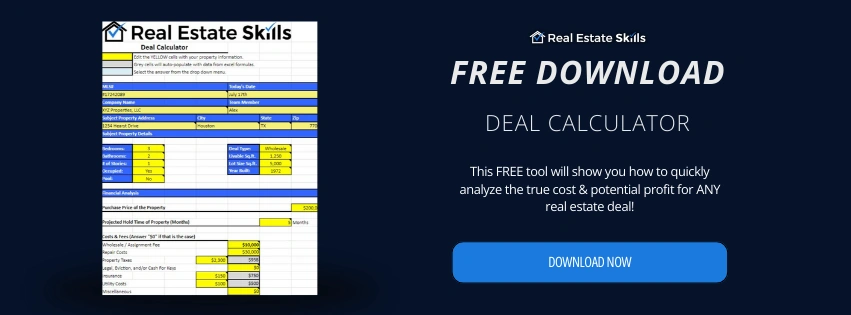
Know Your Assignment Fee Before You Make The Offer
Your income comes down to one number per deal — your fee. This is the same calculator we use on every wholesale and flip to size the assignment fee, reverse-engineer the right offer price, and confirm the deal actually pays before you call the agent. Plug in the ARV, repairs, and your target fee, and it shows you exactly where to offer. Free to download and use on your next deal.
The Income Is Real. The Question Is How To Reach It.
Every number in this guide comes from a real process — finding the deal, locking it up, and collecting the fee. Our FREE Training shows you that exact process step by step, the same system behind the student results above. Watch it, then go put it to work.
Watch The FREE Training →Can Wholesaling Replace Your Income?
Yes — wholesaling can replace a full-time income, and thousands of people have made that transition. But it's a business, not a paycheck, so the switch works when you treat it like one: build lead systems, keep a cash cushion for the ramp-up, and don't quit until you have proof of concept. Most who fail ran out of runway before their pipeline was built.
This is the question underneath the search: not what's the average salary, but can I actually do this instead of my job. The answer is yes — but how you make the switch matters more than whether it's possible.
The cleanest example is Michael's, because he did it the smart way. Before real estate he spent 13 years in community corrections, most recently directing a cognitive-therapy program, with two young kids and a growing itch to get off someone else's schedule. He didn't quit and hope. He ran wholesaling alongside his W-2 for about six months first, made roughly $80,000 in that time, and only then — with real proof the model worked in his market — did he leave his job. In the two to three months after, he made about another $55,000. That's the template: prove it on the side, then transition. Not a leap of faith — a calculated step onto ground you've already tested. (Individual result; income varies and is never guaranteed.)
Notice what made it work, because it's the opposite of how most people fail. Michael was honest that even after going full-time, there were stretches — a month at a time — with no deals closing, where he questioned whether quitting was the dumbest decision of his life. He had the runway and the systems to push through those dry spells. The people who don't make it usually aren't beaten by the model — they're beaten by timing. They quit too early, underestimated how long it takes to build a pipeline from scratch, and ran out of cash before the first real check landed. Wholesaling income is lumpy, especially at the start. You can go weeks with nothing and then close two deals in a month. If your budget assumes a steady paycheck, that lumpiness will break you before the business ever gets a chance to work.
So the honest guidance is this. Wholesaling is genuinely one of the lowest-barrier ways into real estate — no degree, no license required in most states, little capital, and you're never carrying a mortgage or a renovation. It works in hot markets and slow ones, because motivated sellers exist in every economy; what shifts is where you find them. And it scales in a way almost no job does, because you can eventually hire the work out. All of that is real. But "low barrier" is not "easy money," and anyone framing it as passive from day one is describing a fantasy. Treat it like the business it is — systems, a buyer's list you actually maintain, and a financial cushion to survive the ramp — and it can absolutely become your income. Treat it like a lottery ticket and it won't.
This is educational, not financial advice — your results depend on your market, your effort, and your circumstances, and income is never guaranteed.
Wholesale Real Estate Fees By Market
Wholesale assignment fees vary sharply by market. The national average is about $13,000 per deal, but it runs from roughly $5,000 in lower-priced markets like Arizona to around $22,000 in North Carolina and Georgia. Higher-priced markets produce bigger fees but stiffer competition — so your market, not just your effort, shapes your income.
Your fee isn't a fixed number you choose — it's largely a function of where you work, because the assignment fee is a slice of the deal's spread, and spreads are bigger in absolute dollars where property values are higher. The most-cited data here comes from Real Estate Bees, which surveyed more than 1,000 professional wholesalers and landed on a national average of about $13,000 per deal. The spread around that average is wide and worth understanding.
| Market | Average Assignment Fee |
|---|---|
| National Average | ~$13,000 |
| North Carolina & Georgia (highest) | ~$22,000 |
| St. Louis (highest city) | ~$25,000 |
| Arizona (lowest) | ~$5,000 |
Fee figures from the Real Estate Bees 2026 survey of 1,000+ professional wholesalers. Averages by market; individual deals vary widely.
A few things that data doesn't tell you on its face. First, the biggest fee isn't the same as the most money. A $400,000 distressed property in a high-cost metro can produce a $20,000-plus fee — but those markets also come with more competition, more sophisticated sellers, and cash buyers who know to the dollar what a deal is worth. Secondary markets like Memphis, Indianapolis, or Kansas City carry lower property values and smaller headline fees, but also less competition, faster seller responses, and cleaner deal flow. It's common for a wholesaler in a cheaper market to out-earn a peer working harder in an expensive one, purely because their deals close faster and their cost per lead is a fraction of the cost.
Second, don't pick your market off a fee table. Pick it on distressed-property density, cash-buyer activity, and how quickly you can build relationships there. Some of the most profitable wholesaling markets in the country won't look impressive on a fee chart but consistently produce clean deals with solid spreads for people who know them well.
If you want the full mechanics of how the assignment fee is set, structured, and collected — how to size it, protect it, and get paid — that's its own topic, and we cover it in depth in our guide to the wholesale assignment fee.
Real Costs: Your Net vs. Gross Income
Your real wholesale income is net, not gross. A solo wholesaler running two to four deals a month typically spends $1,500 to $5,000-plus monthly on marketing, software, earnest money, and transaction costs — enough to quietly eat 20% to 35% of gross income if you're not tracking it. Two $10,000 deals grossing $20,000 might net closer to $17,000 before taxes.
Here's the part that gets left out of every "here's what wholesalers make" article: the fee is the gross, and the gross is not what you keep. Your actual salary — the number that pays your bills — is what's left after the cost of running the business. And those costs surprise almost every beginner, because most people budget for the obvious ones and get blindsided by the rest.
The most common way this shows up isn't a lead-generation problem — it's a cost-per-deal problem. Earnest money tied up in deals that fall through, transactional funding fees on double closes, and marketing spend with no tracking system quietly carve 20% to 35% off gross income. The fix is boring and non-negotiable: track every dollar in and every dollar out from day one. Cheap accounting software costs about $15 a month. Not using it costs far more.
Here's where the money actually goes for a solo operator.
Marketing is usually the largest line item. Direct mail runs roughly $0.50 to $1.00 per piece all-in; a serious campaign of a couple thousand pieces a month is $1,000 to $2,000 before a single phone rings. Cold calling and texting are cheaper per contact but need a dialer subscription and skip-tracing data. Worth noting: some of the highest-earning wholesalers cut this line item dramatically by working on-market MLS deals instead of paying for off-market leads — Alex's own deals, and most of the student deals in this guide, came without spending on marketing at all. Lead cost is a choice, not a fixed tax.
Software and tools — property data, a CRM built for investors, a phone system with call tracking — typically run $200 to $500 a month at the solo level. Not optional; this is the infrastructure that separates a repeatable business from a random one.
Transaction costs — earnest money deposits ($500 to $2,000 per contract) tie up capital while a deal is live, and you can lose that deposit if a deal collapses outside your contingencies. Title fees run a couple hundred per transaction. And if you double close instead of assigning, transactional funding typically costs 1% to 2% of the purchase price for a 24-hour loan — on a $150,000 deal, that's $1,500 to $3,000 off your gross before you see a dollar.
| Expense Category | Typical Monthly Cost (Solo Operator) |
|---|---|
| Direct Mail / Marketing | $500 – $2,000 |
| CRM + Dialer + Skip Tracing | $200 – $500 |
| Property Data Software | $90 – $120 |
| Earnest Money (in reserve) | $500 – $2,000 |
| Title Search (per transaction) | $75 – $200/deal |
| Transactional Funding (if double closing) | 1–2% of purchase price |
| Legal / Attorney Review | $150 – $400/contract |
| Estimated Monthly Total | $1,500 – $5,000+ |
This is exactly why the gross-versus-net gap is real, and you already met the clearest proof of it. Chase and Diana, the Southern California couple, grossed around $80,000 across their first two deals — but netted roughly $40,000, because they split the fees with joint-venture partners who helped them find buyers. That's not a cost line on a spreadsheet, but it's the same principle: the number you announce at the closing table is not the number that lands in your account. Partner splits, marketing, tools, taxes — they all sit between your fee and your take-home. (Their result; outcomes vary.)
So run the real math. Two deals a month at $10,000 gross, against $3,000 a month in operating costs, is a real net closer to $17,000 — a roughly 15% haircut, and that's before self-employment tax, which you'll owe because a wholesale fee is taxed as ordinary income. None of this makes wholesaling a bad business; the margins are still strong. It just means the honest version of your "salary" is the net number. Know it before your accountant surprises you with it in April.
Cost figures are typical ranges, not fixed amounts, and will vary by market and operator. This is educational, not tax or financial advice — consult a licensed professional about your specific situation.
Wholesaling Salary vs. Real Estate Agent Salary
Wholesaling and getting a license are different paths to real estate income. Wholesaling needs no license, has a near-zero startup cost, and pays per deal — often within weeks. Agents earn commission and need licensing first. The median REALTOR® earns about $58,100 gross, but newer agents earn far less while they ramp; wholesaling's ceiling isn't capped by personal hours.
Most people weighing "should I wholesale or get my license" are standing at a career crossroads where the wrong call costs a year and real money in licensing and training. The two paths differ in three structural ways: barrier to entry, time to your first dollar, and how high the ceiling goes.
| Factor | Wholesale Real Estate | Real Estate Agent |
|---|---|---|
| License Required | No | Yes (state-specific, 60–180 hrs) |
| Typical Income | $30,000–$60,000 first year (independent) | ~$58,100 median gross; most newer agents earn under $10,000 while ramping |
| How You Get Paid | Assignment fee per deal | Commission on sale (~2.5–3%) |
| Speed To First Dollar | 30–90 days (no license wait) | 3–6 months (licensing + ramp) |
| Income Ceiling | Unlimited (team-scalable) | High, but tied to personal deal volume |
| Startup Cost | $0–$2,000 (lean start) | $1,500–$5,000+ (licensing, MLS, brokerage) |
| Scalability | High — build a team, not a job | Moderate — mostly personal production |
Agent income figures from the National Association of REALTORS® 2025 Member Profile (median gross income $58,100). Newer-agent figures reflect NAR data showing most members with two years' experience or less earn under $10,000.
The honest comparison cuts both ways, and pretending otherwise would be dishonest. A top-producing agent in a strong market absolutely out-earns most wholesalers per transaction — a $500,000 listing at 2.5% pays the agent $12,500 for a sale they may have waited 45 days to close. A strong wholesale deal on the same property might net $15,000 to $20,000, and the wholesaler never carried the listing, staged the home, or waited on a traditional close. But per-deal isn't the real difference.
The real difference is time and scalability. An agent is almost always trading personal hours for commissions — their income is capped by how many transactions they can personally run. A wholesaler who builds a team can earn from deals they never personally touched start to finish. That's the ceiling difference, and it's the whole reason the income progression earlier in this guide runs into seven figures at the top while agent income, however strong, stays tied to personal production.
One thing worth saying plainly, because it trips people up: a license doesn't hurt a wholesaler. It's not required, but it's not a disadvantage either. Michael, from earlier, got his license after starting and used it to stack income streams — listing commissions and buyer's-side commissions on top of his wholesale fees. Some of the highest-earning wholesalers are also licensed agents. The two paths aren't mutually exclusive; they're just different starting points, and you don't have to choose one forever. (Individual results vary.)
Read Also: How To Wholesale Real Estate With No Money
How Real Estate Wholesalers Get Paid
Most often, your assignment fee is a line item on the closing settlement statement, and the title company wires it to you or cuts a check at closing. You can also be paid directly by the buyer outside escrow. In a double close, the title company disburses your profit after both transactions complete — usually the same day.
There are three ways the money reaches you, and the first two are what you'll use on nearly every deal.
Through escrow, on the settlement statement. This is the most common. You put your fee on the assignment of contract and send both contracts to the title company. Your fee becomes a line item on the closing settlement statement, and at closing the title company wires it to you or hands you a check. A bonus most beginners miss: being on the settlement statement builds a paper trail of closed deals, which is useful when you're newer and want to show lenders or partners you actually close.
Directly from the buyer, outside escrow. Some wholesalers leave the fee off the assignment and get paid directly by the cash buyer as a consulting or acquisition fee — useful if you'd rather the seller and agents not see your spread. Both methods are completely standard; it's a matter of how you want to structure it.
Profit share. Instead of a flat fee, you partner with the buyer and take a cut of the flip profit or rental income. This one pays only after the buyer finishes the flip or holds the property long enough to generate income — which can be weeks, months, or, if the deal goes sideways, never. It's the slowest and least predictable path, and not one we'd recommend for a beginner. For your first deals, take the assignment fee at closing.
The takeaway: for the vast majority of wholesale deals, you get paid at the closing table — often within two weeks of going under contract — by wire or check. That speed is a big part of what makes wholesaling attractive compared to a flip that pays months later or a rental that pays over years.
Read Also: How Double Closing Works On A Wholesale Deal
Wholesale Real Estate Salary FAQs
Final Thoughts: What Wholesalers Really Make
Strip away the salary figures and the surveys, and a wholesale real estate income comes down to one equation: how many deals you close in a year, times your average fee. A fee typically runs $5,000 to $20,000, averaging around $13,000. The rest is volume — and volume is a function of how many written offers you send and the systems you build to send more of them without living on the phone.
That's why the range is so wide. A beginner closing a deal every other month is looking at $30,000 to $60,000; an operator with systems and a team can run into six and seven figures doing the same fundamental work at higher volume. The gap between those numbers isn't luck or talent. It's the number of deals, and the deals come from the process.
You saw the proof throughout this guide, and it's worth remembering what it actually showed. Alex's first deal was $22,000 — and his numbers weren't perfect. Chase and Diana grossed more than they netted, because deals get messy and partners get paid. Mustafa put in real hours to close his first one in a month. Michael proved the model on the side before he ever quit his job, and still hit dry spells that made him question the whole thing. None of those are highlight-reel stories. They're honest ones — which is exactly why they're useful. The income is real, but it's earned, not given. Treat wholesaling like the business it is, and the numbers in this guide are within reach. (Every result here is individual; income varies and is never guaranteed.)
You Know What Wholesalers Make. Now Learn How To Actually Earn It.
Knowing the numbers is one thing — closing the deals that produce them is another. The wholesalers who actually hit these figures follow a proven process from day one: finding discounted properties, locking them up, and getting paid their fee. Our FREE Training walks you through the entire system, the same one thousands of our students use to close their first deal and beyond. Watch it today, then go build your number.
Watch The FREE Training →
About The Author
Founder & CEO, Real Estate Skills
Alex Martinez is the Founder and CEO of Real Estate Skills. He closed over 50 wholesale and flip deals in his first year and has personally acquired 33+ residential investment properties, generating over $12 million in revenue. Through Real Estate Skills, Alex and his team have helped thousands of students learn how to find deals, negotiate fees, and build real income from wholesaling and flipping across the country.
Real Estate Skills is not a law firm or a financial, tax, or investment advisor, and the information in this article is provided for educational purposes only — it does not constitute legal, tax, financial, or investment advice. Income figures, fees, and student results discussed here are individual examples and are not typical, guaranteed, or a promise of your own results; earnings vary widely based on your market, effort, experience, and circumstances, and all real estate investing carries risk. Always consult a licensed professional before making financial decisions. See our full earnings and income disclaimers.

👉FREE Training
How To Consistently Wholesale, Flip Houses, & Invest In Rental Properties From The MLS
(Without Spending $1 On Marketing)

Alex Martinez, the founder of Real Estate Skills, is known for his strong, practical expertise in real estate, starting from a beginner with no family connections in the industry to acquiring over 55 real estate deals, including wholesale and flips, within his first year.
He has dedicated his career to providing cutting-edge education and resources for real estate professionals. He emphasizes the importance of self-taught knowledge through mentors, books, and hands-on experience.
His journey from earning a modest income to becoming a successful real estate entrepreneur and educator showcases his expertise and dedication to the field.

Ryan Zomorodi, co-founder and COO of Real Estate Skills, leverages his experience from a diverse background in real estate investment, construction management, and entrepreneurship to provide comprehensive education in the real estate sector.
His expertise is rooted in hands-on experience, extensive industry knowledge, and a commitment to empowering others through education.
Ryan's journey reflects a blend of practical experience and entrepreneurial success, contributing to his role in developing a platform that educates and supports aspiring real estate professionals.
Read Ryan's Full Bio >>
