
Wholesale Real Estate Mentor: How To Find & Vet One
Jun 24, 2026
Written by
Alex Martinez — Founder & CEO, Real Estate Skills. Closed his first wholesale deal at age 20 and has since wholesaled, flipped, and invested in rentals across the country.
Reviewed by
Ryan Zomorodi — Co-Founder & COO, Real Estate Skills. Reviewed and verified the mentorship guidance, student results, and legal points in this guide before publication.
Publication history: Originally published April 26, 2022. Updated June 2026 with a full rewrite: what a mentor actually does, a mentor-vetting framework, guidance on finding a mentor near you or virtually, real verified student results, corrected state-by-state legality guidance, and a new FAQ. Reviewed and verified by Ryan Zomorodi, Co-Founder & COO of Real Estate Skills.
A wholesale real estate mentor is an experienced investor who guides you through real wholesale deals — finding motivated sellers, running the numbers, structuring and assigning contracts, and building a cash buyer list — so you skip the costly trial and error of learning alone. A good one can shorten your path to a first deal from years to months.
Most people who want to wholesale don't quit because the strategy is broken. They quit because they spend months doing the wrong things — chasing ten tactics for ten minutes each, listening to people who've never closed a deal, never building enough momentum to land that first contract. The information is everywhere. What's missing is someone who's actually done it telling you what matters and what to ignore.
That's the real job of a mentor. Not motivation, not a course you watch alone at midnight — a person who has closed real deals, who looks at your actual numbers, your actual contract, your actual stuck negotiation, and tells you the next right move. The difference between flailing for a year and closing in a few months usually isn't talent or money. It's having a guide.
Here's the honest version, from someone who lived it. Alex Martinez, who founded Real Estate Skills, closed his first wholesale deal in 2012 for a $22,000 profit. He was 20 years old, about $30,000 in student debt, with no experience and no license. What got him from broke and clueless to that first check wasn't a secret tactic — it was a mentor who'd been where he wanted to go. He's said it plainly: of everything that moved the needle, getting a mentor mattered most, and he's poured hundreds of thousands of dollars into mentorship since, because the return always came back bigger. That's the whole reason this guide exists, and it's the lens for everything below: what a real mentor actually does, how to find one near you or virtually, how to vet one so you don't get burned, and how to tell a genuine guide from someone just selling the dream.
What A Wholesale Real Estate Mentor Does
A wholesale real estate mentor does more than explain the strategy — they pressure-test your real deals. They review your contracts before you sign, sanity-check your comps and offer numbers, help you talk to agents and cash buyers, and catch the mistakes that cost beginners their deals or their deposit.
The gap between watching a wholesaling video and closing a wholesale deal is enormous, and it's where almost everyone gets stuck. You understand the steps in theory. Then a real seller says something the video didn't cover, or an agent pushes back on your offer, or your buyer goes quiet two days before closing — and suddenly you have no idea whether to hold firm, walk away, or panic. A mentor closes that gap. They've already hit the wall you're hitting, so instead of guessing, you get an answer.
Here's what that looks like in practice, in the day-to-day of a real deal:
They review the deal before you commit. Before you lock up a property, a good mentor looks at your comps, your repair estimate, and your offer price and tells you whether the numbers actually work — or whether you're about to tie up a deal no cash buyer will touch. This one habit prevents the most common beginner disaster: getting something under contract that can't be sold.
They read the contract with you. The paperwork is where deals quietly die. A mentor walks the purchase agreement and the assignment with you, makes sure your inspection contingency is real, and confirms your earnest money is protected before your name is on anything binding.
They help you handle the conversations. Talking to listing agents and cash buyers is the part beginners dread most. A mentor gives you the words — and sometimes more than that. At Real Estate Skills, the coaching team does live deal reviews with students, and there have been times a coach got on the phone with an agent directly when a student was getting pushback that didn't make sense. That's the difference between a course and a mentor: a course can't pick up the phone.
They keep you focused on the one thing that works. Alex tells a story he got from one of his own mentors, and it stuck with him. Picture a river, with everything you want on the far bank. Most beginners paddle a quarter of the way across, then see a shinier strategy, paddle back, start over in a new boat — and repeat that forever, never reaching the other side. They don't fail because wholesaling doesn't work. They fail because they never stayed in one boat long enough to cross. A mentor keeps you in the boat.
They tell you the truth about your timeline. This is the part the hype machine skips. A good mentor will tell you that some students close in their first few weeks and others take months of consistent offers — and that both are normal. The ones who make it aren't the most talented. They're the ones who treated feedback as information instead of failure, and kept going when it would have been easier to quit.
None of this requires the mentor to do the work for you — and a good one won't. The deals are yours, the calls are yours, the hustle is yours. What a mentor gives you is a shortcut around the expensive mistakes, so the year you'd have spent learning what doesn't work becomes a few months of doing what does. If you're brand new to the strategy itself, it's worth getting grounded in wholesaling real estate for beginners and how the wholesaling process works before you bring it to a mentor.
Wholesale Mentor vs. Wholesale Coach
A wholesale mentor and a wholesale coach overlap heavily, and most people use the terms interchangeably. The practical difference: a mentor shares what they did and guides you from experience, while a coach builds you a structured plan and holds you to it. The best programs combine both.
Don't get hung up on the labels — in real life, "mentor" and "coach" point at the same thing: someone experienced helping you get to your first deal faster. But there's a real distinction worth understanding, because it tells you what kind of help you're actually signing up for.
A mentor leads with experience. They've done the deals, and they teach by showing you how they did it — their story, their judgment, their "here's what I'd do in your shoes." The value is the pattern recognition that only comes from having been there. The tradeoff is that a pure mentor often leaves it to you to turn their experience into your own plan.
A coach leads with structure. A coach takes that same experience and builds it into a system — a step-by-step path, accountability, deadlines, a defined "do this, then this." The value is that you're never guessing what to work on next. The tradeoff is that structure without real-world experience behind it is just a worksheet.
In practice, the help you actually want is both, and the strongest programs deliver both at once: the lived experience of someone who's closed real deals, plus the structure and accountability that keep you moving. That's the model worth looking for — a guide who can say "here's exactly what I did" and "here's your plan for this week" in the same breath.
If your question is less about the relationship and more about the program — what a structured coaching program includes, how the formats compare, and what it costs — that's covered in depth in our guide to wholesale coaching. The rest of this article focuses on the mentor side: how to find one, how to vet one, and how to know if it's worth it for you.
How To Find A Wholesale Real Estate Mentor (Near You Or Virtually)
To find a wholesale real estate mentor near you, start local: real estate investor association (REIA) meetings, investor meetups, and referrals from investor-friendly agents and title reps. If your market doesn't have a proven wholesaler willing to teach, broaden the search — a great virtual mentor beats a mediocre local one.
The instinct to find someone local makes sense. A mentor in your market knows the neighborhoods, the pricing, the title companies, the quirks of how deals close where you live. So start there, and start in the places real investors actually gather.
REIA meetings come first. A REIA — real estate investor association — is a local networking group where wholesalers, flippers, agents, lenders, and beginners all show up in the same room. Most metro areas have at least one. Go to the meetings, and don't walk in asking strangers to mentor you. Walk in to learn, contribute, and build relationships first. The mentor usually comes after people see you're serious, not because you asked on day one.
Beyond REIAs, the same network keeps producing candidates: local real estate meetups, investor-friendly agents who work with buyers like you, title reps and closing attorneys who see who's actually doing deals, and online communities and forums where local investors hang out. A referral from someone who's watched a wholesaler actually close is worth more than any ad.
When you find a candidate, take it slow, and bring something to the table. Experienced investors get asked to mentor people constantly, and most of those requests go nowhere because the person wants everything and offers nothing. The ones who get a yes show up having already done the work — they've found a real lead, run their own numbers, and they come asking a specific question, not "will you teach me everything?" If you can bring a deal or genuine legwork to an experienced investor, you've just given them a reason to invest in you.
Now the honest part, because it's the question behind "mentor near me": your market may not have a great one. Plenty of cities don't have an experienced wholesaler who's both good and willing to teach. If that's your situation, don't settle for a mediocre local mentor just because they're nearby. This is where virtual mentorship changes the math.
Virtual wholesaling — running deals without ever visiting the property, using the MLS, online listing sites, and e-signature tools — has made location almost irrelevant. The founders of Real Estate Skills have done deals across 12 to 15 states, including markets they've never set foot in; in one recent month they closed around $47,000 in a market they'd never visited. And their students do the same: one, who lived in Miami, closed deals in Jacksonville without driving there. A virtual mentor can guide you into markets you don't live in and teach you the remote system that makes it possible — something a purely local mentor often can't.
So the real answer to "near me" isn't always near you. It's: find the most experienced, most proven guide you can, local or virtual, and let them shorten your learning curve. Proximity is nice. A track record is what actually matters.
Virtual Wholesaling Real Estate 101 (Step By Step)
Alex Martinez and Ryan Zomorodi walk through how to wholesale real estate virtually — finding deals, making offers, and closing without ever visiting the property.

Local vs. Virtual Mentor: Which Is Better?
Neither is automatically better — it depends on the mentor, not the format. A local mentor offers in-person connections and hyper-local market knowledge. A virtual mentor offers flexibility and deal flow across many markets. The deciding factor is always the same: who has the stronger, more proven track record.
A local mentor's edge is real. They know your market's neighborhoods, pricing, and the way deals actually close where you live — and in-person relationships, the kind built at a REIA meeting or over coffee, run deep. If you have access to a genuinely successful local wholesaler who's willing to teach, that's a strong option.
A virtual mentor's edge is different but just as real. They're not limited to one market, which means more deal flow, more flexibility around your schedule, and exposure to the remote systems that let you wholesale anywhere in the country. The whole reason virtual wholesaling exists is that the MLS, online listings, and digital contracts made location optional — and a virtual mentor teaches you to use that.
There's an honest tradeoff worth naming: virtual mentorship can't put a person on your doorstep, and "never visit the property" has limits. Even seasoned virtual investors lean on boots on the ground — a team member, a contractor, an agent, or the cash buyer themselves walks the property before anyone commits. So virtual doesn't mean nobody ever sees the house. It means it doesn't have to be you.
Put the format aside and the choice gets simple. A mediocre local mentor who happens to be down the road will cost you more than a proven virtual mentor three states away. Pick the strongest track record you can get access to, in whatever format it comes. Experience compounds; a zip code doesn't.
How To Vet A Wholesale Real Estate Mentor (And Spot The Fakes)
Vet a wholesale mentor by results, not promises. Look for someone closing real deals recently, with verifiable student outcomes you can check, a clear step-by-step process, and references you can actually talk to. Walk away from income guarantees, high-pressure sales, and anyone coaching you to hide fees or cut legal corners.
There's one rule that filters out most bad mentors before you waste a dollar: never take advice from someone who hasn't achieved the result you want. It sounds obvious, but beginners break it constantly — they take strategy from people who've never closed a deal, or hand money to a "guru" whose only real business is selling coaching. Trust, but verify. Here's how to verify.
Start with their own deals. A real mentor is actively doing this, not just teaching it. Ask what they've closed recently — in the last year or two, not a war story from a decade ago. You want someone whose hands are still in the work, because markets and rules change and you need a guide who's current.
Then check their students' results — and check them for real. Anyone can post a testimonial. A credible mentor can point you to actual student outcomes and let you talk to people who've been through the program. Ask to speak with a past student or two. An honest mentor will make that easy; a fake one will dodge it. When you talk to those students, ask the unglamorous questions: How long until your first deal? What went wrong? Would you do it again?
Look for a real process, not just inspiration. A good mentor teaches a repeatable system — find the deal, analyze it, make the offer, find the buyer, close, get paid — not a pile of motivation and vague encouragement. If you can't see a clear path from where you are to a closed deal, that's a problem.
Make sure they teach the legal and ethical side. Wholesaling is legal, but the rules around disclosure and marketing vary by state and change often. A mentor worth working with teaches you to stay compliant and to operate cleanly — they should never coach you to hide your assignment fee from people who have a right to know, to make payments off the settlement statement to dodge transparency, or to cut a legal corner. That advice isn't a shortcut; it's how you get into trouble.
And use your gut on fit. You'll be taking direction from this person, sometimes when a deal is stressful and money's on the line. Their style, their values, and their goals should line up with yours.
The red flags are just as important as the green ones. Be very cautious with any of these:
🚩 Wholesale Mentor Red Flags
If you see any of these, slow down — the strongest mentors don't need them:
- Income guarantees — a "six figures in 30 days" promise, or any specific number. Real outcomes vary widely, and anyone guaranteeing results is selling, not teaching.
- No recent deals and no checkable student results — if they can't show you either, there's nothing to verify.
- High-pressure sales — pay today, the price doubles tomorrow, no refund policy. A confident mentor doesn't need to rush you.
- Any advice to be dishonest — hiding fees from parties who should see them, off-statement payments to avoid scrutiny, or skirting your state's disclosure rules. This is the brightest red flag of all.
The through-line is simple: a real mentor's track record does the talking, and they're happy to let you check it. The fakes need hype because they don't have results. Make them prove it, and most of the bad ones disqualify themselves.
One area where a good mentor should make you bulletproof is staying legal. Wholesaling is legal in every state, but the disclosure and marketing rules differ from place to place and change often — and getting them wrong is one of the fastest ways for a beginner to get into real trouble. Before your next deal, know exactly where your state stands.
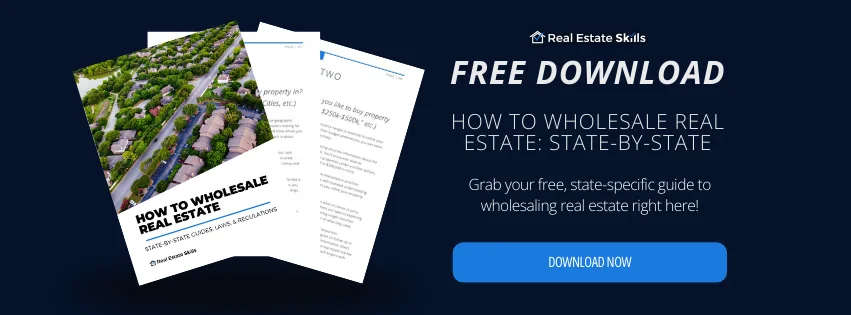
Free Guide: How To Wholesale Legally In Your State
A good mentor will tell you the same thing we will: the rules for wholesaling vary by state and change often, and getting the disclosures wrong is how beginners get into real trouble. This free state-by-state guide breaks down the licensing laws, assignment rules, and disclosure requirements where you operate — so you can wholesale with confidence no matter which market you or your mentor are working. Download it free and know exactly where you stand before your next deal.
What A Real Mentor Relationship Produces: Two Student Stories
The real test of a mentor isn't their own deals — it's whether the people they guide actually close. Here are two Real Estate Skills students who started as complete beginners, in two very different markets, and what the mentored path actually looked like for them — the wins and the friction.
Chase & Diana — Los Angeles
Chase and Diana weren't investors. They were full-time professionals in the entertainment industry with two young kids, working in a field that kept drying up, looking for something more stable they could control. They started with the misconception almost everyone has — that you need buckets of money to invest in real estate — and what they wanted wasn't a course to binge alone. In their words, they needed someone to hold their hand a little, not to coddle them, but to be there when they had questions. That's mentorship.
Their first deal didn't go smoothly, and that's the useful part. They got a property under contract above asking, their buyers balked, and it fell out of contract entirely. Most beginners would have quit there. Instead they treated it as education, moved to the next one — a distressed $2 million hillside property near their home with a roughly million-dollar spread — and learned to navigate JV partners, sporadic comps they had to defend with their own local knowledge, and closings that came down to the wire. Then the first deal came back around at a $200,000 price cut because the agent trusted them and the backup buyer had fallen through. Across those first two wholesale deals, after splitting with JV partners, they netted around $40,000.
What actually got them there maps directly onto everything above: a step-by-step process they could follow, the confidence to talk to agents honestly ("we're new at this, here's our background"), and relationships they protected — at one point Diana sent a thank-you gift to an agent after a deal fell through, and that relationship brought the deal back. Their own honest summary: anyone going in expecting easy money will be disappointed, because there's no such thing. You put in the work, you stay coachable, and the results follow.
How Chase & Diana Made $40,000 Wholesaling In California
Ryan Zomorodi interviews Diana and Chase, two Real Estate Skills students who closed their first two wholesale deals in California for a combined net profit of around $40,000.

Sabbir — Dallas
Sabbir had a full-time IT job, a family, and 15 years in the same industry when he decided to finally act on a long-held interest in real estate. He'd been to the hotel seminars — and walked out with no clue where to start. What made the difference for him was a clear, step-by-step path plus live deal reviews with the coaching team, where they'd pinpoint the exact problem he was about to hit and how to get around it.
He did not rush it. He spent three to four months learning before making serious offers, then sent more than 20 offers, canceled a few deals, and pushed through the frustration in a competitive market. His patience paid off across his first three deals. The first earned a $5,100 assignment fee. Then, in a single month, he closed his second and third deals back-to-back — one a stressful out-of-state-title-company saga he got under contract at $160,000, the other a smooth deal he'd seeded months earlier with an agent from his first deal, where, as he put it, he basically signed the contract, waited a couple of weeks, and picked up his check. Combined across those first three deals, Sabbir made around $22,000.
That third deal is the whole lesson in miniature: it came easily because he'd built a real relationship with one agent on an earlier, harder deal, and she brought him the next one. Relationships compound. His advice to beginners was the same note Chase and Diana hit and the same one Alex teaches — consistency and perseverance over hype; keep going, refine a little every day, and a deal will come.
Wholesaling Real Estate In Texas: How Sabbir Made $22,000
Peter Soros, a coach at Real Estate Skills, interviews Sabbir, a Real Estate Skills student who made around $22,000 across his first three wholesale deals in Texas.

Two things are true about both stories. First, the deals were real and so were the obstacles — fallen-through contracts, title headaches, deadlines to the wire. Second, results like these aren't typical or guaranteed; outcomes vary widely based on your market, your effort, and a hundred things no mentor controls. What a mentor changes isn't the guarantee. It's the odds, and how fast you learn.
A Mentor Shortens The Path. A Proven System Is The Path.
Students like these didn't guess their way to a first deal — they followed a step-by-step process with experienced guides in their corner. Our FREE Training walks you through that exact system, the same one thousands of our students have used to find deals, lock them up, and get paid. Watch it today and see what the mentored path actually looks like.
Watch The FREE Training →How Much Does A Wholesale Real Estate Mentor Cost?
Wholesale mentorship ranges from a few hundred dollars for a self-paced course up to $10,000–$50,000+ for high-touch masterminds, with most structured group programs falling in the low-to-mid four figures. Price tracks access and proof: the more direct, experienced guidance and the stronger the track record, the more it costs.
What you'll pay for a wholesale mentor depends almost entirely on one thing: how much direct access you get to someone experienced. A recorded course you work through alone is cheap. A seasoned investor reviewing your actual deals on a weekly call is not. You're not really paying for information — information is free on YouTube — you're paying for judgment, accountability, and someone catching your mistakes before they cost you a deal.
Here's how the common formats line up:
| Format | Typical Cost | What You Get | Best For |
|---|---|---|---|
| Self-Paced Course | A few hundred to ~$1,000 | The system, plus maybe a community or Q&A. Structure and accountability are on you. | Disciplined self-starters on a budget |
| Group Coaching | Low-to-mid four figures | A structured path plus live calls, deal reviews, and a cohort moving alongside you. | Most beginners — the usual sweet spot |
| One-On-One Mentoring | Several thousand into low five figures | Direct, personal time and deal-by-deal feedback — the fastest hand-holding. | Those who want maximum personal access |
| Masterminds / High-Touch | $10,000–$50,000+ | In-person events, peer networks, and high-level access. | Investors scaling an existing business |
A few things drive where a given program lands: how much one-on-one access and live deal review you get, how complete the system is (scripts, contracts, comp tools), the strength of the mentor's recent track record and student results, whether it's local and in-person or virtual, and whether it's a one-time bootcamp or ongoing support. More access and more proof cost more — and usually they're worth more.
One honest note on value, not price: free content can absolutely teach you the fundamentals, and you should use it. What paid mentorship adds is structure, accountability, and a real person shortening your learning curve — which is why the way to judge cost isn't the sticker, it's the speed and certainty it buys you toward your first deal. Compare programs by verifiable results and what's actually included, not by who's cheapest or most expensive.
If you want a full breakdown of structured program costs, formats, and what to look for when choosing one, that's covered in our guide to wholesale coaching. This section is about understanding the price of the mentor relationship itself.
Is A Wholesale Real Estate Mentor Worth It?
A wholesale real estate mentor is worth it if you're committed and ready to do the work — the right guide can save you years of expensive trial and error and get you to a first deal far faster. It's not worth it if you're looking for passive, guaranteed, or get-rich-quick results.
For the right person, a mentor is one of the highest-return decisions in real estate. The math is simple: going it alone, most beginners spend months or years and real money making mistakes a mentor would have caught in a sentence — locking up unsellable deals, mishandling contracts, burning agent relationships, quitting right before momentum. A good mentor compresses that. You still do the work, but you skip the most expensive lessons, and the time saved is worth more than the fee. That's why Alex, who's now on the other side of it, has invested hundreds of thousands of dollars into his own mentors over the years — the return kept coming back larger.
But "worth it" depends entirely on you, and honesty matters more here than enthusiasm. So here's the straight version.
A mentor is worth it if you're genuinely committed — if you'll show up, make the calls, send the offers, and keep going when a deal falls through. If you're coachable enough to follow a proven process before improvising. And if you can treat setbacks as feedback instead of proof you've failed. For that person, a mentor doesn't just help; it can be the difference between starting and never starting at all.
A mentor is not worth it — at least not yet — if you're looking for passive income with no effort, if you expect a guaranteed outcome on a fixed timeline, or if you're drawn in by "six figures in 30 days" promises. Wholesaling is a real business. It rewards consistency and perseverance, not shortcuts, and no mentor can want it for you. If you won't do the work, the best mentor in the country can't help you, and you'd be wasting your money. The students who succeed all say a version of the same thing: there's no such thing as easy money, and the ones who make it are simply the ones who refused to quit.
And to be fair to the alternative: you can learn wholesaling on your own. Plenty of free content — including ours — will teach you the fundamentals, and some people piece it together through sheer persistence. A mentor isn't the only path. It's the faster, lower-risk one, with someone in your corner when a deal gets tight. If your honest answer is that you're committed and you'd rather not learn every lesson the hard way, that's exactly when a mentor earns its cost.
Wholesale Real Estate Mentor FAQs
Final Thoughts On Hiring A Wholesale Real Estate Mentor
Wholesaling works. That's not the thing that stops people. What stops them is going it alone — burning months on the wrong tactics, taking advice from people who've never closed a deal, and quitting right before it would have clicked. A mentor is how you skip most of that. Not because they hand you deals, but because they've already made the mistakes you're about to make, and they'll tell you the next right move when you're standing at the edge of one.
If there's a single takeaway, it's the one Alex landed on after his own first deal: get a mentor, and judge them by results, not promises. Find someone — local or virtual — who's actually closing deals, who can point you to students who've done it, and who teaches a clear, honest process. Be the kind of person worth mentoring: do the work, stay coachable, bring real effort to the table. Then keep going when a deal falls through, because it will, and the people who make it are simply the ones who don't quit.
Here's your next step. Get clear on what you actually need help with — finding deals, running the numbers, talking to agents, or closing — and start looking for a guide who's strong exactly there. If you want to see what the mentored path looks like in practice, watch how real students are doing it and decide for yourself whether the right guidance could get you to your first deal faster than going it alone.
Don't Learn Wholesaling The Hard Way. Get A Guide.
The wholesalers who make it aren't the most talented — they're the ones who followed a proven process instead of figuring it out alone. Our FREE Training shows you that whole system, from finding your first deal to getting paid, taught by investors who've closed deals across the country. Watch it today, then go put it to work.
Watch The FREE Training →
About The Author
Alex Martinez
Alex Martinez is the Founder & CEO of Real Estate Skills. He closed his first wholesale deal in 2012 for a $22,000 profit at age 20 — broke, in student debt, with no experience and no license — and within a year had wholesaled and flipped dozens of houses. Today he and his team invest across the country and have mentored thousands of students to wholesale, flip, and buy rental properties. This guide was reviewed and verified by Ryan Zomorodi, Co-Founder & COO of Real Estate Skills.
Disclaimer: This article is for educational and informational purposes only and does not constitute financial, investment, legal, or tax advice. Real estate wholesaling involves risk, and laws governing wholesaling, disclosure, and licensing vary by state and change over time. The student results described here are individual experiences and are not typical, guaranteed, or a promise of future performance — your outcome depends on your effort, your market, and many factors outside anyone's control. Always do your own due diligence and consult a qualified attorney, accountant, or licensed professional before making investment decisions or entering into any real estate transaction.
👉FREE Training
How To Consistently Wholesale, Flip Houses, & Invest In Rental Properties From The MLS
(Without Spending $1 On Marketing)

Alex Martinez, the founder of Real Estate Skills, is known for his strong, practical expertise in real estate, starting from a beginner with no family connections in the industry to acquiring over 55 real estate deals, including wholesale and flips, within his first year.
He has dedicated his career to providing cutting-edge education and resources for real estate professionals. He emphasizes the importance of self-taught knowledge through mentors, books, and hands-on experience.
His journey from earning a modest income to becoming a successful real estate entrepreneur and educator showcases his expertise and dedication to the field.

Ryan Zomorodi, co-founder and COO of Real Estate Skills, leverages his experience from a diverse background in real estate investment, construction management, and entrepreneurship to provide comprehensive education in the real estate sector.
His expertise is rooted in hands-on experience, extensive industry knowledge, and a commitment to empowering others through education.
Ryan's journey reflects a blend of practical experience and entrepreneurial success, contributing to his role in developing a platform that educates and supports aspiring real estate professionals.
Read Ryan's Full Bio >>
