
6 Best House Flipping Courses (2026): Honest Comparison & Real Numbers
Jun 12, 2026

Written by
Alex Martinez — Founder & CEO, Real Estate Skills. Has wholesaled and flipped houses for over a decade, personally acquiring 33+ residential investment properties.
Reviewed by
Ryan Zomorodi — Co-Founder & COO, Real Estate Skills. Reviewed and verified the program details, student results, and market data in this guide before publication.
Publication history: Originally published December 29, 2023. Updated June 2026 with a complete rebuild — an honest comparison of the best house flipping courses, verified 2026 flip economics, a real deal breakdown, documented student results, and a new house-flipping masterclass. Program details, student results, and market data verified by Ryan Zomorodi, Co-Founder & COO of Real Estate Skills.
The best house flipping course in 2026 is Pro Fix & Flipper, the fix-and-flip training inside Real Estate Skills' Ultimate Investor Program — ranked #1 here for beginners who want live coaching and a deal-finding system that doesn't rely on cold calling. But "best" depends on what you need, so this guide compares the real courses worth considering on price, curriculum, coaching, and documented results — grounded in what flipping actually pays in 2026. Profit and student figures are individual results; outcomes vary and are not typical or guaranteed.
Picking a house flipping course is a real decision, because the program you learn from shapes the habits you build, the diligence you practice, and how fast you reach a profitable first deal. In a market where the room for mistakes has shrunk, that choice matters more than it used to. The right course can be the difference between a clean first flip and an expensive lesson.
Here's the framing most "best course" lists skip: people learn differently, and "best" depends on fit. A complete beginner who wants accountability needs something different than a self-starter who just wants the concept on a budget. So this guide compares the real house flipping courses worth your time on what actually matters — curriculum depth, coaching access, documented student results, price, and who each one is built for — and grounds every recommendation in what flipping genuinely pays right now.
One thing up front, in the interest of honesty: we built Real Estate Skills, and our program ranks #1 here. You should weigh that exactly as much as you'd weigh any "best course" list written by people who sell one of the courses — which is to say, skeptically, and against the evidence. So instead of asking you to take our word for it, we'll show the real numbers, the documented deals, and the honest limitations, and let you decide. You can start with our free deal calculator and follow along.
How To Flip Houses In 2026 (In 90 Days Or Less)
Real Estate Skills founder Alex Martinez walks through his complete step-by-step process for fixing and flipping your first house in 90 days or less — finding deals, analyzing them, managing the renovation, and selling for profit.

What Is House Flipping?
House flipping is buying a property below market value — usually one that's distressed or outdated — renovating it, and reselling it for more than your total investment. The flipper's profit is the gap between the sale price and everything it cost to get there: the purchase, the rehab, the financing, and the holding costs.
Unlike wholesaling, where you sell a contract without ever owning the home, a flipper actually buys the property, fixes it, and sells it. The deals that work start with a motivated seller and a property that needs work — a home that's dated, neglected, inherited, or facing foreclosure. That's where the margin lives, because a turnkey house in perfect condition leaves no room to add value. You're buying the problem, fixing it, and selling the solution.
Flipping is also one piece of a larger path, and the better courses teach it that way. Most experienced investors describe a progression: start with wholesaling to build active income with little capital and risk, move into flipping for larger profits once you understand deals and have relationships, then roll those profits into buy-and-hold rentals for long-term passive income. You don't have to follow that exact order, but it explains why a course built around only flipping can leave you with a narrower skill set than one that shows how flipping connects to the strategies around it. The more exit strategies you understand, the more deals you can actually do something with.
Read Also: How To Flip A House For The First Time
What House Flipping Actually Pays in 2026
The typical U.S. home flip generated a gross profit of $65,981 in 2025, on a 25.5% return on investment — the lowest ROI since 2008. That number is the single most important context for choosing a course, because it tells you the margin for error has shrunk and the discipline a course teaches now matters more than ever.
This is educational information, not financial advice. Market conditions vary by location and change over time — confirm current figures and consult a licensed professional before investing.
A decade ago, flippers were buying homes for under $150,000 and clearing 50%-plus returns almost by default. Today the median flip is bought around $260,000 and sold around $325,000, and the profit in that spread gets eaten quickly if your numbers are off. Here's the part most "make money flipping" pitches leave out: that $65,981 is gross profit — the difference between the purchase price and the sale price, before you've paid for a single thing. It doesn't include the rehab, which veteran flippers estimate runs 20% to 33% of a home's after-repair value, and it doesn't include holding costs — the loan interest, taxes, insurance, and utilities you pay every month you own the property. After all of that, your actual take-home is meaningfully lower than the gross. A course that shows you only the gross spread and calls it your profit is teaching you to lose money.
Flipping activity reflects the squeeze. About 297,045 homes were flipped in 2025, the fewest since 2020, as rising prices compressed margins to levels last seen in the financial crisis. Returns also vary enormously by location — Pennsylvania flips averaged a 73% return in 2025 while Montana flips averaged 1.2%, and Washington, DC, produced the highest average gross profit at $166,541. Where you flip changes the math as much as how you flip.
None of this means flipping doesn't work in 2026. It means the room for sloppiness is gone. When returns were 50%, you could overpay, blow your rehab budget, and still stumble into a profit. At 25.5%, with costs eating one end and a tighter resale market the other, the discipline a good course teaches — buying at the right price, estimating repairs accurately, and managing the renovation on a timeline — is the whole game. That's exactly why the course you choose matters more now than it did when the market forgave mistakes. Market figures are national and state averages from ATTOM Data as of early 2026; individual results vary by market, property, and execution.
How We Evaluated These Courses
We ranked these courses on the criteria that actually affect whether you close a profitable deal — documented student results and live coaching weighted heaviest, then curriculum, community, and value. In a tighter 2026 market, the difference between a good course and an expensive one is whether it gets you to take action, not how slick the videos look.
Here's what we measured, and roughly how heavily each factor counted toward the ranking:
- Documented student results (30%): Can you actually see real students closing real deals, with real numbers and names — not anonymous testimonials? This is the heaviest factor, because outcomes are the only honest proof a course works.
- Live coaching and deal review (25%): Most courses teach the same mechanics. What separates them is whether a real person reviews your specific deal and holds you accountable past the point motivation fades. For a first flip, where one bad estimate can cost you thousands, that's worth more than another video module.
- Curriculum completeness (20%): Does it cover the whole process — finding deals, analyzing them, funding them, managing the renovation, and selling — or just the parts that are fun to teach?
- Community and accountability (15%): Real estate is a relationship business. A strong community is where you find contractors, lenders, and buyers, and where you go when you're stuck.
- Value and beginner fit (10%): Does the price match what you get, and is it built for someone starting from zero versus someone scaling an existing operation?
A note on honesty: we built and run Real Estate Skills, and Pro Fix & Flipper ranks #1 here. You should weigh that exactly as much as you'd weigh any "best course" list written by the people who sell one of the courses — which is to say, skeptically, and against the evidence. So instead of asking you to take our word for it, the rest of this guide shows the documented deals, the real numbers, and the honest limitations, and lets you decide.
The Best House Flipping Courses in 2026, Compared
There's no single best house flipping course for everyone — there's a best one for you, and it depends on whether you need live coaching or just a concept, how much you can spend, and whether you learn by doing or by watching. Six options are worth your time in 2026.
Here's how all six compare at a glance — price, format, live coaching, and who each one is built for. The deep dive on our #1 pick follows the table, with honest mini-reviews of every option after it.
| Rank & Course | Price | Format | Live Coaching | Best For |
|---|---|---|---|---|
| #1 Pro Fix & Flipper Real Estate Skills (Ultimate Investor) |
Application required | Online + Live | 3×/week | Beginners wanting coaching & on-market deals |
| #2 Future Flipper Ryan Pineda |
~$5,000–$25,000 | Online + Community | Varies by tier | Self-starters investing heavily in mentorship |
| #3 BiggerPockets Courses & community |
Free – ~$300 | Self-paced + forum | None | Researchers wanting depth & a free community |
| #4 Udemy Fix-and-Flip Multiple instructors |
~$20–$100 | Online, self-paced | None | Budget-conscious beginners learning the concept |
| #5 Flipsters Academy Austin Flipsters |
~$49 + ~$30/mo | Self-paced + community | None | DIY beginners wanting a design/build angle |
| #6 Free Options YouTube & free trainings |
FREE | Video, self-paced | None | Testing whether flipping is for you |
#1 — Pro Fix & Flipper (inside the Ultimate Investor Program)
Pro Fix & Flipper is Real Estate Skills' house-flipping training, delivered as the fix-and-flip pillar inside the Ultimate Investor Program — the program that covers wholesaling, flipping, and buy-and-hold together. It earns the top spot because it combines three things most courses only offer one or two of: a complete step-by-step flipping curriculum, three live coaching calls a week, and an on-market way of finding deals that doesn't require cold-calling or marketing spend. The full deep dive is below the competitor reviews.
#2 — Future Flipper (Ryan Pineda)
Future Flipper is built around Ryan Pineda, a high-profile investor with a large following and a genuine track record of hundreds of flips. The coaching program is comprehensive and community-driven, covering flipping, wholesaling, and rentals. The honest catch is price: the coaching tiers run roughly $5,000 to $25,000 depending on the level, which is a serious commitment for a first-time flipper. There are cheaper standalone courses, but the real draw — the mentorship and network — sits at the high end.
#3 — BiggerPockets
BiggerPockets is less a single course than an ecosystem: a massive free forum, podcasts, books, and paid courses. For a researcher who wants to read deeply, ask questions, and learn from thousands of investors at no cost, it's genuinely valuable, and the community is its real strength. What it doesn't offer is structured live coaching or someone reviewing your specific deal — you assemble your own education from the pieces.
#4 — Udemy Fix-and-Flip Courses
Udemy hosts several inexpensive fix-and-flip courses, usually $20–$100, often on sale for less. For the price, you get a solid concept-level introduction — what flipping is, the basic process, what the numbers look like. That's real value for someone testing the waters. What you don't get is live coaching, deal reviews, or accountability, which is what most beginners actually need to turn knowledge into a closed deal.
#5 — Flipsters Academy
Flipsters Academy is a budget-friendly course (around $49, plus an optional ~$30/month community) built by investors who lean into the construction and design side of flipping. It's a reasonable, affordable starting point with a community attached, and the hands-on renovation angle is a genuine differentiator at this price.
#6 — Free Options (YouTube and Free Trainings)
There's more free, high-quality flipping education online than ever — full walkthroughs on YouTube, and free trainings like Real Estate Skills' own. For deciding whether flipping is even for you before paying for anything, free content is genuinely worth it and the right first step. The honest limit is the same one every free option shares: it can teach you the method, but it rarely walks a beginner all the way to a closed, profitable deal. Free is where you start, not usually where you finish.
#1 Pro Fix & Flipper: The Best House Flipping Course for Beginners in 2026
Pro Fix & Flipper is Real Estate Skills' house-flipping training, delivered as the fix-and-flip pillar inside the Ultimate Investor Program. It ranks #1 for beginners because it pairs a complete flipping curriculum with three live coaching calls a week and an on-market deal-finding method that needs no cold calling or marketing budget.
What sets it apart isn't a slogan — it's the deal-finding method. Most flipping education sends beginners chasing off-market leads: cold-calling distressed homeowners, paying for skip traces and direct mail, competing with every other investor for the same seller. Pro Fix & Flipper teaches the opposite. The MLS-based approach has you building relationships with listing agents on properties that are already for sale, where the agent's job is to pick up the phone and the list price is a starting point, not a fixed number. As Alex showed on his Poway deal — a $390,000 purchase on a home listed at $500,000 — a listed price is the agent's suggestion, and a property that's been sitting or shows distress in the photos is often negotiable well below it. For a beginner with no marketing budget, finding deals this way removes the single biggest barrier to a first flip.
The curriculum runs the full process: calculating after-repair value with real comp criteria, estimating rehab costs accurately, reverse-engineering the maximum you can offer, finding hard money and private money so you're not using all your own cash, managing contractors and the renovation timeline, and selling for top dollar. You get a deal calculator to run the numbers, a scope-of-work template to control the renovation, and — the part a self-paced course can't replicate — three live coaching calls a week where experienced investors review your actual deal before you commit money to it.
Pro Fix & Flipper — Strengths & Limitations
| ✓ Strengths | ✗ Limitations |
|---|---|
| Three live coaching calls per week, with deal reviews before you commit money | Application-based — no public price; you book a call to see if it's a fit |
| On-market MLS method finds deals without cold calling or marketing spend | Sits in the premium coaching range, not the budget-course range |
| Complete curriculum — finding, analyzing, funding, renovating, and selling | Includes wholesaling and buy-and-hold — more than you need if you only ever want to flip |
| Includes a deal calculator and scope-of-work template, plus an active community | Not the right fit for experienced flippers who already have deals, crews, and financing |
What you're paying for, in one line, is the thing that actually gets beginners to a first profitable flip: a real system to find deals without marketing, plus a coach who reviews your numbers before you risk anything on them.
Read Also: How To Become A Real Estate Investor
What a Great House Flipping Course Should Teach You
A house flipping course is worth paying for only if it teaches the complete path from finding a deal to cashing the check — not just the fun parts. The whole process comes down to six skills, in order, and if a course skips any of them, it's leaving you to learn the expensive lessons on a live deal.
Use this as a checklist for evaluating any course:
- Find distressed deals without a marketing budget. The first thing that stops beginners is finding a property cheap enough to flip. A good course teaches a repeatable source of deals — ideally on-market listings you can reach through agents, so you're not spending thousands on direct mail before you've made a dollar. If a course's only answer is "cold-call homeowners," it's teaching the hardest, most expensive path.
- Calculate after-repair value (ARV). ARV is what the home will sell for once renovated, and it's the number everything depends on. The course should teach you to pull comparables the way an appraiser does: sold, renovated homes within the last six months, within about a half-mile, the same bed-and-bath count, within roughly 20% of your square footage, in the same neighborhood. The most common beginner mistake is inflating the ARV to make a deal "work" — a good course teaches you to do the opposite and set a number you're sure of.
- Estimate rehab costs accurately. A course should teach you to walk a property and itemize every repair into a scope of work, then get real bids from contractors against it. It should also give you a fast sanity-check, like a dollar-per-square-foot estimate, so you can screen deals in seconds. Underestimating the rehab is how beginners turn a projected profit into a break-even slog.
- Reverse-engineer your maximum offer. Once you know the ARV and the repair cost, the most you can pay — and still hit your target profit after financing, closing, and holding costs — is math. The course should teach you to work backward from your desired profit, not forward from the seller's asking price. A simple "70% of ARV minus repairs" rule is a starting point, but it often produces an offer too low to win a real deal.
- Fund the deal without all your own cash. Beginners assume they need the full purchase price in the bank. They don't. A good course teaches how hard money lenders (companies that lend on the deal itself) and private money lenders (individuals lending for a return) work, how to combine them to cover the purchase and rehab, and how to get a proof of funds so agents take your offers seriously.
- Manage the renovation and sell for top dollar. The deal is won at purchase but kept or lost during the renovation. The course should teach you to vet contractors, control the budget against your scope of work, pay in stages tied to completed work, keep the timeline tight, and prepare and price the finished home to sell. This is where profits quietly evaporate, and where good instruction earns its cost.
If a course covers all six with real depth — and gives you the tools and a coach to apply them — it can take you from never having flipped a house to closing your first deal. If it covers only two or three, you're buying a head start, not a finish line.
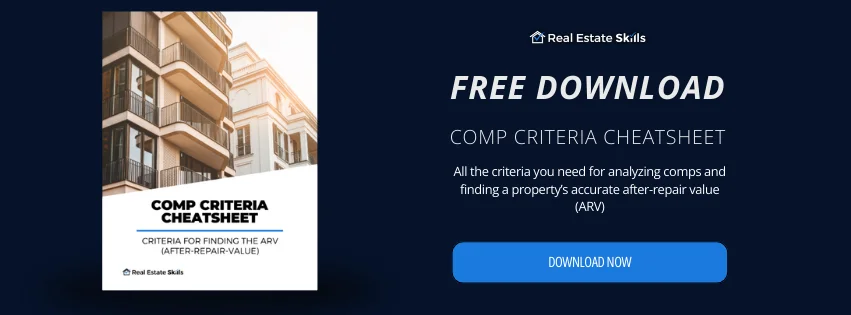
How the Pros Figure Out What a Flip Will Sell For
Almost every losing flip starts the same way: an inflated guess at the resale value. Pulling accurate comparables — recently sold, renovated homes that genuinely match your property — is the skill that tells you whether a "cheap" house is a real deal or a money pit. This cheatsheet lays out the exact comp criteria we use to set an after-repair value you can trust. Download it free and price your first flip like an investor, not a hopeful.
A Real Flip, Start to Finish: The Numbers Behind a $61,000 Profit
The best way to judge what a house flipping course should teach is to watch a real deal run from purchase to payday. Here's the first house flip Alex Martinez took on the majority of the work for — a Poway, California property he bought for $390,000 and sold for $535,000, netting about $61,000 after paying back his lenders.
📓 From The Field — Alex Martinez
In June 2015 I bought a 3-bed, 2-bath, 1,358-square-foot house in Poway, just outside San Diego. It wasn't a wreck — outdated, cosmetic work needed, nothing structural. It had been listed at $500,000, and I actually got it as a backup offer: another buyer went under contract first, got cold feet, and couldn't perform, so I stepped in. We negotiated to $390,000 — $110,000 under the original list price. People say that can't be done on a listed property. We've done it again and again, and still do.
Here's how that deal worked, and why the order matters.
First, the after-repair value (ARV). ARV is what the home will sell for once it's fixed up, and you find it with comparables — recently sold, renovated homes that match yours. Alex's comps were selling around $520,000 to $540,000. The discipline that protects you here is one most beginners skip: never inflate the ARV. He set his at $520,000 — a price he was confident it would sell at "all day" — even though he believed it could go higher. Setting a conservative ARV means the surprises at the end are good ones.
Second, the repair cost. He walked the property line by line with a general contractor (referred by a flipper friend — relationships, again) and got the renovation estimated at $40,000 for a full cosmetic update: new flooring, paint, fixtures, landscaping, a refreshed kitchen and bathrooms. The final cost came in at about $42,000 over roughly four weeks. A $2,000 miss on a $40,000 budget is what a realistic estimate looks like.
Third, the purchase price falls out of the first two. Once you know what a property will sell for and what it'll cost to get there, the maximum you can pay to hit your target profit is just math. At $390,000 in, against a $520,000 conservative ARV and ~$42,000 in repairs, Alex's deal calculator showed roughly $34,000 of estimated profit — conservatively, with margin built in. This is also why beginners who rely only on the basic "70% rule" formula often lose deals: that rule of thumb would have capped the offer near $324,000, far below the $390,000 that still penciled as profitable. The simple formula is a starting point, not the answer.
He funded it without using all his own cash — a hard money loan of $312,000 (at 10% plus two points) plus three private money lenders covering the rest. The renovation ran about four weeks. He listed it in a price range to draw competing offers and got it under contract at $535,000 — $15,000 above his conservative ARV. After the closing statement and paying back the private lenders, the true net profit was a little over $61,000.
That's the whole framework on one real deal: conservative ARV, accurate repairs, a purchase price reverse-engineered from both, funded with other people's money, renovated fast, sold above a number he was sure of. A house flipping course worth paying for teaches you to run every deal this way — and gives you a calculator and a coach so you're not doing it alone on your first one. This is one investor's individual result; outcomes vary by market, property, and execution, and are not typical or guaranteed.
My First House Flip: From Start to Finish
Watch Alex Martinez walk through the full Poway deal — how he found it, analyzed the numbers, funded it, renovated it, and sold it for a profit on his first hands-on flip.

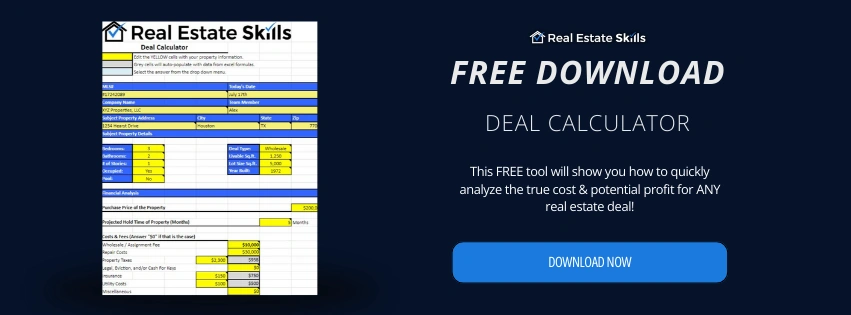
Run Your First Flip's Numbers Before You Make an Offer
Flipping is a numbers game, and the math is unforgiving — miss your after-repair value or your rehab budget by a few percent and the profit's gone. This is the same deal calculator our students use on every property: plug in the comps, the repairs, and the financing, and it works backward to the exact maximum you can offer and still hit your target profit. Download it free and stop running deals on back-of-the-napkin math.
Read Also: The Maximum Allowable Offer (MAO) Formula
You Don't Need To Pick The Perfect Course To Start Learning Today.
Before you spend a dollar on any program, our FREE Training shows you the actual system behind a profitable flip — how to find the deal, calculate your maximum offer, manage the renovation, and sell for top dollar. It's the same process our students use to close their first deals, and it costs nothing to watch.
Watch The FREE Training →How Beginners Actually Fund a House Flip
You do not need the full purchase price in your bank account to flip a house. Most flippers — including beginners on their first deal — fund the purchase and renovation with borrowed money from two sources: hard money lenders and private money lenders. Understanding how they work together is what makes flipping possible without a fortune.
A hard money lender is a company in the business of lending on fix-and-flip deals. They lend on the strength of the deal itself, not your credit history, which is why they're beginner-friendly — if the numbers are good, they'll often lend even to someone with no track record, because worst case they can take the property back and still be protected. They typically lend a percentage of the total cost (purchase plus rehab), charge an annual interest rate (often around 10%) plus upfront "points" (a percentage fee), and the loans are usually interest-only and non-recourse, meaning they're tied to the property and not your personal assets. They can also give you a proof of funds — the document that shows agents you can actually close, which gets your offers taken seriously.
A private money lender is an individual lending you money for a return — a high-net-worth contact, a fellow investor, sometimes a real estate agent or even a former seller. The difference is flexibility: you negotiate the terms, rates can run lower (anywhere from about 6% to 12%), and there are often no points. Private money is typically how you cover the gap a hard money lender won't — the down payment and the costs hard money doesn't fund.
📓 From The Field — Stephanie, Real Estate Skills Student (Minneapolis)
On one of her flips, Stephanie didn't have the down payment, so she paired a hard money lender with a private money lender who covered the gap. "That's the only way I could make it happen," she said — without it, she couldn't have done the deal. It cost more to carry two lenders, but it let her do a deal she otherwise couldn't have: the trade-off between keeping more profit on one deal versus doing more deals with other people's money. Individual result; outcomes vary and are not typical or guaranteed.
There's also a sharper move worth knowing about, because a beginner used it successfully on her very first flip.
📓 From The Field — Lindsay, Real Estate Skills Student (Greenville, SC)
Lindsay bought her first flip in cash to make her offer more attractive and close fast — no financing contingency — then used a delayed purchase (also called delayed financing): after closing, a hard money lender placed a loan on the property and returned most of her cash, which she immediately put back to work toward her next deal. "I was only temporarily out of pocket for a couple of weeks," she said. Her first flip, bought for $275,000 off the MLS, is projected to net about $47,000 — and it sold with a full-price offer within five hours of listing. Projected, individual result; outcomes vary and are not typical or guaranteed.
The lesson underneath both stories is the one a good course drills: financing isn't the obstacle beginners think it is, but it is a cost you have to account for precisely. Every month you hold a property, you're paying interest, and that interest comes straight out of your profit. Cheap money and a fast timeline are as important to a flip as the purchase price itself.
How To Make $47,000 On Your First House Flip
Real Estate Skills student Lindsay left a 17-year corporate career, flipped her first house off the MLS in Greenville, SC, and received a full-price offer within five hours of listing — here's her full story and the numbers behind it.

Read Also: 9 Best Hard Money Lenders For Beginners
Managing the Renovation: Where Flips Are Won or Lost
You make your money when you buy a flip, but you keep or lose it during the renovation. The two things that quietly destroy a beginner's profit are an inaccurate repair budget and a timeline that drags — because every extra month you own the property is more interest, taxes, insurance, and utilities coming straight out of your spread.
It starts with a scope of work — an itemized list of every repair the property needs, from the roof to the flooring. This document does two jobs: it forces you to budget for the whole renovation up front instead of discovering costs as you go, and it gives every contractor the same clear plan to bid against, so you get accurate, comparable quotes instead of vague estimates. The discipline of getting three bids against one scope of work, rather than trusting a single contractor's number, regularly saves five figures on a deal.
For a fast first estimate, experienced flippers use a dollar-per-square-foot rule: a light cosmetic refresh might run around $10 a square foot, a typical outdated-but-solid home around $30, and a heavy gut closer to $60. It's a screening tool, not a final budget — you confirm with real bids before you buy — but it lets you analyze a property in seconds instead of getting stuck in analysis. Then there's the timeline. A useful rule of thumb is that every $10,000 of renovation takes about a week of work, so a $40,000 cosmetic rehab should run roughly a month. Knowing that tells you when something's wrong — if a one-month job is stretching to three, the holding costs are eating your profit.
Here's where the honest lessons matter most, because the renovation is where even capable beginners get hurt.
📓 From The Field — Stephanie, Real Estate Skills Student (Minneapolis)
Her flips made money — roughly $40,000, then $35,000, then $35,000 across her first three, with a larger one underway — but her hardest lessons all came from the renovation side, not finding deals. On one flip, the budget bid at $170,000 came in at $205,000, because her contractor gave estimates instead of getting items formally bid out, and electrical and foundation work turned out to be far more than he'd guessed. On another, she hired the same contractor to run two flips at once; permit delays scrambled his crews, and a job that should have taken 16 weeks took 32 — doubling the hold time and the interest. "Time is everything. That just ate up a ton of my profit." By her fourth deal she changed her whole approach: getting bids herself and managing the project directly. Individual results; outcomes vary and are not typical or guaranteed.
Her experience is the most useful thing a beginner can hear, because it's not a failure story — it's a profit story with the friction left in. She made money on every deal and still lost real margin to timeline overruns and loose budgeting. That gap between gross spread and take-home profit is exactly what the 2026 numbers warned about, and it's why a course that teaches renovation management — not just deal-finding — is worth far more than one that stops at the purchase.
Flipping Houses With Private Money: Stephanie's Story
Co-founder Ryan Zomorodi sits down with Real Estate Skills student Stephanie to break down four real Minneapolis flips — the numbers, the contractor lessons, and what she'd do differently.

A few rules that protect a first-time flipper's renovation, drawn from how experienced investors run theirs:
- Pay in stages tied to completed work, never all upfront. Inspect the work, confirm it matches the scope, then release the next payment. The saying is "be ahead on work and behind on pay."
- Do the easy, cosmetic flip first. The bigger the renovation, the more walls you open, the more hidden problems you find, and the longer it takes. A first flip that mainly needs paint, flooring, and fixtures has far less that can go wrong.
- Build in a contingency. Even a careful inspection misses things behind the walls. Budget at least 10% extra on a light renovation, more on a heavy one.
- Protect the timeline like profit, because it is. Order long-lead items like windows early, keep contractors moving, and remember that finishing a month late can erase thousands in holding costs.
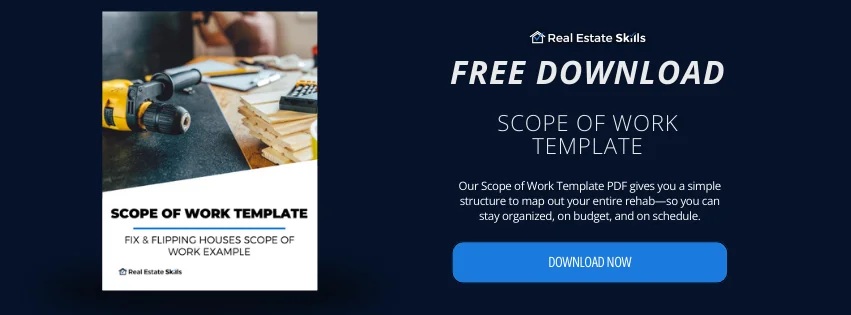
The Document That Keeps a Renovation On Budget
The fastest way to watch a flip's profit disappear is a renovation with no written plan — a missed repair here, a "while we're at it" there, and the budget's gone. A scope of work is the itemized list of every repair a property needs, from the roof to the flooring, and it's what lets you hand contractors one clear plan and get real, comparable bids. Download the free template and build your first one before you ever close.
Read Also: How To Estimate Rehab Costs
Can a Beginner Really Learn to Flip Houses?
Yes — someone who has never touched real estate can learn to flip houses, and flipping is one of the more accessible ways into real estate investing because you don't need a license, a construction background, or all the cash yourself. What you do need is the willingness to learn the numbers, make a lot of offers, and push through the discomfort of a first deal.
The students whose deals appear in this guide started from zero — a food-service business owner, a corporate executive who'd never flipped — and closed real, profitable flips within months of starting. The honest expectation to set is that flipping is a numbers game. You won't find a deal on your first offer, or your tenth. One beginner ran 60 deal analyses, saw 16 properties in person, and made 5 offers to get 1 accepted on her first flip. Those early "no"s aren't failure — they're the process working. A good course doesn't just teach the mechanics; it sets that expectation and keeps you making offers through the stretch where motivation alone would quit.
How Long Does It Take to Learn to Flip a House?
Most beginners who commit can go from starting to a first flip in a few months, though it varies widely with effort, market, and how the deal goes. The students documented here closed first flips within months of joining a program — one had her first deal under contract about two months after leaving her job. The learning itself is fast; a structured course can teach you the full process in weeks. What takes time is the doing: finding the right deal, closing it, and running a renovation that typically takes a month or more on a cosmetic flip and longer on a heavy one.
The biggest variable isn't how quickly you learn — it's how quickly you take action. The people who close aren't the ones who watched the most videos; they're the ones who made offers, got told no, and kept going. As one investor puts it, you never need to know 100% before you start; you need to know enough to take the first step and the willingness to learn the rest on the way. Individual results; outcomes vary and are not typical or guaranteed.
Is a Free House Flipping Course Worth It?
A free house flipping course is worth it as a starting point — it can teach you the fundamentals and help you decide whether flipping is right for you before you spend a dollar. What it can't do is review your specific deal before you risk money on it, hold you accountable when you stall, or be there at the closing table when something goes sideways.
There's more high-quality free education available now than ever: full deal walkthroughs on YouTube, and free trainings like Real Estate Skills' own that cover the entire process. If a free resource does nothing more than show you what flipping actually involves so you can decide it's for you, it's done real good. But there's an honest limit, and it's the same for every free option. Free content can teach you the method — what an ARV is, how to estimate a rehab, how funding works. What it can't replace is guidance on a live deal. The people who actually close their first flip aren't usually the ones who watched the most free videos; they're the ones who got help when it counted. Free is where you start. It's rarely where you finish.
So the realistic path is to use free content exactly as far as it goes: watch the trainings, learn the fundamentals, and confirm flipping is something you want to do. Then, if your goal is to actually close a profitable deal rather than just understand the concept, that's the point where a course with coaching and a community earns its cost — because on a first flip, in a 2026 market with little room for error, the gap between knowing and doing is where money is made or lost.
Read Also: How To Flip A House For The First Time
House Flipping Course FAQs
Final Thoughts on Choosing a House Flipping Course
The best house flipping course is the one that gets you to a profitable first deal — and which one that is depends on where you're starting. If you already understand the business and just want to fill a few gaps, a cheap course or free training may be all you need. If you're starting from zero and want a real shot at closing a deal in a market that no longer forgives mistakes, coaching and accountability are what move people from learning to doing.
That's why Pro Fix & Flipper, inside the Ultimate Investor Program, ranks first here for beginners — not because it's the cheapest or the flashiest, but because it pairs a complete curriculum with three live coaching calls a week and a way to find deals without a marketing budget. The students in this guide didn't succeed because they watched the most videos. They succeeded because they learned the numbers, made offers, and had support on a live deal when it counted.
Whatever you choose, here's the concrete next step: before you spend a dollar on any course, watch a free training and run one real property through a deal calculator yourself. Pull the comparables, estimate the repairs, work backward to what you could offer, and see whether the profit is actually there. That single exercise will teach you more about whether flipping is for you — and whether a given course teaches it properly — than any course description ever could. Do that this week, on a real listing in your own market, and you'll know far more about your next move than you do right now.
Most People Compare Courses Forever And Never Flip A House.
The ones who actually close already know how to find a distressed property, run the numbers, and turn it into a profit — the part no course description can teach you in a sentence. Our FREE Training walks you through exactly how to find flip deals, analyze them like a pro, and fund them without a pile of your own cash. Watch it today, then put whatever course you choose to real work.
Watch The FREE Training →
About the Author
Alex Martinez is the Founder & CEO of Real Estate Skills, where he has helped thousands of beginners learn to wholesale and flip houses. He started in real estate over a decade ago, personally wholesaling and flipping properties — including the Poway, California flip detailed in this guide — before building Real Estate Skills into a leading investing education platform. This guide was reviewed for accuracy by Ryan Zomorodi, Co-Founder & COO of Real Estate Skills.
Disclaimer: This article is for educational and informational purposes only and does not constitute financial, investment, legal, or tax advice. Real estate investing involves risk, including the potential loss of capital, and house flipping is not suitable for everyone. The student and investor results described here — including the Poway deal and the experiences of Stephanie and Lindsay — are individual outcomes shared for illustration; they are not typical, not guaranteed, and your results will vary based on your market, your effort, financing, and conditions outside your control. Market figures are national and state averages from ATTOM Data as of early 2026 and change over time. Pro Fix & Flipper is offered through the Ultimate Investor Program on an application basis. Always conduct your own due diligence and consult a licensed real estate, financial, legal, or tax professional before making any investment decision.

👉FREE Training
How To Consistently Wholesale, Flip Houses, & Invest In Rental Properties From The MLS
(Without Spending $1 On Marketing)

Alex Martinez, the founder of Real Estate Skills, is known for his strong, practical expertise in real estate, starting from a beginner with no family connections in the industry to acquiring over 55 real estate deals, including wholesale and flips, within his first year.
He has dedicated his career to providing cutting-edge education and resources for real estate professionals. He emphasizes the importance of self-taught knowledge through mentors, books, and hands-on experience.
His journey from earning a modest income to becoming a successful real estate entrepreneur and educator showcases his expertise and dedication to the field.

Ryan Zomorodi, co-founder and COO of Real Estate Skills, leverages his experience from a diverse background in real estate investment, construction management, and entrepreneurship to provide comprehensive education in the real estate sector.
His expertise is rooted in hands-on experience, extensive industry knowledge, and a commitment to empowering others through education.
Ryan's journey reflects a blend of practical experience and entrepreneurial success, contributing to his role in developing a platform that educates and supports aspiring real estate professionals.
Read Ryan's Full Bio >>
