
7 Best Wholesale Real Estate Courses (2026)
Jun 05, 2026
Written by
Alex Martinez — Founder & CEO, Real Estate Skills. Has wholesaled and flipped houses for over a decade, personally acquiring 33+ residential investment properties.
Reviewed by
Ryan Zomorodi — Co-Founder & COO, Real Estate Skills. Reviewed and verified the program details, student results, and state-law points in this guide before publication.
Publication history: Originally published June 4, 2022. Updated June 2026 with re-ranked courses, corrected competitor pricing, refreshed and verified student results, current state-by-state legal guidance, and a new 2026 wholesaling masterclass. Program details, student results, and state-law points verified by Ryan Zomorodi, Co-Founder & COO of Real Estate Skills.
The best wholesale real estate course in 2026 is Real Estate Skills' Pro Wholesaler VIP — ranked #1 here for beginners who want hands-on coaching, on the strength of its on-market MLS Offer System, three live coaching calls a week, and documented student deals from a few thousand dollars up to $40,000. But "best" depends on what you need, so this guide compares all seven courses on price, curriculum, coaching, and real results. Student figures are individual results; outcomes vary and are not typical or guaranteed.
Picking the best wholesale real estate course to build on is a real decision, because the program you choose shapes the habits you form, the diligence you practice, and how fast you reach your first deal. It's not hyperbole to say the right choice can shape your trajectory in the business — so it's worth getting right.
Here's the honest framing most "best course" lists skip: students learn differently. Some need only videos and templates; others need live coaching and a community holding them accountable. That's why the market is crowded with programs that all promise the same outcome through different methods — and why "best" is partly about fit. This guide compares all seven on what actually matters: curriculum depth, coaching access, documented student results (and failures), pricing, and who each one is built for.
One more thing, up front. Plenty of "best course" lists claim pure objectivity, but you can rarely take that at face value — affiliate commissions and personal bias creep in, and there's no reason you shouldn't assume the same about this very article. We get it. We're doing our best to stay objective because we believe anyone can and should be able to invest in real estate. We think we're the best — and instead of just asserting it, we'll give you the evidence and let you decide. You can start with our free State-by-State Wholesaling Guide and follow along.
FREE Wholesale Real Estate Course: How To Get Started With $0!
Real Estate Skills founders Alex Martinez and Ryan Zomorodi teach the full MLS Offer System in this free live class — how to start wholesaling with no money down and no experience.

What Is Wholesale Real Estate?
Wholesale real estate is a strategy where the investor acts as an intermediary between a motivated seller and an end buyer. The wholesaler secures the right to buy a property under contract, then sells that right to another buyer for an assignment fee — without ever owning the property themselves.
Often called "flipping paper," wholesaling doesn't actually involve buying the property (with rare exceptions). Instead, the investor finds a seller motivated to part with a home for less than it's worth, secures the right to buy it under a wholesale real estate contract, and then sells that right to another buyer — usually a fix-and-flipper — rather than closing on it themselves. The distinction matters: the wholesaler isn't buying or selling a home; they're selling their right to buy it, in exchange for an assignment fee.
The process runs on a few wholesale real estate contracts. The most important, the Purchase and Sale Agreement (PSA), is the catalyst — it gives the wholesaler the exclusive right to buy the property and, once signed, an equitable interest in it. To pass that right to an end buyer, the wholesaler uses an Assignment Contract, which acts as an addendum to the PSA to make sure it's legally assignable.
When a contract can't or shouldn't be assigned, the alternative is a double close, which requires actually buying the home and immediately reselling it to the end buyer. Because of the capital and time it takes, it's the backup route, not the default — but it's handy to have in a tight situation.
All of this depends on being able to find distressed properties with motivated sellers — foreclosures, estate situations, properties needing real repair. That's where the margin lives; you can't assign a non-distressed house, because there's no room left for the end buyer's profit. On a typical residential deal, the average assignment fee tends to land somewhere around $10,000–$13,000, and considerably more in high-demand markets — because buying well below market leaves the end buyer enough room to renovate, profit, and still pay the wholesaler.
How We Ranked These Courses
We weighed every course against the criteria that actually affect your decision: curriculum completeness, live coaching access, documented student outcomes, pricing transparency, community quality, and beginner suitability — with student outcomes and coaching weighted the heaviest.
We've worked through the wholesale real estate courses on the market and weighed each against the criteria that matter most. To weed out the pretenders, here's what we measured and how heavily each factor counted toward the ranking.
📝 Why Most Wholesale Course Reviews Miss The Point
Plenty of "best course" lists claim to rank on merit alone, but you can rarely take that at face value — affiliate commissions and personal bias creep in. And there's no reason you shouldn't assume the same about this very article. We get it. We're doing our best to stay objective because we believe anyone can and should be able to invest in real estate — and we're convinced we're the best, so we'll show you the evidence and let you decide.
The six evaluation criteria we believe have the biggest impact, along with how much we weighted each:
- Student Outcomes (30%): Don't even consider a course if you can't quickly and confidently see how its students are doing. This is the most important factor, which is why we weigh student success — how long the first deal takes and how much they make — the heaviest.
- Live Coaching Access (25%): We carefully consider the quality of the live coaching each program offers. Students learn in different ways, and if live coaching is what you need, you'll want to know how often you can talk to someone and how personalized the sessions are.
- Curriculum Completeness (20%): Our rankings account for how comprehensive the curriculum is. We want to make sure the course actually teaches you everything you need to know.
- Community Quality (10%): Real estate is a people business. The community is where you go to learn, talk through ideas, network, and grow — a good one is non-negotiable.
- Value for Cost (10%): We account for pricing. It's important that students get what they pay for.
- Beginner Accessibility (5%): Our rankings reflect the experience level each course is tailored to. If you've already got a few deals under your belt, you may want a course that's less beginner-focused and more advanced.
The 7 Best Wholesale Real Estate Courses of 2026
The top seven wholesale real estate courses span the gamut, from self-paced, affordable options to comprehensive coaching programs. Pro Wholesaler VIP ranks best for beginners who want coaching, while AstroFlipping and Wholesaling Inc. TTP win for their own offerings — and even the free options have their place.
Here's how all seven compare at a glance — price, format, duration, live coaching, and who each one is built for. The deep dive on our #1 pick follows the table, with honest mini-reviews of every competitor after it.
| Rank & Course | Price | Format | Duration | Live Coaching | Best For |
|---|---|---|---|---|---|
| #1 Pro Wholesaler VIP Real Estate Skills |
Application required | Online + Live | ~6 weeks | 3×/week | Beginners wanting MLS-based, on-market deals |
| #2 AstroFlipping Jamil Damji |
One-time $997 | Online + Community | Self-paced, lifetime access | Monthly group call | Self-starters who want a community & co-wholesaling |
| #3 Wholesaling Inc. (TTP) Brent Daniels |
~$5,000 | Online + Daily Live | ~3 months | Daily (M–Th) | Cold-calling lead generation |
| #4 Property MOB Academy Tracy Caywood |
$99–$500+/mo | Online, Self-Paced | Self-paced | Limited | Automation & scaling systems |
| #5 Udemy Wholesale Courses Multiple instructors |
$20–$100 | Online, Self-Paced | 4–10 hours | None | Budget-conscious beginners |
| #6 David Dodge & Mike Slane DiscountPropertyInvestor.com |
FREE | Online, Self-Paced | 7 modules | None | Zero-cost introduction to wholesaling |
| #7 PropStream Academy PropStream |
FREE | Online, Self-Paced | 3–5 hrs/course | Webinars | Data-driven deal finding for PropStream users |
#1 Pro Wholesaler VIP: The Best Wholesale Real Estate Course of 2026
Pro Wholesaler VIP is Real Estate Skills' flagship coaching program — a largely self-paced course wrapped in live coaching. Most students work through the core curriculum in about six weeks, with 50+ HD video modules, three live coaching calls a week, an active community, and a Cash Buyer Concierge that helps line up buyers.
The program earns the top spot for one concrete reason, not a slogan: its deal-sourcing method. Most wholesaling education sends beginners into the "Red Ocean" of off-market leads — cold-calling foreclosure lists, paying for skip traces, competing with every other investor for the same distressed seller. Pro Wholesaler VIP teaches the opposite: the MLS Offer System, which finds distressed, motivated-seller deals on-market, where you're talking to listing agents who are paid to pick up the phone rather than homeowners who never asked to hear from you. That system, combined with live coaching, comprehensive modules, and well-documented student results, is what makes the program hard to top.
The program's track record has landed it on RealEstateBees' 2026 ranking of the 14 Best Wholesale Real Estate Courses, one of the few third-party sources that evaluate programs on curriculum and merit.
What You Actually Learn: The Math Behind The Method
The program's engine is a single piece of reverse-engineering most courses never make explicit. Start from what you want to earn. If the average wholesale fee runs around $10,000, and it takes roughly 15 written offers to land one deal, then $10,000 a month is about one offer every other day. Want to double it? Double the offers. That's the whole framework — a fee target worked backward into a daily activity you can actually hit on roughly 15 hours a week, with the live coaching there to hold you to it. It turns wholesaling from a guessing game into a number. These are averages, not guarantees — results vary by market and effort.
There's also a compliance angle most "best course" lists ignore, and it's a real reason the on-market method is friendlier to a beginner. Off-market wholesaling means cold-calling homeowners who never asked to hear from you — and in 2026 that runs straight into the Telephone Consumer Protection Act (TCPA), where calling a number on the Do Not Call registry can carry penalties of $500–$1,500 per call. The MLS Offer System sidesteps it: you're calling the listing agent, whose number is published precisely so buyers will call, and who is paid to pick up. It's a quieter benefit of the on-market approach — you're not one misdialed number away from a fine. This is educational, not legal advice; confirm current TCPA rules and your state's disclosure laws with an attorney.
Pro Wholesaler VIP — Strengths & Limitations
| ✓ Strengths | ✗ Limitations |
|---|---|
| Three live group coaching calls per week — the highest frequency in this comparison | Pricing isn't publicly listed — requires scheduling an onboarding call |
| The MLS Offer System teaches deal-finding without cold calling or paid marketing | The MLS-based system is less effective in markets with extremely low inventory (under ~60 days of supply) |
| Cash Buyer Concierge actively helps students find buyers and close deals | No refund policy — full commitment required before enrolling |
| 50+ HD video modules with audio versions for mobile learning | Cash Buyer Concierge uses a 50/50 fee split when the team finds your buyer (you keep 100% if you find your own) |
| Documented on-camera student outcomes spanning roughly $2,500 to $40,000 in assignment fees | Higher price point than Udemy or the free course alternatives |
Student Outcomes: Documented Deal Results
The honest case for any "best course" claim isn't testimonials that sound good — it's named people, real markets, and real deal mechanics you can watch. Here are three on camera, followed by a wider sample. Every figure below is an individual result; outcomes vary and are not typical or guaranteed.
How Chase & Diana Made $40,000 Wholesaling In California
A Los Angeles couple with full-time jobs, two kids, and zero investor experience closed two deals totaling $40,000 in combined assignment fees — on roughly seven or eight written offers.

Chase and Diana started from about the hardest position there is — full-time jobs, two kids, no experience, in one of the most expensive markets in the country. Their deals weren't clean: one was a mold-ridden hillside property where the obvious zip-code comps undersold it, so Diana mapped the real comp boundary herself; the other got tied up above list, fell through, then came back at roughly a $200,000 price cut after the first buyer walked — because they'd kept the agent relationship warm. Net across both, after JV splits: about $40,000. What's worth copying isn't the number — it's that they landed two deals on roughly seven or eight written offers by being honest that they were new and putting the agent relationship first.
Mark's $7,500 Deal in Arizona
Working around a full-time job and two kids under two, Mark closed a second wholesale deal in Arizona for a $7,500 total fee — about $3,500 as his share after a 50/50 JV split.

Mark's second deal shows two things the program drills. First, the backup offer: he'd lost a North Phoenix property but asked the agent in writing to log him as first backup — and got the call on Christmas Eve that it was his. Second, the JV: it came together with a co-wholesaler who brought the cash buyer, and Mark kept everyone over-informed through title. He locked it around $281,000 on a roughly $400,000 ARV. The total fee was $7,500, split 50/50 with his partner — about $3,500 to him. Not a life-changing check on its own; the point is the reps and the follow-up.
How Landon Made $20K on a Virtual Deal in North Carolina
Landon closed his first deal entirely virtually — a property in North Carolina while living in South Carolina — for a $20,000 assignment fee, about $19,000 net, with no money spent on marketing.
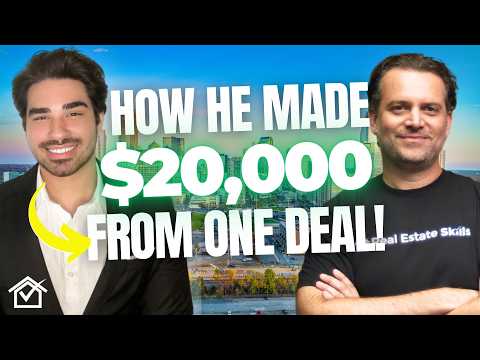
Landon came to wholesaling after a string of sales jobs, even vetting Real Estate Skills by running it through ChatGPT first. His first deal was fully virtual: a half-renovated home in Wilson, NC, for a $20,000 fee (about $19,000 net after a referral fee to his agent), with no money spent — just time. He found it the way the method teaches: cold-calling listing agents on-market, one of whom later handed him an off-market lead. It wasn't smooth — every cash buyer passed at first, and he salvaged it through investor Facebook groups, then renegotiated both sides after a rough inspection, which is how an $18,000 spread became $20,000.
📝 More Documented Student Results
These aren't the only ones. A wider sample of documented student interviews shows the same pattern across different people and markets:
- Jesse — at 21, closed his first deal entirely virtually (an inherited home in Texas while living in Canada) for about $2,500, candid that a first-timer's nerves cost him room he'd keep with experience.
- Nathan — a San Antonio video producer and the honest slow burn: his first two contracts fell apart, and it took most of a year before he closed two JV deals for roughly $7,000–$8,000 combined.
- Robert — a California automotive tradesman who closed his first deal for $20,000, but only after canceling four or five contracts first.
- Raymond — a Northern California entrepreneur and former flipper who runs it like a business with a small team and closed a deal for a $28,000 fee (about $23,000 after a JV split).
- John — a warehouse worker near Orlando who closed his first wholesale deal and bought his first rental in the same week.
Dozens more are on Real Estate Skills' Student Success Stories playlist. All individual results; outcomes vary and are not typical or guaranteed.
#2 AstroFlipping (Jamil Damji)
AstroFlipping is a community-driven program built around founder Jamil Damji and a co-wholesaling approach. At a one-time $997, it's a lower price point than a premium coaching program — best for self-starters who want Damji's community and are comfortable building relationships to source deals.
AstroFlipping comes in second, owing much of its standing to founder Jamil Damji, who built KeyGlee — one of the country's higher-volume wholesaling operations — and hosts A&E's Triple Digit Flip. The program is built around a community of investors and a co-wholesaling approach: leaning on agent relationships and buyer-network building rather than a single deal-sourcing system. Priced at a one-time $997, it includes a seven-module training, the AstroFlipping Elite community, a monthly group coaching call with Damji, and email support, with lifetime access. Confirm current pricing directly, as course pricing changes.
The trade-off versus a higher-touch program: the co-wholesaling and network-building approach assumes more initiative, which can be more advanced for a complete beginner. Best for self-starters who want Damji's community and are comfortable building relationships to source deals.
#3 Wholesaling Inc. — TTP Program (Brent Daniels)
Wholesaling Inc.'s TTP (Talk To People) program is one of the longest-running, most established options. It's built on disciplined, off-market cold-calling — best for people willing to do consistent outbound lead generation by phone.
One of the longest-running, most established programs, Wholesaling Inc.'s TTP (Talk To People) program is built on operational experience through the last housing downturn. Brent Daniels runs a seven-figure wholesaling business and teaches the same playbook. The method leans heavily on off-market deals — the "Red Ocean" of high competition — and expects consistent cold-calling, which not everyone is comfortable doing. Best for people who are willing to do disciplined outbound lead generation by phone.
#4 Property MOB Academy (Tracy Caywood)
Property MOB Academy offers 30+ self-paced modules from broker and wholesaler Tracy Caywood. It's comprehensive but oriented toward automation and scaling — better suited to someone with a little experience than a complete beginner.
Property MOB owes much of its credibility to founder Tracy Caywood, a broker and wholesaler with roughly 1,000 deals of experience. It offers 30+ self-paced modules covering lead generation through closing and assignment fees. It's comprehensive, but oriented toward automation and scaling systems — which can make it better suited to someone with a little experience than to a complete beginner. Best for investors focused on building automation and scaling an existing operation.
#5 Udemy Wholesale Courses
Udemy hosts several wholesaling courses, typically $20–$100. The price is convenient, but you get a concept-level introduction with no live coaching — best for budget-conscious beginners who just want to understand the concept first.
Udemy — the general online-education marketplace — hosts several wholesaling courses, typically $20–$100. Popular options include introductory courses on wholesaling fundamentals. The price is convenient, but you get what you pay for: a solid concept-level introduction with no live coaching, which makes it hard for most beginners to translate knowledge into a closed deal. Best for budget-conscious beginners who just want to understand the concept before investing more.
#6 Free Wholesale Course — David Dodge & Mike Slane
DiscountPropertyInvestor.com offers a free seven-module course covering wholesaling fundamentals at no cost — an excellent validation tool to complete before deciding whether to pay for coaching.
DiscountPropertyInvestor.com offers a free seven-module course from David Dodge (500+ transactions, 15 years' experience) and Mike Slane, covering the fundamentals — what wholesaling is, how contracts work, finding buyers and sellers — at no cost. It's an excellent validation tool: complete it before deciding whether to pay for coaching. As most beginners discover, understanding the concept isn't the same as executing a deal. Best for a zero-cost first look at whether wholesaling is for you.
#7 PropStream Academy
PropStream Academy provides free courses tied to the PropStream data platform. It's a data-intelligence supplement rather than a coaching program — most valuable for investors who already use PropStream and want structured training on its tools.
PropStream Academy provides free courses tied to the PropStream data platform, covering deal finding, lead generation, comps, and analysis. It's most valuable for investors who already use PropStream and want structured training on its deal-finding tools. It's a data-intelligence supplement, not a replacement for a coaching program. Best for PropStream users who want to get more out of the platform's data.
Wholesaling Programs vs. Wholesaling Courses: Key Differences
A course delivers knowledge through curriculum — videos, guides, templates. A program builds on that with a human element: live coaching, community, and support. At their best, programs fill the gaps that courses leave people to fall through.
It's easy to assume a wholesaling program and a wholesaling course are the same thing — the terms get used interchangeably — but there's a real difference. A course strives to instill knowledge through curriculum. A program adds the human element on top: live coaching, community networking, and support. Here's how the two stack up feature by feature.
| Feature | Course Only | Coaching Program |
|---|---|---|
| Step-by-step curriculum | ✓ Yes | ✓ Yes |
| Video modules + templates | ✓ Yes | ✓ Yes |
| Live coaching calls | ✗ No | ✓ Yes (1–3×/week) |
| Active deal reviews | ✗ No | ✓ Yes |
| Peer community + accountability | Limited or none | ✓ Active community |
| Buyer matching or concierge | ✗ No | ✓ Some programs |
| Ongoing support post-completion | ✗ No | ✓ Lifetime access (most) |
| Typical price range | Free – $200 | $5,000 – $10,000 |
Can a Beginner Learn to Wholesale Real Estate?
Yes. Someone who has never touched real estate can wholesale, and it's widely considered the best entry point into the business. Low capital requirements, a relatively straightforward process, and built-in ways to limit risk make wholesaling almost purpose-built for beginners.
Wholesaling was practically designed with beginners in mind. The lack of capital requirements, the relatively straightforward nature of the process, and the unique strategies to mitigate risk make it the most accessible way into real estate. Pro Wholesaler VIP students with no prior experience have closed their first deals and earned assignment fees in as little as 45 days. Individual results; outcomes vary and are not typical or guaranteed.
📝 From The Field — Alex Martinez
After more than a decade doing this, I can tell you the hardest part of wholesaling as a beginner isn't learning how to wholesale. The real learning curve is gaining the confidence to start — to make that first offer, call that agent, network with cash buyers. Confidence comes from knowing the material, but applying it for the first time on a live deal, where the margin for error can be just a few thousand dollars, is nerve-racking. That's exactly why coursework alone isn't enough — having someone who's already been where you want to go, on a live coaching call, can turn the tide of a deal.
There's one expectation worth setting honestly up front, because it's where most beginners get discouraged: wholesaling is a numbers game. Across experienced wholesalers, it tends to take around 15 written offers per deal — often one in nine to fifteen — so early "no"s aren't failure, they're the process working. A good program doesn't just teach the mechanics; it sets that expectation and keeps you sending offers through the stretch where motivation alone would quit. General averages; individual results vary widely by market and effort.
The Pro Wholesaler VIP program is built to take investors from total beginner to closing, covering every base along the way:
- How to calculate After-Repair Value (ARV) and Maximum Allowable Offer (MAO) using the 70% Rule
- How to find motivated sellers using on-market MLS properties — no cold calling required
- How to build and maintain a cash buyer list from REIA meetings, online platforms, and referrals
- How to structure an Assignment of Contract and a double close — and when to use each
- How to estimate repair costs accurately enough to protect your MAO calculation
- How to communicate professionally with title companies, agents, and sellers
Students have reported closing in as little as 45 days from joining. It's also possible to move faster, especially for those who pair a strong work ethic with the weekly coaching calls. A few focused hours a day plus consistent attendance on coaching calls is enough to be well on your way to a first deal — how fast it comes is largely up to you. Individual results; not typical or guaranteed.
How To Start Wholesale Real Estate In 2026 (15 hrs/wk)!
In this 2026 masterclass, Real Estate Skills founder Alex Martinez walks through how to start wholesaling on roughly 15 hours a week — no money down, no experience, no marketing spend — using the MLS Offer System.

Is a Free Wholesale Real Estate Course Worth It?
A free wholesale course is worth it as a starting point — it can make you aware of the strategy and teach the fundamentals. But free courses teach the concept without getting most beginners to a closed deal; they're incomplete without a coach or mentor.
Any competent course that gets someone interested in wholesaling and teaches even a fraction of what they need is worthwhile — free ones included. If a free course does nothing more than make someone aware that wholesaling is an option, it's done real good. That said, wholesaling has to be executed precisely; done carelessly, it can be costly or even run afoul of the law. So as long as the material is sound and the instructors aren't steering you toward anything improper, a free wholesale course is worth it. Just go in knowing you get what you pay for — there isn't a free course out there that's a substitute for guidance on your first real deal.
Thanks to the internet, it's easier than ever to learn the basics. David Dodge and Mike Slane's free course lays out the fundamentals clearly; PropStream Academy introduces data-driven deal-finding; and even Real Estate Skills — known for live coaching — offers an extensive free training webinar covering the full MLS Offer System.
But here's the honest divide between a free course and a coaching program, and it's not about information. Free videos can teach you the method. What they can't do is make you send the offer, hold you to an offer a day, or review the deal with you when you're stuck at the closing table. The people who actually close aren't the ones who watched the most videos — they're the ones who took action and kept going when it got uncomfortable. As Alex puts it, you never need to know 100% to start; you need enough to take the first step and the willingness to keep learning from there. Knowledge without action is just a hobby. That gap — between knowing and doing — is the single biggest thing a program provides that a free course can't.
I'll reiterate: free courses have a real place and are a great way to get started. But they're incomplete without a coach or mentor — it's that simple. No matter how good the material, almost everyone benefits more with an available professional in their corner.
Wholesale Real Estate Laws: What's Changed (2026)
Wholesaling is legal in all 50 states, but the rules tightened sharply between 2024 and 2026. New state laws now add disclosure requirements, homeowner cancellation rights, and in some places licensing thresholds — which directly affects which course you should trust.
This is educational information, not legal advice. Wholesaling laws vary by state and change over time — always confirm current requirements with a licensed attorney in your state before operating.
The single most important legal question when choosing a course isn't "is wholesaling legal?" (it is); it's "does this course teach current, state-specific compliance, or is it years out of date?" A few examples show how much the landscape has shifted. Illinois remains the strictest state in the country, effectively limiting unlicensed investors to one wholesale deal per 12-month period. Pennsylvania's Act 52 now requires wholesalers to be licensed and to give homeowners specific disclosures and a cancellation window. And Oklahoma's SB 1075, effective November 2025, requires written disclosure of assignment intent and gives homeowners a two-business-day right to cancel. Several other states — including Connecticut, Maryland, North Dakota, and Tennessee — have added their own disclosure or registration rules, with more likely to follow.
This is exactly why a course's recency matters. Material that hasn't been updated since these laws took effect can put you on the wrong side of a disclosure requirement without you realizing it — and free courses are the most likely to go stale. For the complete, regularly updated breakdown of where wholesaling stands in every state, see our full guide on whether wholesaling is legal in your state.
Wholesale Legally in Any State: Your 2026 Compliance Roadmap
Whether you are operating in a strict regulatory environment or a high-velocity metro market, staying compliant is the foundation of a long-term investment career. We teach you how to wholesale legally in any state, no matter where you are, giving you the specific legal structures and technical transparency needed for the current year. Start today with this guide to audit-proof your business and ensure every deal you analyze is backed by a bulletproof legal strategy.
Best Wholesale Real Estate Course FAQs
Final Thoughts On Wholesale Real Estate Courses
When all is said and done, choosing the best wholesale real estate course comes down to one question: what would help you close your first deal the most? If you've already got a foot in the door and someone willing to mentor you, a free course may be all you need to fill the gaps. Real Estate Skills' free training, for example, is genuinely useful and costs nothing — which is more than enough for some people.
Most people, however, don't have access to an experienced mentor, let alone any experience in the housing sector. For those who need a little more, the Pro Wholesaler VIP Program from Real Estate Skills is the strongest choice. With everything you need to start wholesaling your first deal as soon as possible — live coaching, comprehensive curriculum, an active community, and a chance to partner with professionals when you're just getting your footing — it's a step above the rest for anyone who needs to cross from learning to actually doing.
Ready to stop learning and start closing? Our FREE Training walks through the full MLS Offer System — how to find deals, calculate accurate offers, build a buyer list, and assign contracts without cold calling or paid marketing.
It's the same system our students use to close their first deals — and it costs nothing to watch.
About The Author
Founder & CEO, Real Estate Skills
Alex Martinez is the Founder and CEO of Real Estate Skills. With more than a decade of investing experience and 33+ residential properties acquired, he has personally wholesaled and flipped houses across the country. Since 2020, he has built Real Estate Skills into one of the leading educational platforms for new and experienced investors alike, helping thousands of students learn to find deals, use the right systems, and close profitable wholesale transactions. He also serves as a mentor at the Lavin Entrepreneurship Center at San Diego State University.
Real Estate Skills is not a law firm, and the information in this article is provided for educational purposes only — it does not constitute legal, tax, or financial advice. Wholesale real estate laws and requirements vary by state and change over time. All investments involve risk, and the past performance of an investment, industry, sector, or market does not guarantee future returns or results. Investors are responsible for any investment decision they make, and such decisions should be based on an evaluation of their financial situation, investment objectives, risk tolerance, and liquidity needs. Always consult a licensed real estate attorney and your own tax and financial advisors before entering into any contract or transaction.
👉FREE Training
How To Consistently Wholesale, Flip Houses, & Invest In Rental Properties From The MLS
(Without Spending $1 On Marketing)

Alex Martinez, the founder of Real Estate Skills, is known for his strong, practical expertise in real estate, starting from a beginner with no family connections in the industry to acquiring over 55 real estate deals, including wholesale and flips, within his first year.
He has dedicated his career to providing cutting-edge education and resources for real estate professionals. He emphasizes the importance of self-taught knowledge through mentors, books, and hands-on experience.
His journey from earning a modest income to becoming a successful real estate entrepreneur and educator showcases his expertise and dedication to the field.

Ryan Zomorodi, co-founder and COO of Real Estate Skills, leverages his experience from a diverse background in real estate investment, construction management, and entrepreneurship to provide comprehensive education in the real estate sector.
His expertise is rooted in hands-on experience, extensive industry knowledge, and a commitment to empowering others through education.
Ryan's journey reflects a blend of practical experience and entrepreneurial success, contributing to his role in developing a platform that educates and supports aspiring real estate professionals.
Read Ryan's Full Bio >>
