
Reverse Flipping: The Ultimate "Exit First" Strategy for Real Estate Investors (2026)
Feb 16, 2026
Key Takeaways: What Is Reverse Flipping?
- The Core Concept: Instead of buying a property and hoping to find a buyer, you secure the buyer first and find a property that fits their exact criteria.
- The "Risk Shift": This strategy moves you from being a "Speculator" who bets on market value to an "Order Filler" who locks in a guaranteed spread before purchasing.
- The Benefit: By reversing the order of operations, you eliminate the two biggest killers in real estate investing: market exposure and holding costs.
What You’ll Learn: This guide breaks down the "Exit First" approach. We will teach you how to build a VIP buyer list, calculate your maximum allowable offer based on their price, and structure the legal contracts to ensure you get paid without ever using your own cash or credit.
Mastering reverse flipping isn't just a strategy anymore—it’s the pivot you have to make if you want to stay liquid in 2026. While the "traditional" guys are bleeding out on 12% hard money interest while praying for a retail buyer, a reverse flipper acts more like a transaction engineer. You aren't guessing; you're fulfilling a purchase order. By locking in the demand before you ever touch the supply, you’re essentially insulating your equity from market swings and killing that "holding cost drag" that’s currently eating 15% of the average rehabber's margins.
Here is what we will cover:
- The 4-Step "Backwards" Blueprint
- How to Build Your VIP Buyer List
- The "Purposeful" Search Method
- Calculating the Perfect Offer
- Legal Safety Nets & Contracts
- FAQ: Common Questions About Reverse Flipping
Stop Gambling on Rehabs. Start Fulfilling Orders.
Don't buy a property until it's already sold. The "Exit First" strategy is the only way to guarantee your profit margin before you put money at risk. Our FREE Training reveals the exact "reverse flipping" roadmap we use to build VIP buyer lists, secure risk-free contracts, and collect five-figure assignment fees in as little as 14 days—without ever swinging a hammer.
How The Reverse Flipping Process Works
To succeed in the current landscape, you must move beyond the "shotgun" method of wholesaling. To rank as a top-tier operator, your process must focus on Profit Per Hour (PPH). Because you aren't managing renovations or babysitting contractors, your active time spent per deal is reduced by roughly 70%, effectively tripling your true hourly wage compared to traditional rehabbers.
- Phase 1: Cultivating the VIP Buyer List: In 2026, the highest-quality buyers are institutional hedge funds and mid-sized Residential Transition Loan (RTL) users. You must verify their proof of funds before discussing inventory.
- Phase 2: Defining the 2026 "Buy Box": Modern buyers are looking for "high-velocity" assets. This typically means 3-bedroom suburban homes with an After-Repair Value (ARV) between $350k and $550k, where the renovation is cosmetic rather than structural.
- Phase 3: Precision Asset Sourcing: Using predictive data filters, you target off-market properties that match your buyer's criteria. You aren't "looking for deals"; you are looking for the missing piece of your buyer's portfolio.
- Phase 4: Transaction Velocity and Assignment: Because the buyer is pre-vetted, the "paper flip" occurs in days. In 2026, top operators are averaging a 14-day close, which dramatically boosts your Internal Rate of Return (IRR) compared to a 6-month fix-and-flip.
The 2026 Profit Metric: While a traditional flip may net $50,000 in 6 months, a reverse flip netting $15,000 in 2 weeks provides a significantly higher "Velocity of Capital" and allows you to scale without additional debt.
Related Reading: Reverse Wholesaling: The Ultimate Guide & 6-Step Process
STEP 1: Finding VIP Buyers For Reverse Flipping
Your entire business hinges on the quality of your list. In the world of reverse flipping buyers, not all contacts are created equal. You are not looking for "tire kickers" who might want to buy a rental someday. You are hunting for VIPbuyers (serious investors who have purchased a property with cash in the last 90 days and are actively looking for their next deal).
To execute this strategy, you need to verify that your buyers have the capital and the intent to close immediately. The most effective way to build this list is with data, not guesswork. You can pull cash sales lists from the MLS or software like PropStream to identify entities that are buying multiple properties in your target zip codes. These public records are the footprints of your future partners.
Another powerful method is real estate networking with hard money lenders. These lenders hold the purse strings for the active flippers in your market. A simple referral from a lender can instantly connect you with verified buyers who are pre-approved and hungry for inventory. Once you make contact, you must validate them. Do not add anyone to your list until you have their specific buy box criteria and proof of funds.
Script: The 3 Questions You Must Ask to Vet a Buyer
1. What is your specific "Buy Box"? "I need to know exactly what you are looking for—zip codes, bed/bath count, and price range—so I don't waste your time with deals that don't fit."
2. Are you buying with cash or hard money? "If I bring you a home run deal today, do you have the proof of funds or a lender letter ready to go within 24 hours?"
3. How quickly can you close? "My sellers usually need speed. If the title is clear, are you able to close in 14 days or less?"
Finding cash buyers is the front-end work that makes the rest of the process effortless. Once you have five to ten VIP buyers who have answered these questions, you have a license to print money. You simply go out and find what they just told you they wanted.
Don't Burn Your Leads. Know Exactly What To Say.
Finding cash buyers is only half the battle—you still have to win their trust. One wrong word can signal that you are a "newbie," causing serious investors to hang up instantly. Stop guessing and start closing with confidence. Download our battle-tested Cash Buyer Script to sound like a seasoned pro from the very first "Hello," uncover their exact Buy Box, and lock down relationships that will pay you for years.

STEP 2: The "Purposeful" Search Method For Reverse Flipping Deals
Most real estate investors operate with a "shotgun" approach. They blast thousands of generic postcards to every homeowner in a city, hoping one of them wants to sell. This is expensive, inefficient, and exhausting. Because you have already secured your buyer and their specific criteria, you can utilize the Purposeful" method. You are not looking for a deal; you are looking for the deal that fits your order.
This shift in strategy allows you to drastically reduce your marketing budget while increasing your conversion rate. Instead of marketing to 10,000 homes, you might only market to the 500 that match your VIP buyer's exact buy box. This is targeted lead generation at its finest. You are simply connecting the dots between a specific problem (the distressed seller) and a specific solution (your cash buyer).
When you use software like PropStream or DealMachine, you can layer specific filters to ensure you are only spending time on off-market real estate that your buyer will actually want. This precision eliminates the "analysis paralysis" of wondering if a deal is good or not.
The "Purposeful" Checklist: Essential Search Filters
- Geography: Filter strictly by the Zip Codes or neighborhoods your buyer identified (e.g., "Only 92109 and 92104").
- Property Specs: Input the minimum Bed/Bath count and Square Footage (e.g., "3+ Beds, 1,500+ Sq Ft").
- Equity: Target homeowners with 40% to 100% equity to ensure there is room for your spread.
- Distress Signals: Layer on motivation factors like "Tax Delinquent," "Divorce," "Probate," or "Pre-Foreclosure."
- Ownership Type: Focus on "Absentee Owners" (landlords) who may be tired of managing tenants, or "Vacant" properties.
By using the Purposeful" sources on driving for dollars in the exact neighborhoods where your buyer is already renovating, effectively delivering them their next project on a silver platter.
Target the Right Sellers: The 5 Types of Distress
To execute the "Purposeful" method effectively, you can't just look for "ugly houses." You need to understand the specific life events that force a sale. In this breakdown, we reveal the five motivation triggers—from pre-foreclosure to probate—that signal a seller is ready to accept your offer immediately.
Watch as we break down the exact distress signals you need to filter for to find off-market deals.
To execute this at scale, you have to stop "browsing" and start "filtering." The goal of reverse flipping is to find the exact asset your VIP buyer already ordered. In 2026, the most successful "buy box" matches are coming from owners who are "equity rich but cash poor"—homeowners who have significant equity but are struggling with the 2026 surge in property taxes and insurance premiums.
When you're using professional data tools like PropStream or DealMachine, use the following "Precision Filters" to isolate the highest-probability deals for your 2026 buyers.
By layering these specific filters, you aren't just looking for "distressed real estate." You are curating a list that fits the Institutional buy box—the 3-bedroom suburban homes that mid-sized funds are hungry for right now. Instead of sending 5,000 generic postcards, you can send 200 targeted mailers to owners who are statistically 5x more likely to sell. This move alone doubles your profit per hour (PPH) by cutting out the "junk lead" noise that sinks most beginners.
STEP 3: Reverse Flipping Math: Calculating The Perfect Offer
One of the most paralyzing fears for new investors is overpaying for a property. In traditional flipping, you have to estimate the After-Repair Value (ARV) and renovation costs, and if you are wrong, you lose money. In reverse flipping math, you do not determine the value; your buyer does.
If your VIP buyer tells you they will pay $200,000 for a 3-bedroom fixer in a specific neighborhood, your valuation work is done. You simply work backward from that number to determine your Maximum Allowable Offer (MAO). This essentially guarantees your profit margin is locked in before you ever sign a contract.
Related Reading: Free ARV Calculator: Instantly Estimate After-Repair Value
The "Reverse Math" Profit Formula
Example: $200,000 (Buyer) − $10,000 (Fee) = $190,000 (Your Offer)
This simple equation removes the need for complex real estate valuation spreadsheets. You are not speculating; you are calculating a spread based on a firm exit price. By anchoring your offer to what a verified buyer has already promised to pay, you eliminate the risk of holding a property you cannot sell.
This method ensures your wholesale fee calculation is baked into the deal from day one, giving you the confidence to negotiate with sellers knowing exactly where your ceiling is.
Stop Guessing. Calculate Your Exact Offer in Seconds.
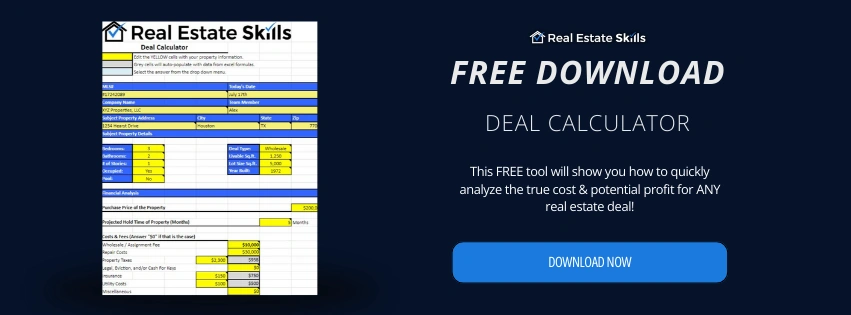
Reverse flipping is a numbers game. If your math is off by even a few percent, your assignment fee disappears. Don't risk your deal on back-of-the-napkin math. Download our **Free Deal Calculator Spreadsheet** to instantly determine your Maximum Allowable Offer (MAO), factor in closing costs, and lock in your profit spread with total confidence before you ever make an offer.
The 14-Day Velocity: A 2026 Case Study
To understand the true power of an "exit-first" model, you have to look past gross assignment fees and focus on the 2026 efficiency metrics. In a market where traditional rehabs are sitting for 45+ days, reverse flipping allows you to cycle capital with zero exposure. Below is a breakdown of a recent suburban deal completed in a mid-velocity market (Jacksonville, NC) following the February 2026 inventory shift.
Investor Note: A traditional flipper might make $40k on this same house, but they would spend 150+ hours managing a 4-month rehab and pay $12k in financing. Their PPH would drop to roughly $180/hr. By reverse flipping, you are out-earning the "pro" flippers on a per-hour basis without any of the liability.
STEP 4: Protecting Your Reverse Flipping Deal Legally
Even with a VIP buyer waiting in the wings, you must never enter a real estate transaction without a shield. Your real estate purchase agreement is not just a formality; it is the mechanism that allows you to profit without taking title and protects you if the deal goes sideways.
There are two critical components you must include in every contract to execute a reverse flip safely:
First, you need an assignment of contract clause. This provision gives you the legal right to sell your interest in the purchase agreement to a third party (your buyer). Without this, you are legally obligated to close on the home yourself. In a reverse flip, you are not selling real estate; you are selling the "paper"—the exclusive right to buy the property at a specific price.
Second, you must have an inspection contingency. This is your escape hatch. If your buyer backs out, or if you discover the foundation is crumbling during the walkthrough, this clause allows you to cancel the contract and get your earnest money deposit back. It gives you a risk-free window (usually 7-14 days) to secure your assignment fee or walk away unharmed.
⚠️ Red Flag Warning: The "No Assignment" Clause
Watch out for this language: Many standard realtor contracts, bank-owned (REO) addendums, and HUD contracts explicitly state that the agreement is "Non-Assignable." If you sign a contract with this language, you cannot flip the paper to your buyer. You will be forced to double close (buy it and resell it immediately), which requires transactional funding and doubles your closing costs. Always ensure your reverse flipping contracts explicitly state "Buyer and/or Assigns."
The 2026 Transparency Standard: Navigating New Disclosure Laws
The rollout of "Act of Disclosure" laws in 2025 impacted some of the most popular states for reverse flipping: California, Tennessee, and Pennsylvania (just to name a few). Following the changes, the bodies that govern laws in these states now view true principals and unlicensed brokers through a new lens. As a result, it's more important than ever to make your contracts entirely transparent; that's the only way you'll really be able to protect your profits.
First, you need a mandatory disclosure of intent. You must explicitly state in writing—ideally as a standalone, un-missable paragraph—that you do not intend to take legal title and are marketing an equitable interest for profit. Under 2026 statutes like CA AB 1850, skipping this "Intent to Assign" can actually make your contract unenforceable if the seller gets cold feet.
You also need to stay on top of the FinCEN "Residential Report" rule that went into effect in March 2026. If your VIP buyer is an LLC or a Trust and the deal is all-cash, a federal report has to be filed within 30 days of closing. While the title agent usually handles the paperwork, you’re the transaction engineer. It’s on you to make sure your buyer provides their Beneficial Ownership Information (BOI), so the deal doesn't stall at the finish line.
One veteran tip: Don't just rely on "and/or assigns" to do the heavy lifting. I recommend adding a specific profit disclosure clause. This confirms the seller knows you might assign the contract for a fee that’s higher than the purchase price. In 2026, this is how you kill "unconscionability" claims before they ever have a chance to start.
Is Reverse Flipping Right For You? Pros & Cons
This strategy is the safest entry point into the game, but I’m not going to pretend it’s a cheat code. It requires a hard pivot in how you view the business: you have to stop acting like a speculator and start operating as a "transaction engineer." You are intentionally choosing to give up the massive upside of a renovation in exchange for speed and guaranteed cash. That is the trade-off. Let’s look at the honest reverse flipping pros and cons so you can decide if that specific balance of risk and reward fits your goals.
Here is an honest breakdown of the trade-offs:
The Pros (Why It Works)
- Ultimate Risk Mitigation: Because you never take title to the property, you are never exposed to market corrections, vandalism, or surprise foundation issues.
- Zero Holding Costs: You do not pay mortgage interest, property taxes, insurance, or utility bills. Your "time on market" is effectively zero.
- High Velocity: You can turn a deal in 14 to 30 days. This allows you to close 5-10 deals in the time it takes a traditional flipper to complete one renovation.
- No Cash Required: Since you are assigning the contract, you do not need a down payment or a credit check.
The Cons (The Trade-Offs)
- Lower Margins: You are taking a "slice" of the equity (a $10k-$30k fee) rather than the whole pie ($50k-$100k profit).
- Relationship Capital: This strategy relies 100% on trust. If you bring a bad deal to a VIP buyer, you can burn that bridge forever.
- Dependency: You are limited by your buyers' criteria. If they stop buying, your business pauses until you find new ones.
- Intense Sales Skills: You must be good at negotiating with sellers and managing buyers simultaneously. It is a people business, not a house business.
FAQ: Common Questions About Reverse Flipping
To help you navigate the nuances of this strategy, we have answered the most common questions investors ask when transitioning from traditional methods to the reverse flipping "exit first" approach.
Final Thoughts: The Ultimate Safety Net
You now have a powerful new weapon in your investing arsenal. While I have built my career on traditional flipping (and it remains a highly profitable strategy when done right), reverse flipping gives you the ultimate safety net. It allows you to pivot when capital is tight or the market feels uncertain.
You have learned how to build a VIP buyer list, use our search methods to find exact matches, and structure contracts that protect your downside. You don’t have to choose just one path; use this "exit first" strategy to diversify your deal flow and guarantee your profits.
Stop Gambling on Rehabs. Start Fulfilling Orders.
Don't buy a property until it's already sold. The "Exit First" strategy is the only way to guarantee your profit margin before you put money at risk. Our FREE Training reveals the exact "reverse flipping" roadmap we use to build VIP buyer lists, secure risk-free contracts, and collect five-figure assignment fees in as little as 14 days—without ever swinging a hammer.
*Disclosure: Real Estate Skills is not a law firm, and the information contained here does not constitute legal advice. You should consult with an attorney before making any legal conclusions. The information presented here is educational in nature. All investments involve risks, and the past performance of an investment, industry, sector, and/or market does not guarantee future returns or results. Investors are responsible for any investment decision they make. Such decisions should be based on an evaluation of their financial situation, investment objectives, risk tolerance, and liquidity needs.

👉FREE Training
How To Consistently Wholesale, Flip Houses, & Invest In Rental Properties From The MLS
(Without Spending $1 On Marketing)

Alex Martinez, the founder of Real Estate Skills, is known for his strong, practical expertise in real estate, starting from a beginner with no family connections in the industry to acquiring over 55 real estate deals, including wholesale and flips, within his first year.
He has dedicated his career to providing cutting-edge education and resources for real estate professionals. He emphasizes the importance of self-taught knowledge through mentors, books, and hands-on experience.
His journey from earning a modest income to becoming a successful real estate entrepreneur and educator showcases his expertise and dedication to the field.

Ryan Zomorodi, co-founder and COO of Real Estate Skills, leverages his experience from a diverse background in real estate investment, construction management, and entrepreneurship to provide comprehensive education in the real estate sector.
His expertise is rooted in hands-on experience, extensive industry knowledge, and a commitment to empowering others through education.
Ryan's journey reflects a blend of practical experience and entrepreneurial success, contributing to his role in developing a platform that educates and supports aspiring real estate professionals.
Read Ryan's Full Bio >>
