
Deal Sauce Review (2026): Pricing, Features & Is It Worth It?
Jul 01, 2026

Written by
Alex Martinez — Founder & CEO, Real Estate Skills. Has wholesaled and flipped houses across the country for over a decade and built the deal-finding systems his team teaches.
Reviewed by
Ryan Zomorodi — Co-Founder & COO, Real Estate Skills. Reviewed and verified the pricing, features, and legitimacy assessment in this guide before publication.
Publication history: Originally published November 5, 2025. Updated June 2026 with corrected two-tier pricing, current founder details, an honest legitimacy assessment, re-verified competitor comparisons, and an expanded "who it's for" verdict. Reviewed and verified by Ryan Zomorodi, Co-Founder & COO of Real Estate Skills.
This Deal Sauce Review breaks down a real estate investing platform built by Jamil Damji and Pace Morby that bundles property data, comps, underwriting, skip tracing, and marketing into one tool. It starts at $97/month with a 14-day free trial. Worth it for active investors doing volume; likely overkill for one or two deals a year.
Here's the short version, up front: Deal Sauce is a legitimate, all-in-one platform with serious, verifiable people behind it — Jamil Damji and Pace Morby — and for an investor running real volume it can replace a stack of separate subscriptions. But there are two catches worth knowing before you sign up: the pricing changed recently, so there's now a $297/month tier most reviews haven't caught up to, and a few of the "is it a scam" claims floating around online are simply out of date.
So let's be straight about what this review is. Most real estate software reviews are written by people getting paid to send you to a signup page. We haven't run our own deals inside Deal Sauce — what we have done is build a real estate investing business (wholesaling, flipping, and rentals across the country), so we know exactly what an investor needs a tool like this to do, and where a $97-a-month subscription earns its keep versus where you're paying for something you could do free. We'll walk through all of it — features, the real current pricing, the honest pros and cons, how it stacks up against PropStream and the others, and who should actually pull the trigger.
Before you spend a dollar on any tool, it helps to know how deals get found and analyzed in the first place — that's the part the software is supposed to speed up, not replace. If you want the foundation, you can grab our free Ultimate Guide to Start Real Estate Investing and follow along.
Software Finds Deals — This Teaches You To Spot The Good Ones
A tool like Deal Sauce can surface hundreds of properties in seconds. But a list of properties isn't a list of deals. The investors who actually make money are the ones who can look at what the software pulls and know which ones have enough room to profit — and which ones just look good on a filter.
That's the skill no subscription teaches you. Before you pay for any platform, learn the fundamentals: how to find genuinely discounted properties, how to run the numbers, and how to tell real equity from a deal that'll cost you money. Our free Ultimate Guide to Start Real Estate Investing walks you through all of it — the foundation any tool is supposed to build on.

What Is Deal Sauce & Who Created It?
Deal Sauce is a cloud-based, all-in-one real estate investing platform that combines nationwide property data, deal filters, comps, underwriting calculators, skip tracing, and marketing in one login. It was created by wholesaler Jamil Damji and creative-finance investor Pace Morby, with investor Justin Tuminowski as a co-founder.
The idea behind Deal Sauce is to stop investors from paying for five separate tools to do one deal. Instead of one app for property data, another for comps, a third for skip tracing, and a fourth for marketing, Deal Sauce puts all of it under a single subscription. The company says you get access to more than 160 million property records and over 50 filters, which is the kind of reach you'd normally cobble together from a couple of paid services.
The names behind it are the reason most people have heard of it. Jamil Damji is a co-host of A&E's Triple Digit Flip, a co-founder of the wholesaling company KeyGlee, and by his own account has done more than 6,000 wholesale and fix-and-flip deals. Pace Morby is the creative-finance half of the show, known for his SubTo community and, by his own count, over $5 billion in deals structured through seller financing and subject-to. There's also a third name that gets left out of most write-ups: Justin Tuminowski, an investor and SubTo educator who's a co-founder and co-owner of the software. Worth knowing, because it tells you the platform is run by people actively in the business, not just two famous faces on a logo.
That founder pedigree matters for one specific reason, and it's the honest version of why "built by real investors" is a selling point: the filters and deal logic are shaped by people who've actually done thousands of deals, so the tool is trying to surface the kinds of properties an experienced investor would look for. The founders have joked that they "uploaded Pace's brain into the software." That's marketing, obviously — but the underlying point is fair. A deal-finding tool is only as good as the criteria built into it, and these are criteria that came from real deals.
Here's what Deal Sauce is actually built to fix:
- Too many subscriptions. One login instead of paying separately for data, comps, skip tracing, and marketing.
- Scattered data. Nationwide property records, ownership info, and comps in one place instead of three tabs.
- Slow analysis. Built-in calculators do the math so you can make offers faster.
- Manual outreach. Skip tracing and marketing live inside the pipeline instead of in a separate app you export CSVs to.
Whether that bundle is worth the price depends entirely on how much you'd actually use — and that's the question the rest of this review answers, starting with what's really inside it.
Read Also: The Ultimate Guide To Real Estate Investing
Deal Sauce Key Features & Tools
Deal Sauce's core features are nationwide property search with 50+ filters, built-in comps and underwriting, strategy filters by deal type, and an integrated skip tracing and marketing suite. Its private-money and cash-buyer database sits in the higher-priced HOT plan, not the entry tier.
Deal Sauce isn't a single-purpose data tool — it's trying to be the whole workflow. Below is what each part actually does, where it's genuinely useful, and one honest note up front: a couple of the features people assume come standard are actually gated to the more expensive plan. We'll flag those as we go.
Nationwide Property Search & Smart Filters
You get access to more than 160 million property records nationwide, searchable by city, zip, or whole state, with over 50 filters — equity, ownership length, property type, and distress signals among them. The point is to turn a giant database into a short list of motivated-seller leads instead of scrolling listings.
This is the feature most worth understanding clearly, because it's also the one you can partly replicate for free. Our founder Alex finds discounted, distressed properties in any market using nothing but free Redfin filters — sorting by price per square foot, using the fixer-upper filter, and running keyword searches like "cash," "investor," or "TLC" to surface motivated listings. So the honest framing isn't "Deal Sauce can find deals and free tools can't." It's that Deal Sauce does it at scale and nationwide in one place — pulling off-market and ownership data a public listing site won't show you, across every market at once, instead of one city at a time on Redfin. If you work one market and do a couple deals a year, free tools may genuinely be enough. If you're hunting across markets and need volume, that's what you're paying to consolidate.
Built-In Underwriting & Comps
Deal Sauce runs comps and underwriting inside the platform — one-click comps, an ARV (after-repair value) estimate, and rough rehab numbers — plus a simple pipeline that doubles as a CRM. For a newer investor staring at a blank spreadsheet, having the math built in lowers the intimidation factor a lot.
One important caveat, and it's the difference between a good review and a sales pitch: a tool's automated comps are a starting point, not gospel. Any software — Deal Sauce, Zillow, anything — can spit out an ARV that's confidently wrong, because it doesn't know that the comp two streets over backs onto a freeway or sold furnished. You still have to know what a good comp looks like to sanity-check the number the software hands you. Our COO, Ryan Zomorodi, walks through exactly how to do that — pulling and filtering comps the way an appraiser would — in the video below. Use Deal Sauce's comps to move fast; use your own judgment to make sure the fast number is the right one.
How To Find Real Estate Comps For Wholesaling (FAST & FREE)!
Ryan Zomorodi walks through how to find real estate comps and determine the market value of any property — the skill you need to sanity-check what any software's comps tool gives you.

Don't Trust A Comp You Can't Check
Deal Sauce hands you a comp and an ARV in one click — but a number is only as good as the comps behind it. Before you trust any software's valuation, you need to know what makes a comp good or garbage. Download our free Comp Criteria Cheatsheet — the same criteria our team uses to value every deal — so you can sanity-check what any tool spits out and never overpay on a bad number.

Private Money & Cash Buyer Tools HOT TIER — $297/mo
Deal Sauce offers a database of pre-vetted cash buyers, lenders, landlords, and note holders, so you can line up funding or an exit without cold outreach, and run quick double-close scenarios. Useful — but here's the thing most reviews get wrong now: this lives in the $297/month HOT plan, not the $97 entry tier. So if the cash-buyer database is the reason you're signing up, know you're looking at the higher price.
And it's worth asking what that buys you, because finding cash buyers is something we teach investors to do for free. The method is simple: search the keywords a motivated seller would type — "we buy houses [your city]," "sell my house fast [your city]" — and the local cash-buying companies who paid to rank for those terms come right up. Check their "About" page, confirm they're an established local buyer doing real volume, and call them. Five minutes, no software, no skip tracing. A good cash-buyer relationship is about quality, not a list of a thousand names — three to five active local buyers can take everything you find for years. So the HOT tier's database isn't worthless; it's convenience and pre-vetting. Whether that convenience is worth $200 a month more than sourcing your own buyers depends on how much you value the time.
Strategy Filters By Deal Type
You can filter searches by exit strategy — subto/creative finance, fix-and-flip, or buy-and-hold — so you only see properties that fit how you actually make money. For an investor with a defined model, this is a real time-saver: it keeps you from analyzing deals that were never going to work for your strategy in the first place.
Marketing & Skip Tracing Suite
Skip tracing is built in — pull phone numbers, emails, and mailing addresses for owners directly from the property data — and you can launch outreach (direct mail, SMS, follow-up) inside the platform without exporting anything. For an investor who markets to sellers at volume, keeping tracing and outreach in one system instead of stitching together two or three tools is a legitimate convenience. Note that unlimited skip tracing is a HOT-tier feature; the entry plan includes it, but with limits.
Reports & Dashboards
Deal Sauce includes pro formas, CMA templates, and real-time ROI dashboards so you can visualize a deal's numbers and compare strategies side by side. For visual thinkers, this is friendlier than a spreadsheet, and it makes presenting a deal to a partner or lender look professional.
Deal Sauce AI
The platform now includes an AI feature (branded "Deal Sauce AI") alongside its training library — a current addition that wasn't part of the original lineup. We're flagging it as present rather than assessing it, since we haven't tested it; what's confirmable is that it's a live, listed feature on the current plans.
Here's how the core features stack up at a glance — including which tier each one lives on.
| Feature | What It Does | Tier |
|---|---|---|
| Nationwide Property Search | Search 160M+ property records with 50+ smart filters to find motivated sellers. | MILD |
| Underwriting & Comps | One-click comps, ARV estimates, and rehab numbers inside the platform. | MILD |
| Skip Tracing & Marketing | Find owner contact info and launch direct-to-seller campaigns in-platform. | MILD (limited) — unlimited on HOT |
| Strategy Filters | Filter searches by exit — subto, fix-and-flip, buy-and-hold. | MILD |
| Reports & Dashboards | Pro formas, CMAs, and real-time ROI dashboards. | MILD |
| Deal Sauce AI | Built-in AI feature alongside the training library. | MILD |
| Cash Buyer & Lender Database | Pre-vetted cash buyers, landlords, lenders, and note holders. | HOT — $297/mo |
Put together, the pitch is real: this genuinely is a lot of workflow under one login. The fair-minded catch is that the headline price covers the MILD tier, and a few of the features people most want — the cash-buyer database, unlimited skip tracing — sit a tier up. Which makes the pricing the next thing to get straight.
Deal Sauce Pricing, Plans & Free Trial
Deal Sauce costs $97/month (or $78/month billed annually) for the entry MILD plan, and $297/month ($238/month annually) for the HOT plan, which adds the cash-buyer and lender database plus unlimited skip tracing. There's a 14-day free trial and no cancellation fees on either plan.
The pricing is where most existing Deal Sauce reviews are out of date, including, until this update, ours. The platform used to read as one plan billed two ways. It's now two real tiers, and the difference between them is exactly the features investors care about most.
| Plan | Monthly | Annual | What You Get |
|---|---|---|---|
| MILD | $97/mo | $78/mo | 160M+ records, 50+ filters, deal alerts, heat map, comp calculator, skip tracing & marketing, training, Deal Sauce AI. |
| HOT | $297/mo | $238/mo | Everything in MILD, plus the cash-buyer, lender, landlord, flipper & note-holder database and unlimited skip tracing. |
| Third tier | — | — | Listed as "coming soon," with no pricing published yet. |
MILD — $97/month, or $78/month billed annually. This is the entry plan and the price you see advertised. It includes the core that makes Deal Sauce useful: 160M+ property records, 50+ filters, real-time deal alerts, the market heat map, the comp calculator and analysis wizard, the skip tracing and marketing suite, the training library, and Deal Sauce AI. For most investors evaluating the tool, this is the plan you're actually deciding on.
HOT — $297/month, or $238/month billed annually. This is everything in MILD plus the pieces that got moved up: the cash-buyer, landlord, flipper, private-lender, and note-holder database, and unlimited skip tracing. If the buyers-and-funding database is the reason Deal Sauce is on your radar, this is the real price of entry — three times the headline number, and worth knowing before you start a trial expecting it on the cheaper plan. There's also a third tier listed as "coming soon," with no pricing published yet.
The good news on both plans is that there's a genuine 14-day free trial with no credit card games and no cancellation fees — confirmed on the official pricing page. That matters more here than with most software, because the honest way to evaluate Deal Sauce is to run it against your own market: pull comps on a few properties you actually know, see whether the data is accurate where you invest, and test whether the leads match what you'd find yourself. Two weeks is enough to answer that for free before any money changes hands.
One thing the pricing page leans on is the "replace five subscriptions" math, and it's a fair point worth checking against your own setup. If you're currently paying separately for property data, a dialer, and a CRM and it's running you well over $100–$200 a month, consolidating into one MILD subscription can genuinely come out ahead. If you're not paying for much of that today — because you're using free tools and doing low volume — then "it replaces five subscriptions" isn't really a saving, because you weren't spending the five. Whether the price is a deal depends on what you're replacing.
Deal Sauce Pros & Cons
Deal Sauce's main strengths are its all-in-one workflow, credible founders, and built-in automation that saves real time per deal. Its main drawbacks are a single-family focus, a steep jump to the $297 tier for cash-buyer tools, no mobile app, and a learning curve for beginners.
Here's the honest ledger. We're assessing Deal Sauce as researchers who know the investing workflow, not as daily users of the software — so these are weighed against what an investor genuinely needs a tool like this to do, and against what public reviews and the platform's own materials show. The pros are real. So are the trade-offs.
| Pros | Cons |
|---|---|
| One platform instead of five — search, comps, underwriting, skip tracing, and marketing in one login. | Single-family focused; multi-family needs manual inputs and commercial needs other tools. |
| Automation saves real hours per deal — built-in comps and calculators mean faster offers. | The cash-buyer database and unlimited skip tracing are $297 HOT-tier, not the $97 headline price. |
| Credible, public, verifiable founders (Jamil Damji & Pace Morby) in a category full of faceless tools. | No mobile app — browser-only, so it's not built for driving for dollars in the field. |
| Strong support — live human chat and a built-in training library make it approachable. | A learning curve — a feature-dense dashboard can feel like a lot at first. |
| Nationwide reach — 160M+ records across every market for virtual and multi-market investors. | Company WHOIS ownership is hidden (though the founders themselves are very public). |
📍 On The "Is It Safe" Question
You'll see other reviews cite a single glowing "trust score" as proof Deal Sauce is safe. We're not going to, because those numbers move and they don't agree with each other — depending on which checker you look at, Deal Sauce scores anywhere from middling to good, and at least one major one recently reset to no score at all. A cherry-picked number isn't evidence. The honest read is in the next section, where we go through the actual safety signals — SSL, payment protections, founder verification, and the third-party scores in full — rather than leaning on one figure.
The short version: Deal Sauce is a strong, legitimate tool whose value scales with how much you use it. Heavy, multi-market, single-family-focused investors get the most out of it. Casual or commercial investors will feel the focus and the price more than the benefit.
Is Deal Sauce Legit & Safe?
Yes, Deal Sauce appears legitimate and safe. The site uses valid SSL encryption, offers standard payment protections and no-hassle cancellation, and its founders are public, verifiable real estate investors. Third-party trust scores vary, so do your own due diligence, but there are no credible signs it's a scam.
Whenever real estate software gets popular, the "is it a scam?" searches follow, and Deal Sauce is no exception. The honest answer is that the evidence points to legitimate — but we're going to show you the actual signals rather than wave one number at you, because the way most reviews answer this question is part of the problem.
Here's what genuinely supports it being safe:
- Valid SSL encryption. The site uses a valid SSL certificate, so anything you enter is encrypted in transit.
- Standard payment protections. It takes normal credit and debit cards, which come with their own fraud protection and dispute mechanisms, and there are no cancellation fees — you're not locked in.
- Real, public founders. This is the strongest signal. Plenty of software companies hide behind a brand; Deal Sauce was built by Jamil Damji and Pace Morby, two of the most visible people in real estate investing, with verifiable track records and a national TV show. You can tie the product to real, named people.
- Live human support. A real support team you can chat with, plus a training library — not how scam operations tend to invest their time.
And here's the honest caveat, the thing other reviews skip:
- The website's ownership is hidden in WHOIS. Taken alone that can look like a red flag, but it's an extremely common privacy precaution, and here it's outweighed by how public the founders are. The brand traces to real people even though the domain registration doesn't.
- Third-party "trust scores" don't agree, and they move. You'll see reviews quote a single high score as proof. We won't, because it isn't stable proof. As of this update, the automated scanners genuinely disagree with each other — one rates Deal Sauce as doubtful/medium-risk, another as mostly positive, and a third recently reset to no score at all. These tools largely judge domain age, traffic, and hosting, not whether a company delivers — which is why a legitimate business can score low and a polished scam can score high. Treat any single score as one weak data point, not a verdict.
| Factor | Details | Assessment |
|---|---|---|
| SSL Encryption | Valid SSL certificate secures data between you and the site. | Secure ✅ |
| Founders | Public, verifiable investors (Jamil Damji & Pace Morby). | Strong ✅ |
| Payment & Cancellation | Standard card protections; no cancellation fees. | Positive ✅ |
| Owner Transparency | WHOIS ownership hidden, but founders are public figures. | Neutral ⚠️ |
| Third-Party Trust Scores | Vary by source, from middling to good; one recently reset. See note above. | Mixed ⚠️ |
So the responsible read is this: Deal Sauce shows the markers of a legitimate company — encryption, payment protections, verifiable human founders, real support — and no credible evidence of fraud. That's not the same as a guarantee, and it isn't financial advice. Before you put in a card on any platform, do the basic things: confirm you're on the official site, use a payment method with dispute protection, and start with the free trial so you're testing it before you're paying for it.
How Deal Sauce Compares To Alternatives
Deal Sauce competes by bundling data, comps, skip tracing, and marketing in one tool, where rivals specialize. PropStream leads on data depth, DealMachine on mobile driving-for-dollars, and REsimpli on CRM. Deal Sauce's edge is consolidation; its main gaps versus these are no mobile app and a single-family focus.
Most tools in this category are good at one or two things and expect you to bolt on the rest. PropStream is a data powerhouse. DealMachine is built for driving for dollars from your phone. REsimpli is a CRM. Deal Sauce's whole pitch is that you don't run three subscriptions — you run one. That's the lens to compare them through: you're weighing depth-in-one-area against everything-in-one-place.
| Platform | Core Strength | Main Weakness | Pricing |
|---|---|---|---|
| Deal Sauce | All-in-one: data, comps, underwriting, skip tracing, marketing, cash-buyer database (HOT). | Browser-only, no app; single-family focus. | $97/mo MILD, $297/mo HOT (14-day trial) |
| PropStream | Deep nationwide data, strong list-building filters, and a driving-for-dollars mobile app. | Thinner CRM; skip tracing and some marketing are paid add-ons. | $99/mo base (add-ons extra) |
| DealMachine | Best-in-class driving for dollars, mobile-first, unlimited skip tracing on its plans. | Narrower if you're not driving for deals; dialer/mail are usage-priced. | $119/mo Starter (~$99/mo annual) |
| REsimpli | Strong all-in-one CRM with calling, list building, and marketing for follow-up-heavy investors. | CRM-first, so property data and comps lean on integrations. | Tiered & recently restructured — check current pricing |
A few honest observations from comparing them. First, the "one price replaces five tools" claim cuts both ways: PropStream and DealMachine both look cheaper at the base, but their real cost rises with add-ons and usage (skip tracing, mail, extra seats), so a $97 all-in MILD plan can come out even or ahead once you'd have stacked those. Worth doing your own math on what you'd actually use.
Second, the clearest place Deal Sauce loses is mobility. There's no mobile app — it's browser-only. If your acquisition strategy is driving neighborhoods and pulling owner info from the curb, DealMachine is purpose-built for that and Deal Sauce isn't. If you work from a desk or run deals virtually across markets, that gap won't matter to you.
Third — and this is the fair bottom line — none of these is objectively "best." Deal Sauce is the strongest fit if you want one consolidated, single-family-focused workflow and you'll use the whole thing. PropStream wins on pure data depth. DealMachine wins in the field. REsimpli wins on CRM and follow-up. Match the tool to how you actually find and work deals, not to the longest feature list.
Who Should Use Deal Sauce?
Deal Sauce fits active, single-family-focused investors doing real volume across one or more markets who want one consolidated workflow. It's likely not worth it for investors doing one or two deals a year, those comfortable with free tools, or anyone focused on multi-family or commercial — where the focus and price outweigh the benefit.
The fair way to answer "should I use Deal Sauce" isn't a yes or no — it's "it depends on how you work." Here's the honest breakdown, including the case for not paying for it, which most reviews skip because they're paid to send you to checkout.
Who Genuinely Benefits
- Active single-family investors doing volume. This is the core fit. If you're analyzing properties most days and the consolidation saves you time, the subscription pays for itself in hours back.
- Multi-market and virtual investors. Nationwide records in one place is a real advantage if you work outside your own backyard.
- Investors who hate juggling tools. If you're paying for data, a dialer, and a CRM separately and the tab-switching is killing you, one login is worth something on its own.
- Newer investors who want the math built in. The calculators and comps lower the intimidation factor — just go in knowing the number the software gives you is a starting point, not the answer.
When It's Honestly Not Worth It
This is the part worth being straight about, because we teach the free version of a lot of what Deal Sauce charges for.
- You're doing one or two deals a year. At $97/month, a casual investor pays over $1,100 a year for a tool they'll open occasionally. Our founder finds discounted, distressed properties in any market using free Redfin filters — sorting by price per square foot, the fixer-upper filter, and keyword searches like "cash" or "TLC." If that's your pace, free tools likely cover you.
- You're mainly after a cash-buyer list. The buyer database is the $297 HOT tier, and finding quality local cash buyers is genuinely free: search "we buy houses [your city]" or "sell my house fast [your city]," and the established local buyers who paid to rank come right up. Three to five solid local buyers can take everything you find for years.
- You focus on multi-family or commercial. The data and tools are built for single-family. You can force small multi-family through manual inputs, but larger or commercial deals need purpose-built tools.
- You want to work from your phone in the field. No mobile app. If driving for dollars is your strategy, this isn't your tool.
Found A Cash Buyer? Now Don't Sound Like A Newbie.
You don't need a $297/month database to build a cash-buyer list — but once you've found one, one wrong word can make a serious investor hang up. Download our free Cash Buyer Script to sound like a pro from the first hello, uncover their exact buy box, and lock in relationships that pay you for years.

The Honest Middle Ground
None of that means Deal Sauce is a rip-off. It means you're paying for consolidation and speed, not for capability you couldn't otherwise get. The free methods work — they just take more of your time and live in more places. What a subscription buys is having it in one system, faster, at scale. For a busy investor doing real volume, that time is worth real money. For a casual one, it isn't yet. That's the whole decision.
And here's the thing the software can't do for you either way: finding a deal isn't the same as making money on it. The money is in analyzing it correctly — and an automated comp or ARV is only as good as the judgment you bring to checking it. The investors who win with a tool like this are the ones who already know how to evaluate a deal and use the software to go faster. The ones who expect the tool to think for them are the ones who overpay for properties a filter told them were good.
The Software Finds It. This Tells You If It's Actually A Deal.
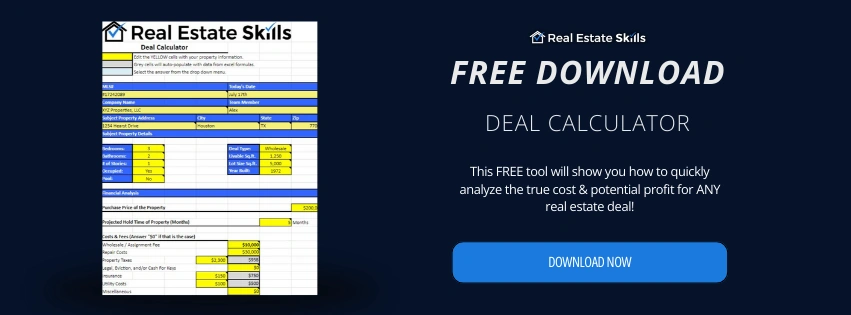
A filter can flag a property in seconds. It can't tell you your Maximum Allowable Offer, factor your rehab and closing costs, or protect your spread. That part is on you — and getting it wrong is how investors overpay on deals a tool told them were good. Download our free Deal Calculator and run the numbers like a pro before you ever make an offer.
- Deal Sauce is probably worth it if…
-
- You want to stop paying for and juggling multiple separate tools.
- You work single-family, wholesale, or creative deals at real volume.
- You're scaling your deal flow over the next 6–12 months.
- You'll actually use the comps, calculators, and marketing — not just the property search.
If you nodded at most of those, the trial is worth your two weeks. If you didn't, your money's better spent elsewhere for now.
Deal Sauce Review: Final Verdict
Deal Sauce is a legitimate, capable all-in-one platform that's worth it for active single-family investors who'll use the full toolkit and value consolidation over juggling separate tools. At $97/month (or $297 for cash-buyer tools), it's hard to justify for casual, multi-family, or free-tool-comfortable investors. Try the 14-day trial first.
After working through the features, the real pricing, the legitimacy signals, and how it stacks up against the alternatives, the verdict is straightforward: Deal Sauce does what it claims. It's a real all-in-one platform, built by credible and verifiable investors, that can replace a stack of separate subscriptions for someone running real volume. The 160M+ records, the built-in comps and calculators, and the integrated marketing are genuinely useful when you actually use them.
The honest caveats are the ones we've flagged throughout. The headline $97 covers the MILD tier; the cash-buyer database and unlimited skip tracing live in the $297 HOT tier, so price it for the features you actually want. It's single-family focused. There's no mobile app. And a lot of what it does — finding distressed deals, sourcing local cash buyers — you can do for free with more time and more tabs. So the tool isn't selling you capability you can't get elsewhere. It's selling you speed and consolidation, and whether that's worth the monthly cost comes down entirely to your volume.
So here's the bottom line. If you're an active, single-family-focused investor who'll use the whole platform and you're tired of stitching tools together, Deal Sauce is a strong, fair-value choice, and the 14-day free trial is the right way to confirm it on your own market before you pay. Pull comps on properties you actually know, check whether the data holds up where you invest, and see if the leads beat what you'd find yourself. If you're doing a couple deals a year, you focus on multi-family or commercial, or you're comfortable with free tools, your money is better spent elsewhere for now. For how it compares head-to-head with PropStream, DealMachine, and REsimpli, see the comparison above.
And whatever tool you land on, remember the part no software does for you: the tool finds and speeds up deals, but your judgment is what turns a deal into a profit. The investors who win with platforms like this already know how to evaluate a property and use the software to move faster. That's the real skill — and it's worth building before, or alongside, any subscription.
Deal Sauce Review FAQs
Quick answers to the most common questions about Deal Sauce — pricing, the free trial, legitimacy, and how it works.
Final Thoughts on Deal Sauce
Deal Sauce earns its reputation: a real, all-in-one platform from people who've genuinely done the deals, and a fair-value pick for an active investor who'll use the whole thing. Just buy it for what it actually is — a way to do faster and in one place what a disciplined investor can already do across free tools — and price it for the tier with the features you want, not the headline number.
The tool finds and speeds up deals. It doesn't make them good. That part is still on you, and it's the most valuable skill in this business — worth building whether or not you ever pay for software. Start with the free trial, test it on a market you know, and let your own numbers make the call.
Most People Compare Software Forever And Never Close A Deal.
The ones who win already know how to find a property, run the numbers, and turn it into a check — the part no subscription teaches you. Our FREE Training walks you through exactly how to find deals, analyze them, and build real income, with nothing to buy. Watch it today, then put any tool you choose to real work.
Watch The FREE Training →
About The Author
Founder & CEO, Real Estate Skills
Alex Martinez is the Founder and CEO of Real Estate Skills. With more than a decade of investing experience and properties acquired across multiple states, he has personally wholesaled and flipped houses around the country and built and tested the deal-finding and analysis systems his team teaches. Through Real Estate Skills, Alex and his team have helped thousands of students learn how to find deals, evaluate the right tools, and close profitable real estate transactions.
Real Estate Skills is not a law firm, and the information in this article is provided for educational purposes only — it does not constitute legal, tax, or financial advice. Software features, pricing, and plan inclusions change over time; always confirm current details on the official Deal Sauce website. All investments carry risk, and past results do not guarantee future outcomes. Real Estate Skills has not been compensated by Deal Sauce for this review, and is not affiliated with the product. Always do your own due diligence before purchasing any software or entering into any transaction.

👉FREE Training
How To Consistently Wholesale, Flip Houses, & Invest In Rental Properties From The MLS
(Without Spending $1 On Marketing)

Alex Martinez, the founder of Real Estate Skills, is known for his strong, practical expertise in real estate, starting from a beginner with no family connections in the industry to acquiring over 55 real estate deals, including wholesale and flips, within his first year.
He has dedicated his career to providing cutting-edge education and resources for real estate professionals. He emphasizes the importance of self-taught knowledge through mentors, books, and hands-on experience.
His journey from earning a modest income to becoming a successful real estate entrepreneur and educator showcases his expertise and dedication to the field.

Ryan Zomorodi, co-founder and COO of Real Estate Skills, leverages his experience from a diverse background in real estate investment, construction management, and entrepreneurship to provide comprehensive education in the real estate sector.
His expertise is rooted in hands-on experience, extensive industry knowledge, and a commitment to empowering others through education.
Ryan's journey reflects a blend of practical experience and entrepreneurial success, contributing to his role in developing a platform that educates and supports aspiring real estate professionals.
Read Ryan's Full Bio >>
