
How To Invest In Real Estate PDF: Free Guides, Templates & Calculators
Aug 21, 2026

Written by
Alex Martinez — Founder & CEO, Real Estate Skills. Has wholesaled and flipped houses for over 14 years, been part of 1,000+ real estate transactions, and personally acquired 33+ residential investment properties. Has trained 6,000+ investors nationwide.
Reviewed by
Ryan Zomorodi — Co-Founder & COO, Real Estate Skills. Reviewed the resource descriptions, contract details, and deal workflow in this guide before publication.
Publication history: Originally published March 31, 2025. Updated August 2026 with a full resource catalog covering 11 free downloads, contents disclosure for each, a routing guide by situation, a deal workflow, and new schema. Reviewed by Ryan Zomorodi, Co-Founder & COO of Real Estate Skills.
The best how to invest in real estate PDF here is The Ultimate Guide To Start Real Estate Investing — one of 11 free downloads on this page, alongside two deal calculators, attorney-drafted wholesale contracts, a scope of work template, a state-by-state wholesaling legality guide, and four call scripts.
Most people hunting for a real estate investing PDF have already done plenty of reading. They've watched the videos, saved the threads, maybe finished a book or two. What they don't have is a single thing they can put on the desk and use against a real address.
That's the gap these fill. A guide can explain what a maximum allowable offer is. A calculator tells you what to offer on the house you're looking at tonight. One is education. The other is a tool, and tools are what actually move a deal forward.
Everything below is free and everything below is described honestly — what's in it, who it's for, and when you'd reach for it. Some of these you'll use on your first deal. Some you won't touch for a year. Take what fits where you are right now, and come back for the rest.
What Real Estate Investing PDFs Can You Download For Free?
Eleven free downloads: a beginner's guide to getting started, two calculators for analyzing deals, attorney-drafted wholesale contracts, a scope of work template for rehabs, a state-by-state legality guide, and four scripts for talking to sellers, agents, and cash buyers.
They're grouped by the job they do. The first is where to start if you're new. The next three are for running numbers. Then the paperwork. Then the scripts, for the conversations that make or break a deal.
You don't need all eleven. Most people need two or three, and the ones you need depend entirely on where you are — which is what the descriptions below are for.
The Ultimate Guide To Start Real Estate Investing
A beginner's roadmap covering how to identify properties worth buying and how to get started correctly. If you're looking for one PDF that explains real estate investing from the beginning, this is the one to take first.
This is the starting point, and it's the one to grab if you only take one thing from this page.
Most beginners get stuck in the wrong place. They read about tax structures and entity setup before they've found a single property worth buying — which is backwards, because there's nothing to protect until there's a deal. Finding properties with enough margin in them to cover a rehab, a lender, and a profit is the skill everything else depends on.
That's what this guide is built around: identifying properties worth pursuing, and getting started without the detours that stall people for months.
Who it's for: Anyone at the beginning. If you've been reading about investing but haven't looked seriously at a specific property yet, start here and come back for the tools once you have one in front of you.
Start With The Fundamentals, Not The Fine Print
Entity structures and tax strategy matter eventually. They don't matter yet. What matters first is being able to look at a property and know whether there's enough room in it to make money — because everything else in this business is downstream of that one skill. This guide covers how to find properties worth buying and how to get started without the detours that keep beginners stuck for a year. Download it free.
Free Real Estate Deal Calculator
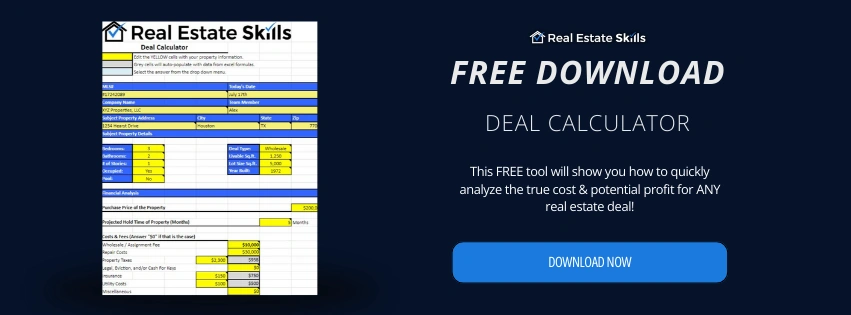
A spreadsheet that works backward from resale value to tell you what to offer. You enter the after-repair value, repair costs, your target assignment fee, plus taxes, insurance, and utilities — and it returns the maximum you can pay and still make money.
This is the tool that decides whether a deal is a deal.
Most beginners price offers with the 70% rule: take the after-repair value, multiply by 70%, subtract repairs, subtract your fee. It's fast and it's directionally fine, but it's a blunt instrument — and on a competitive property, blunt loses.
📓 From The Field
Alex ran the same property both ways on a recent example. ARV of $600,000, $60,000 in repairs, targeting a $10,000 assignment fee. The 70% rule capped the offer at $350,000. Running it through the deal calculator — with taxes, insurance, and holding costs entered, and knowing what his cash buyers actually accept — the number came out at $445,000. Same house, same target fee, $95,000 more room to bid. That's the difference between winning a property and watching someone else take it. Individual deals vary; this is one worked example, not a typical result.
What's in it: Input fields for after-repair value, repair costs, purchase price, your desired assignment fee, property taxes, insurance, and utility costs. It returns your maximum allowable offer.
Who it's for: Wholesalers and flippers pricing an offer. If you're buying to hold, use the rental calculator below instead.
Format: Spreadsheet, not a PDF — it does the math for you.
Know Your Number Before You Pick Up The Phone
Rules of thumb are fine until you're bidding against someone who's done the real math. Enter the resale value, the repair estimate, and the fee you're after — the spreadsheet returns the most you can pay and still get paid. Free download.
Free Rental Property Calculator
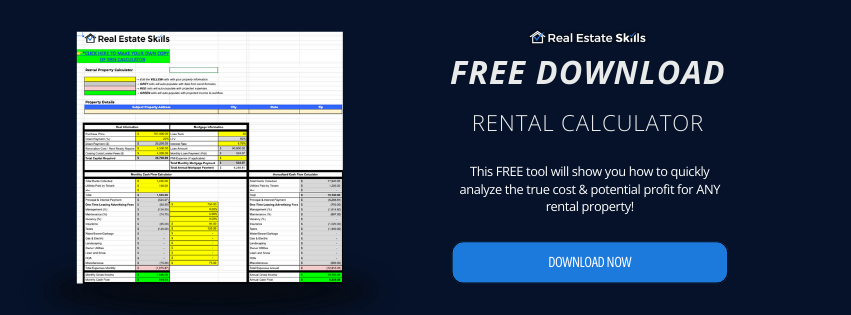
A spreadsheet for underwriting a buy-and-hold. Enter purchase price, down payment, interest rate, projected rent, and your expense assumptions — it returns monthly and annual cash flow, plus your cash-on-cash return.
Different job from the deal calculator entirely. That one asks what you should offer. This one asks what you'd earn if you kept it.
The expense side is where beginners get burned. Rent minus mortgage looks like profit until you add property taxes, insurance, management, vacancy, maintenance, capital expenditures, utilities, and HOA fees. Leave two of those out and a property that looked like it cleared several hundred a month is actually costing you.
The adjustable inputs are the point. Down payment, interest rate, reserve amounts, and the percentage you allocate to each expense category can all be moved, so you can run a conservative case against an optimistic one instead of trusting a single number. As one of our team puts it: the only reliable thing about a projection is that it'll be wrong. Running scenarios is how you find out how wrong you can afford to be.
Who it's for: Anyone analyzing a rental before making an offer. If you're working toward your first one, our guide on buying your first rental property walks through the whole process.
Format: Spreadsheet.
Find Out What It Actually Cash Flows
Rent minus mortgage isn't cash flow. Taxes, insurance, management, vacancy, maintenance, and reserves all come out first, and missing any of them turns a good-looking rental into a monthly bill. Enter your numbers, adjust the assumptions, and see the real figure before you commit. Free download.
Comp Criteria Cheatsheet
A one-page reference listing the seven criteria that make a comparable sale usable: property type, sold status, condition, recency, distance, size, and bed/bath match. Pulling accurate comps is how you get an after-repair value you can trust.
Every number in both calculators depends on the after-repair value, and the after-repair value depends entirely on your comps. Get the comps wrong and everything downstream is wrong with them.
The criteria are strict on purpose. Same property type — houses to houses, not a house against a duplex. Sold, not listed. Renovated condition, since you're pricing the property after work is done. Sold within six months, because markets move. Within a half mile. Same city and ZIP. Within 20% of the square footage. Matching bed and bath count.
Miss one of those and you'll talk yourself into a value the market won't support.
What's in it: All seven criteria with the specific thresholds, on one page you can keep open while you're pulling comps.
Who it's for: Anyone estimating after-repair value — wholesalers, flippers, or buy-and-hold investors checking they're not overpaying.
Bad Comps, Bad Deal
Every offer you make traces back to what the property is worth fixed up, and that number is only as good as the sales you compared it to. Seven criteria, one page, no guesswork. Keep it open next to Redfin. Free download.
Wholesale Real Estate Contract Templates
Two attorney-drafted documents: an investor-friendly Purchase & Sale Agreement running 30 numbered sections, and a one-page Assignment Addendum that transfers your position to a cash buyer for a fee. Print them and fill them in, or complete them digitally.
A wholesale deal runs on two pieces of paper. The purchase agreement locks the property up so the seller can't sell it out from under you and gives the title company something to open escrow on. The assignment addendum is how you get paid.
What makes these wholesaler-friendly rather than generic comes down to four things built into the purchase agreement. The buyer line includes "and/or assigns" language, so there's no ambiguity about your right to assign. There's an inspection contingency, which is the window that protects your deposit while you find a buyer. There's a liquidated damages clause, which caps your downside at the earnest money rather than leaving it open-ended. And there's a marketing clause — the seller acknowledges in writing that you may market the property and your contractual interest before closing, which is the thing wholesalers actually do and most contracts never address.
📓 From The Field
Ryan makes a point of running assignment fees through escrow rather than collecting outside it. The fee shows up as a line item on the settlement statement, and when you're new, that paper trail is worth more than it looks. A stack of settlement statements is how you prove to a private lender or a partner that you close deals instead of just talking about them. Saying you wholesale and showing it are different conversations.
What's in it: The Purchase & Sale Agreement covers parties, property, what conveys, purchase price and deposit structure, financing, inspection, closing and title company, deed and title, prorations, buyer default, risk of loss, disclosures, marketing rights, and signatures. The Assignment Addendum covers assignor and assignee, the underlying agreement, your assignment fee, an optional non-refundable deposit, the closing date, and your right to reassign if the buyer doesn't perform.
Who it's for: Wholesalers working directly with sellers. On a listed property the agent usually supplies the contract; when you're buying direct, this is what you use. If you want to understand what each clause in these contracts actually does, we walk through both documents line by line.
These are educational templates, not legal advice. Contract requirements vary by state — have a licensed real estate attorney in your market review anything before you sign it.
The Two Documents A Wholesale Deal Runs On
Without a signed purchase agreement you don't control the property — the seller can take a better offer tomorrow. Without an assignment contract you have no clean way to get paid. These are attorney-drafted and built for wholesaling: assignable, with an inspection contingency, capped liability, and written permission to market your interest before closing. Free download.

Scope Of Work Template
A template for itemizing every repair a property needs, line by line, so you can put a price on each one. Hand it to contractors for accurate bids instead of ballpark guesses, and use the total to negotiate the purchase price.
A rehab number pulled from a square-footage rule of thumb is fine for a first pass. It's not something to buy a house on.
The itemized version does two things a lump-sum estimate can't. It lets you bid line items separately — if a house needs rewiring, you can put that single item in front of three electricians and let them compete, rather than accepting whatever one general contractor quotes for everything. And it gives you documented numbers to negotiate with.
That second part is where it earns its keep. Stan on our team makes the point that a repair estimate priced by a licensed contractor is hard for a seller or agent to argue with. An investor's own estimate is easy to dismiss as self-serving — of course the buyer says it needs $80,000 of work. A contractor's itemized bid is a different conversation entirely.
One number worth building in: contingency. A minimum of 10% on a small renovation, and up to 25% on a full down-to-the-studs rehab. Something always turns up behind a wall.
Who it's for: Anyone rehabbing a property, and wholesalers who want a defensible repair number to negotiate with.
One Missed Repair Item Is The Whole Margin
Guess the rehab and you'll find out what you missed after you own it. Itemize every repair, get real prices against each line, and walk into the negotiation with numbers a seller can't wave off. Free download.
How To Wholesale Real Estate & Legalities Guide
A state-by-state PDF covering how to wholesale legally where you are — licensing requirements, assignment rules, and disclosure obligations. Wholesaling is legal in all 50 states, but several regulate how you do it.
No state bans wholesaling. Several regulate it, and the rules have moved in the last two years — mostly around disclosure and how you're allowed to market a property you don't own yet.
That's the gap this fills. Knowing wholesaling is legal isn't the same as knowing what your state requires you to disclose, or whether marketing before closing is restricted where you operate.
Who it's for: Anyone wholesaling in a state they haven't worked in before, and anyone who's been operating on the assumption that the rules are the same everywhere.
State wholesaling requirements change. Confirm current rules with a licensed real estate attorney in your market.
Know Your State's Rules Before You Sign
Wholesaling is legal everywhere. How you're allowed to do it isn't the same everywhere, and the requirements have shifted recently in several states. Check yours before your first deal there, not after. Free download.
Four scripts for the four conversations a deal runs through: finding buyers, qualifying them, talking to listing agents, and calling owners directly. Take the one that matches the call you're about to make.
The Google Ninja Trick — Find Cash Buyers For Free
A search technique for finding active cash buyers in any market at no cost. Search a motivated-seller phrase for your target city, then read the organic results — the companies ranking there have spent real money and time building presence in that market.
Search "sell my house fast" plus your city and state, and skip the ads. What's ranking organically underneath is a list of companies actively buying houses in that market, with their phone numbers on their own websites.
The reasoning is the useful part. Organic position isn't something you buy on Tuesday and have on Wednesday — it takes sustained investment. A company sitting there has committed to that market. And searching the way a distressed seller would surfaces precisely the buyers who want the kind of property you're bringing them.
Some results will be other wholesalers rather than end buyers. That's not a wasted call — it's a joint venture conversation.
Who it's for: Anyone building a buyers list from scratch, especially in a market you don't live in.
Your Buyers List, Starting From A Search Bar
You don't need paid data or a subscription to find cash buyers. You need to know what to search and which results to trust. Works in any market, costs nothing, and takes about as long as reading this. Free download.

Cash Buyer Script
Thirteen qualifying questions plus a scripted open and close, built to establish a buyer's exact criteria: the areas and price ranges they buy in, their minimum return, how many deals they're doing, how they fund them, and how fast they can close.
Finding buyers is the easy half. Knowing which ones will actually close is the half that costs people deals.
The script inverts how most beginners work. Instead of finding a random property and hoping it fits someone, you establish exactly what a buyer wants first — zip codes, price range, property types, the scope of work they'll take on, their ideal deal — and then go find that. It also surfaces the people who won't perform: no deals in the last year, no answer on where the money comes from, needing three months to close.
📓 From The Field
Alex's rule, ten years in: when a buyer quotes a return figure, ask how they calculate it. Every time, no exceptions. People assume that throwing out "15% ROI" means the other person should just nod along — and most do, because asking feels like admitting you don't know something. It isn't. It's the question that separates buyers who run real numbers from ones repeating a phrase they heard. Ryan makes a related point after a live buyer call: be more careful, not less, with anyone who says they'll take any deal that makes money. No stated criteria usually means no real criteria.
What's in it: Thirteen questions covering buying areas, price range, ideal property, property types, scope of work, minimum profit or ROI, areas they avoid, projects in progress, projects completed, capacity for multiple deals, six-month goals, financing source, and closing speed — plus red-flag guidance on the answers.
Who it's for: Any wholesaler building a buyers list they can rely on.
Know Which Buyers Will Actually Close
A long buyers list is worthless if the people on it can't perform. Thirteen questions get you a buyer's real criteria and their real track record — so when you put a property under contract, you already know who wants it and how fast they can move. Free download.

The Discovery Call Script
Roughly fifteen questions for your first call to a listing agent on a distressed property — the seller's motivation, the property's real condition, how many offers are in, what price locks it up today, and how flexible that price is.
This is the call that happens before you analyze anything. Alex is explicit about the order: he doesn't work up numbers on a property until he's had a good conversation with the listing agent, because analyzing every listing you find is how you end up making no offers at all.
📓 From The Field
One question in the script is a test rather than a request for information. Alex asks the agent what the home would be worth fully renovated — then treats the answer as a read on the agent, not as data. If an agent says the property needs $50,000 of work and will sell for $500,000 when it's currently listed at $500,000, that agent has priced a distressed house at retail. Which tells you there's room to negotiate. The answer to the question matters less than what the answer reveals.
What's in it: An opening that gets permission to talk, the dual-commission ask, then questions covering the seller's reason for selling, condition in the agent's own words, major structural or electrical issues, recent upgrades, features affecting resale, the agent's valuation, current offer activity, the price that locks it up, price flexibility, terms the seller wants, when offers get reviewed, and whether the agent represents other buyers — closing with an ask about other fixers, including listings not yet on the market.
Who it's for: Anyone pursuing on-market distressed properties through agents.
The Call Before The Offer
Most investors look at photos and guess. One call to the listing agent tells you why the seller is selling, what's actually wrong with the property, how many offers are already in, and what number takes it off the market today. Free download.
The Ultimate Wholesaling Cold Calling Script
A cold calling script for reaching property owners and agents directly, covering how to open the call, handle common objections, and build enough rapport to move toward an appointment or an offer.
Cold calling is where most people quit before they start. Not because it's hard, but because they don't know what to say after "hello" and the silence is unbearable.
This is the version to have in front of you on the first fifty calls, until the words stop being something you're reading.
Who it's for: Anyone doing direct outreach to owners rather than working through agents.
Know What To Say Before You Dial
The first call is the hardest one, and it's easier with the words in front of you. Openers, objection responses, and a path to the next step. Free download.

Which Download Should You Start With?
Start with the Ultimate Guide if you're new. Start with the Deal Calculator if you're looking at a specific property. Start with the contracts if you have a seller ready to sign. Take what matches where you are — the rest will still be here.
Downloading all eleven feels productive and isn't. Files you don't need yet sit unopened while the one you do need gets lost among them.
Find your situation below.
- You haven't looked at a property yet. Take the Ultimate Guide. That's it — one file. Come back when you have an address you're serious about.
- You're looking at a specific house right now. Comp Criteria Cheatsheet and Deal Calculator, in that order. Pull comps first to get a defensible after-repair value, then run the numbers on what you can offer. Doing it the other way round means you're calculating off a figure you guessed.
- You want the property as a rental, not a flip. Rental Property Calculator. Different job entirely from the deal calculator — it tells you what you'd earn holding the property, not what to bid on it.
- You've got a seller ready to sign. The wholesale contracts. And if you haven't wholesaled in that state before, the legality guide alongside them.
- You have deals but nobody to sell them to. The Google Ninja Trick to find buyers, then the Cash Buyer Script to qualify the ones you find. Building the list is the easy half; knowing which of them will actually close is the half that matters.
- You're calling on listed properties. Discovery Call Script. If you're calling owners directly instead, take the Cold Calling Script.
- You're about to have a contractor walk a property. Scope of Work Template. Show up with it filled in and you'll get a real bid instead of a number pulled out of the air.
If none of those describe you, you're probably still deciding whether real estate investing is for you at all. That's a fair place to be, and it's a reading question rather than a downloading one — the section below points you at the right guides.
What's Actually Inside These Guides?
Contents at a glance: two spreadsheets with live formulas, four PDF scripts running 13 to 15 questions each, two attorney-drafted contracts, a rehab itemization template, a seven-criteria comp reference, and two guides. Everything except the calculators prints and fills in by hand.
Most sites that give away a PDF won't tell you what's in it until you've handed over an email. Here's the inventory first.
| Resource | Format | What's actually in it |
|---|---|---|
| Ultimate Guide To Start REI | Getting started, identifying properties worth buying | |
| Deal Calculator | Spreadsheet | 7 inputs → maximum allowable offer |
| Rental Property Calculator | Spreadsheet | Purchase, financing, rent and expense inputs → cash flow and cash-on-cash return |
| Comp Criteria Cheatsheet | 7 criteria for a usable comparable sale | |
| Wholesale Contracts | 30-section Purchase & Sale Agreement + 1-page Assignment Addendum | |
| Scope Of Work Template | Line-by-line repair itemization for contractor bids | |
| Legalities Guide | State-by-state licensing, assignment and disclosure rules | |
| Google Ninja Trick | Search method for finding active cash buyers free | |
| Cash Buyer Script | 13 qualifying questions + open and close | |
| Discovery Call Script | ~15 questions for listing agents on distressed properties | |
| Cold Calling Script | Openers, objection handling, path to appointment |
Can you print these and use them on a real deal?
Yes, and that's what they're for. The scripts are meant to sit in front of you while you're on the phone — nobody memorizes fifteen questions before their first agent call, and reading them is fine. The contracts print and fill in by hand or complete digitally with any e-signature tool. The comp cheatsheet is designed to stay open next to Redfin while you work.
The two calculators are the exception. They're spreadsheets because they run live formulas — printing one gets you a blank grid.
What these aren't
Worth being straight about the limits.
- The contracts are attorney-drafted, not state-specific. They're built for wholesaling and contain the clauses that protect a wholesaler, but requirements vary by state and change. Have a local attorney review them before your first deal in a new market. That's not boilerplate — several states have tightened their rules recently.
- The calculators are only as good as your inputs. A deal calculator fed a wishful after-repair value returns a wishful offer price. That's why the comp cheatsheet exists, and why it's worth pulling comps before you open the spreadsheet rather than after.
- The scripts are frameworks, not word-for-word performances. Read them straight on your first calls. After twenty you'll be having a conversation and reaching for a question when you need it, which is the point.
- None of these replace understanding the underlying concepts. A template tells you what goes in each blank; it doesn't teach you why the blank is there. If you want the explanation behind the tools, the section below points at the guides that cover it.
How To Use These Together On One Deal
A wholesale deal runs through six of these in order: find buyers first, call the agent, pull comps, run the numbers, paper the deal, then assign it. Most beginners work this backwards and find a property before they know who'd buy it.
The order matters more than people expect. Here's the sequence a real deal follows.
- Before you have a deal at all — build the buyers list. Google Ninja Trick to find them, Cash Buyer Script to qualify them. This feels like the wrong place to start, which is why most people skip it. But a property is only a good deal relative to what a buyer will pay for it, and you can't know that number without having asked someone. Three to five buyers who'll actually close is worth more than a list of two hundred names.
- You find a distressed listing — make the discovery call. Discovery Call Script. This comes before analysis, not after. Alex is firm on the point: analyzing every property you find is how you end up making no offers. One call tells you whether the seller is motivated, what's actually wrong with the property, how many offers are already in, and whether the agent wants to work with you. If the answers are bad, you've saved yourself an hour of underwriting.
- The call went well — now pull comps. Comp Criteria Cheatsheet. Seven criteria, and they're strict for a reason: the after-repair value you land on here becomes the input for everything downstream.
- Estimate the repairs. Scope Of Work Template if you want a defensible number, particularly on anything past cosmetic. A contractor-priced itemization gives you something to negotiate with that a seller can't dismiss as self-serving.
- Run the numbers. Deal Calculator if you're wholesaling or flipping. Rental Property Calculator if you're holding. Now you have an after-repair value from real comps and a repair figure from real bids, so the offer the spreadsheet returns is one you can defend on a follow-up call.
- Make the offer and paper it. Wholesale Contracts. Purchase agreement first — that's what gives you control of the property and lets a title company open escrow. Check the legality guide alongside it if you haven't wholesaled in that state before.
- Assign it and get paid. Assignment Addendum, once your buyer commits. Send both documents to the title company and your fee comes through at closing.
What that looks like end to end: buyers list built before you needed it, one phone call that qualified the property, comps that gave you a real number, an offer you could justify, two documents that made it binding, and a fee at closing. Six tools, one deal.
The tools don't do the work. But you're never guessing at what number to use or what to say next, and that alone is most of the distance between people who close deals and people who read about them.
Where To Learn The Concepts Behind These Tools
These downloads assume you know what you're doing with them. If you want the explanation rather than the template — what the strategies are, what a deal analysis actually measures, how financing works — that's covered in our written guides, linked below.
A calculator won't teach you what a good return looks like. A contract won't tell you which strategy suits your situation. If that's what you came for, you want the guides rather than the files.
📍 Start Here
The complete guide to real estate investing — strategies, what each one costs to get into, how to analyze a rental, financing options, and where to invest. If you only read one thing on this site, read that.
Then, depending on your situation:
- Investing around a full-time job — How To Invest In Real Estate With A Full-Time Job
- Starting with little or no capital — How To Become A Real Estate Investor With No Money
- Building toward retirement income — Real Estate Investing For Retirement
- Scaling past your first property — How To Build A Real Estate Portfolio
On the specific documents above: the contracts, clause by clause and buying your first rental property.
Take the file when you're ready to act. Take the guide when you're ready to learn. Most people need both, in that order or the reverse depending on how they think.
Real Estate Investing PDF FAQs
Final Thoughts On The How To Invest In Real Estate PDF
Eleven files, and most people need three.
That's the honest summary. A guide to understand what you're getting into, a calculator for the property in front of you, and the contracts when someone's ready to sign. The rest matter when they matter — the scripts when you start making calls, the scope of work when a contractor walks a property, the legality guide when you cross a state line.
What none of them do is make the decision for you. A calculator returns a number based on what you fed it. A script tells you what to ask, not how to read the answer. The judgment underneath comes from running the numbers on properties you don't end up buying, and calling people who don't end up working with you. Nobody skips that part.
But there's a real difference between figuring it out from scratch and figuring it out with the paperwork already handled. Knowing what to say on your first agent call, having comps criteria that hold up, walking into a negotiation with a contractor-priced repair number — that's not the whole job, it's just the part you don't have to invent. Which is most of why people stall in the first year.
So take what fits where you are. If you're still deciding whether any of this is for you, the complete guide to real estate investing is the better starting point — a how to invest in real estate PDF is worth downloading once you know what you'd do with it.
You've Got The Tools. Now Learn The System That Uses Them.
Downloads don't close deals — a process does. The investors who actually get paid run the same sequence every time: finding properties priced below what they're worth, running real numbers before anyone else has picked up the phone, locking them up with paperwork that holds, and getting to the closing table. Our FREE Training walks you through that entire system, the same one thousands of our students use. Watch it today, then go put those eleven files to work.
Watch The FREE Training →
About The Author
Founder & CEO, Real Estate Skills
Alex Martinez is the Founder and CEO of Real Estate Skills. He has wholesaled and flipped houses for over 14 years, been part of 1,000+ real estate transactions, and personally acquired 33+ residential investment properties. Through Real Estate Skills, Alex and his team have trained 6,000+ investors nationwide on how to find deals, analyze them accurately, and close profitable real estate transactions.
Real Estate Skills is not a law firm, and the information in this article is provided for educational purposes only — it does not constitute legal, tax, or financial advice. Real estate laws, contract requirements, and wholesaling regulations vary by state and change over time. All investments carry risk, and past results do not guarantee future outcomes. Always consult a licensed real estate attorney and your own tax and financial advisors before entering into any contract or transaction.

👉FREE Training
How To Consistently Wholesale, Flip Houses, & Invest In Rental Properties From The MLS
(Without Spending $1 On Marketing)

Alex Martinez, the founder of Real Estate Skills, is known for his strong, practical expertise in real estate, starting from a beginner with no family connections in the industry to acquiring over 55 real estate deals, including wholesale and flips, within his first year.
He has dedicated his career to providing cutting-edge education and resources for real estate professionals. He emphasizes the importance of self-taught knowledge through mentors, books, and hands-on experience.
His journey from earning a modest income to becoming a successful real estate entrepreneur and educator showcases his expertise and dedication to the field.

Ryan Zomorodi, co-founder and COO of Real Estate Skills, leverages his experience from a diverse background in real estate investment, construction management, and entrepreneurship to provide comprehensive education in the real estate sector.
His expertise is rooted in hands-on experience, extensive industry knowledge, and a commitment to empowering others through education.
Ryan's journey reflects a blend of practical experience and entrepreneurial success, contributing to his role in developing a platform that educates and supports aspiring real estate professionals.
Read Ryan's Full Bio >>
