
The Ultimate Real Estate Deal Analysis Spreadsheet (Free Template & Guide)
Dec 16, 2025
Key Takeaways: Real Estate Deal Analysis Spreadsheet
- What: A calculator that converts emotional buying decisions into mathematical certainty by isolating variables like Net Operating Income (NOI) and Cap Rate.
- Why: It prevents you from buying "alligators"—properties that eat your cash—by exposing hidden costs like deferred maintenance, vacancy, and rising insurance premiums.
- How: By inputting verified data (not seller pro-formas), you determine the exact Cash-on-Cash Return and Debt Service Coverage Ratio (DSCR) before making an offer.
What You’ll Learn: You will learn how to build a stress-tested buy box that automatically filters out bad investments.
The spreadsheet doesn't lie, but sellers often do. If you are not using a standardized real estate deal analysis spreadsheet to verify every single number in a listing, you are gambling, not investing.
Most beginners rely on "napkin math" or, worse, they trust the "Projected ROI" listed on the marketing brochure. This is financial suicide. A marketing flyer will never tell you that the roof has only three years of life left or that the county is reassessing property taxes next month. To build a rental portfolio that actually pays you, you must remove emotion from the equation.
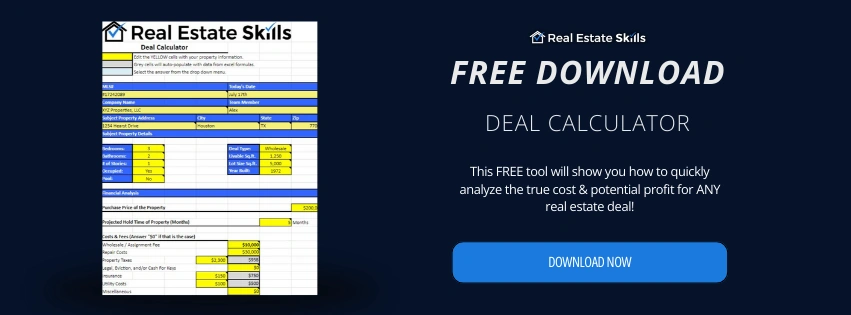
You need a rigorous system that forces you to account for all of the expenses that can wipe out your profit margins. We show you all of the line items in our FREE Deal Calculator.
Here is what we will cover:
- Why You Need a "Garbage In, Garbage Out" Rule for Your Real Estate Deal Analysis Spreadsheet
- The 5 Metrics Every Real Estate Deal Analysis Spreadsheet Must Calculate
- Step-by-Step: How to Build Your Custom Real Estate Deal Analysis Spreadsheet
- 2025 Stress Test: Updating Your Real Estate Deal Analysis Spreadsheet for Risk
- Advanced Real Estate Deal Analysis Spreadsheet Tactics: The "Triage" Matrix
- FAQ: Common Questions About Using a Real Estate Deal Analysis Spreadsheet
Does the deal actually make money? Whether you are wholesaling, flipping, or buying a rental, you cannot rely on "back of the napkin" math. One missed repair cost or wrong ARV estimation can wipe out your entire profit.
Analyze any strategy in seconds. Our Free Real Estate Deal Calculator is built for versatile investors. Plug in your numbers to instantly see your Maximum Allowable Offer (MAO), fix-and-flip profit, or rental cash flow.
Why You Need a "Garbage In, Garbage Out" Rule for Your Real Estate Deal Analysis Spreadsheet
A real estate deal analyzer spreadsheet is a logic engine, not a crystal ball. It cannot tell you if a number is true; it can only tell you if the math works. The most dangerous thing an investor can do is confuse a spreadsheet's clean output with financial reality.
If you rely on the seller's "Pro Forma" (a fancy word for "optimistic guessing") or input a generic Zillow estimate for rent, you are feeding your calculator garbage data. Consequently, the spreadsheet will output a garbage result—usually giving a "Green Light" to a deal that is actually a money pit.
In the current market, automated valuation models (AVMs) are frequently off by 15% or more because they rely on lagging sales data. To ensure your real estate deal analysis spreadsheet protects your capital, you must apply the "Forensic Verification" method.
The 3-Source Verification Checklist
- The "Round Number" Red Flag: Scan the seller's expense sheet. If you see nice, round numbers like "$500 for Maintenance" or "$1,200 for Insurance," it is a lie. Real bills are messy (e.g., $487.12). Round numbers indicate the seller is guessing.
- Tax Reassessment Check: Never trust the current owner's tax bill. Property taxes often reset based on the new purchase price, not the old value. Use a property tax assessment search on the County Assessor’s portal to calculate the tax based on your offer price.
- The "Binder Quote" Rule: Insurance rates have spiked in 2025. Online estimators are obsolete. You must call a broker and get a "binder quote" for that specific address to get the truth.
Once you have scrubbed the data and removed the "seller fluff," you are ready to crunch the numbers. Let's break down the five "Truth Metrics" that separate a profitable asset from a liability.
The 5 Metrics Every Real Estate Deal Analysis Spreadsheet Must Calculate
Many investors get distracted by "Vanity Metrics" like gross rent or appreciation potential. While those numbers are nice, they don't pay the bills. To audit a deal properly, your real estate deal analysis spreadsheet must automatically calculate the five "Truth Metrics."
Before we look at the formulas, it is critical to visualize how money actually flows through a property. Most beginners confuse "gross rent" with "profit." They are not the same.
| Metric Name | The Formula | The "Buy Box" Target |
|---|---|---|
| Net Operating Income (NOI): The pure profit before the mortgage is paid. | (Gross Income - Vacancy) − Operating Expenses | Positive & Growing (This is the specific number banks use to value the asset). |
| Cash on Cash Return (CoC): The velocity of your money (ROI). | Annual Cash Flow ÷ Total Cash Invested | 8% – 12%+ (If it's lower than 6%, you are better off in an index fund). |
| Cap Rate: The unleveraged return based on price. | NOI ÷ Purchase Price | 5% – 8% (Warning: A 12%+ Cap Rate usually means a high-crime area). |
| DSCR Debt Service Coverage Ratio. | NOI ÷ Annual Debt Service | > 1.25 (Lenders require this. Below 1.0 means you are losing money). |
| Gross Rent Multiplier (GRM) A quick "sniff test" filter. | Purchase Price ÷ Gross Annual Rents | < 8 – 10 (Lower is better. If it's 15+, it likely won't cash flow). |
A Critical Warning on "Spreadsheet Logic": Do not blindly chase the highest number. These metrics operate on a sliding scale of risk. A property with a 15% Cap Rate looks amazing on paper, but in reality, it likely sits in a neighborhood with high tenant turnover and zero appreciation. A 5% Cap Rate in a prime area might yield lower immediate cash flow but offers massive stability and appreciation. Your goal is to find the balance, not just the highest number.
⚡ Instant Deal Analyzer
Run a quick "Napkin Test" right now. If it passes, download the full sheet.
We automatically estimate taxes, insurance, vacancy, and repairs at 50% of rent for this quick test.
The Fast Track: Why You Need A Proven System
Here is the hard truth about Real Estate Deal Analysis:
You can find a potential deal, but one math mistake can bankrupt you.
If you forget to factor in closing costs, underestimate repairs, or miscalculate your Maximum Allowable Offer (MAO), you aren't investing—you are gambling. Amateurs try to build their own spreadsheets from scratch, often breaking formulas without realizing it until it's too late.
To scale your business, you need speed and precision.
You need to be able to analyze a Flip, Wholesale, or Rental deal in under 60 seconds with total confidence. We built a tool that handles the complex logic for you.
Stop guessing. Download our Free Real Estate Deal Calculator. It is the exact "Fill-in-the-Blank" system we use to verify profitability before we ever make an offer.
Step-by-Step: How to Build Your Custom Real Estate Deal Analysis Spreadsheet
Whether you use our automated tool or build your own in Excel, you must understand the underlying logic. A real estate deal analysis spreadsheet is simply a flow chart for money. It tracks every dollar from the tenant's wallet to your bank account.
Most beginners fail here because they miss the "Hidden Leakage" in their expense lines. Here is the exact four-step hierarchy we use to structure a bulletproof analysis:
Step 1: Calculate Effective Gross Income (The Real Revenue)
Most investors start with "Gross Scheduled Rent" (100% occupancy). This is a mistake. You must calculate "Effective Gross Income" by subtracting two types of vacancy:
- Physical Vacancy (5%): The time the unit sits empty between tenants.
- Economic Vacancy (Bad Debt) (2-3%): This is the "Experience" factor. In 2026, evictions can take months. Economic vacancy accounts for a tenant who is living there but not paying. If you don't budget for this, one bad eviction will wipe out your year's profit.
Step 2: The Operating Expenses (The "Big 4" + The Forgotten List)
This is where deals go to die. A realistic operating expense ratio (Expenses divided by Income) for a single-family rental is typically 35% to 45%. If your real estate deal analyzer spreadsheet shows 20%, you are likely missing items.
The "Big 4" (The Obvious Ones):
- Property Taxes: Always use the new purchase price to estimate taxes, not what the seller is currently paying.
- Insurance: Get a verified quote. Premiums vary wildly by zip code.
- Utilities: Water, Sewer, Trash, and "House Meter" Electric. (Pro Tip: Check if the municipality charges a "Sewer Capacity Fee"—these are often hidden).
- Property Management: Do not just list the monthly percent (e.g., 8-10%). You must also account for Lease-Up Fees (usually 50-100% of the first month's rent) and Lease Renewal Fees.
⚠️ The "Forgotten" Expense List:
Most spreadsheets ignore these, but you will pay them eventually: Pest Control, Snow Removal, Gutter Cleaning, Accountant/CPA Fees, and LLC Filing Fees. Add a miscellaneous buffer line of $50/month to catch these leaks.
Step 3: The "Reserves" Bucket (CapEx vs. Repairs)
You must have two separate reserve buckets. Mixing them is a rookie error that distorts your Cash-on-Cash return.
- Maintenance & Repairs (5%): This is for "OpEx" items—fixing a leaky toilet, patching drywall, or unclogging a drain. These happen frequently.
- Capital Expenditures (CapEx) (5-10%): This is for major systems. A roof costs $15,000 and lasts 20 years. That means the roof costs you $62.50 every single month. If you don't budget for this monthly, the expense will bankrupt you in Year 20.
Step 4: Debt Service (P&I Only)
Do not include taxes and insurance here (we already counted them in Step 2). This line is strictly for Principal and Interest payments to the lender. This is the final deduction before you reach "Cash Flow."
Effective Gross Income – Operating Expenses (Repairs + Big 4 + Mgmt Fees) = Net Operating Income (NOI)
*Note: You subtract Debt Service from NOI to get Cash Flow.
2026 Stress Test: Updating Your Real Estate Deal Analysis Spreadsheet for Risk
In a stable market, you can afford to be optimistic. In the current economic climate, optimism is expensive. Standard deal analysis focuses on "Blue Sky" scenarios (what happens if everything goes right). However, the savvy investor in 2025 focuses on "Red Sky" scenarios (what happens if things go wrong).
To "audit-proof" your investment against market volatility, you must add a specific "Stress Test" tab to your real estate deal analyzer spreadsheet. Here are the three critical variables you must adjust to ensure your deal survives the next 12 months:
- 1. The "Insurance Spike" Buffer: Insurance markets in states like Florida, Texas, and California are in turmoil. Premiums have risen 30-50% year-over-year.
- The Protocol: Do not just use today's quote. In your real estate risk analysis, add a permanent 20% buffer on top of your current insurance quote. If the deal still cash flows with that inflated cost, you are safe against next year's premium hike.
- 2. Exit Cap Rate Expansion (Decompression): Beginners assume they can sell the property for the same Cap Rate they bought it for. This is dangerous. As interest rates fluctuate, Cap Rates often "expand" (go higher), which lowers property values.
- The Protocol: If you buy at a 6% Cap Rate, stress test your exit at a 7% or 8% Cap Rate. If you are flipping or using the BRRRR method, this ensures you don't get trapped holding an asset worth less than your renovation costs.
- 3. The "Refi Trap" (For BRRRR Investors): Many investors get a hard money loan at 12%, assuming they can refinance into a long-term loan at 6.5% in six months. But what if rates jump to 7.5%?
- The Protocol: When stress testing rental portfolio loans, calculate your future refinance payment at 1.0% to 1.5% higher than today's prevailing rates. If the deal goes cash-flow negative at that higher rate, do not buy it.
By forcing your deal to pass these three "Red Sky" tests, you eliminate the fragile investments that would otherwise bankrupt you during a market correction.
*For in-depth training on real estate investing, Real Estate Skills offers extensive courses to get you ready to make your first investment! Attend our FREE training and gain insider knowledge, expert strategies, and essential skills to make the most of every real estate opportunity that comes your way!

Advanced Real Estate Deal Analysis Spreadsheet Tactics: The "Triage" Matrix
The biggest mistake new investors make is not math—it is time management. You should not spend 20 minutes plugging data into your real estate deal analysis spreadsheet for a property that never had a chance.
Professional investors use a "Triage" process. Before you open your real estate deal analyzer spreadsheet, you run the deal through a quick deal analysis filter. If it doesn't pass these two mental checks, delete the email and move on.
The 60-Second Deal Filter
- The 1% Rule Check: Does the monthly rent equal at least 0.8% to 1% of the purchase price? (e.g., A $100,000 house should rent for $1,000).
*Note: In high-appreciation markets like CA or NY, the 1% rule real estate benchmark often drops to 0.5%–0.6%, but cash flow will be tight. - The 50% Rule Check: Assume that 50% of your gross rent will vanish into operating expenses (taxes, insurance, repairs). Take the remaining 50% and subtract the mortgage payment. Is there anything left?
*The 50% rule real estate guideline is a blunt instrument, but if the numbers are negative here, a detailed spreadsheet won't save the deal.
Use these "Rules of Thumb" only as a filter, never as a final decision. Once a property passes this 60-second triage, then you load it into the full calculator to verify the pennies.
FAQ: Common Questions About Using a Real Estate Deal Analysis Spreadsheet
Here are the most common questions investors ask when learning how to analyze rental properties and vet their deals.
Conclusion: Mastering Your Real Estate Deal Analysis Spreadsheet
A real estate deal analysis spreadsheet is a powerful tool, but it is not a crystal ball. It cannot predict the future, and it certainly cannot turn a bad investment into a profitable one. Its only job is to protect you from making an emotional decision based on bad data.
Remember, the spreadsheet is the final step in the process, not the first. You make your money when you buy, not when you analyze. If you spend all your time tweaking formulas but never make offers, you are just playing "financial dress-up." Your primary focus should be on generating leads and negotiating with sellers to find properties that work on paper before you even open Excel.
If you have the calculator but are struggling to find the discounted properties to put into it, you need a better acquisition strategy. Download our Ultimate Guide to Start Real Estate Investing. It is the comprehensive blueprint that teaches you how to find, negotiate, and close off-market deals that make the spreadsheet turn green every time.
Does the deal actually make money? Whether you are wholesaling, flipping, or buying a rental, you cannot rely on "back of the napkin" math. One missed repair cost or wrong ARV estimation can wipe out your entire profit.
Analyze any strategy in seconds. Our Free Real Estate Deal Calculator is built for versatile investors. Plug in your numbers to instantly see your Maximum Allowable Offer (MAO), fix-and-flip profit, or rental cash flow.
*Disclosure: Real Estate Skills is not a law firm, and the information contained here does not constitute legal advice. You should consult with an attorney before making any legal conclusions. The information presented here is educational in nature. All investments involve risks, and the past performance of an investment, industry, sector, and/or market does not guarantee future returns or results. Investors are responsible for any investment decision they make. Such decisions should be based on an evaluation of their financial situation, investment objectives, risk tolerance, and liquidity needs.

👉FREE Training
How To Consistently Wholesale, Flip Houses, & Invest In Rental Properties From The MLS
(Without Spending $1 On Marketing)

Alex Martinez, the founder of Real Estate Skills, is known for his strong, practical expertise in real estate, starting from a beginner with no family connections in the industry to acquiring over 55 real estate deals, including wholesale and flips, within his first year.
He has dedicated his career to providing cutting-edge education and resources for real estate professionals. He emphasizes the importance of self-taught knowledge through mentors, books, and hands-on experience.
His journey from earning a modest income to becoming a successful real estate entrepreneur and educator showcases his expertise and dedication to the field.

Ryan Zomorodi, co-founder and COO of Real Estate Skills, leverages his experience from a diverse background in real estate investment, construction management, and entrepreneurship to provide comprehensive education in the real estate sector.
His expertise is rooted in hands-on experience, extensive industry knowledge, and a commitment to empowering others through education.
Ryan's journey reflects a blend of practical experience and entrepreneurial success, contributing to his role in developing a platform that educates and supports aspiring real estate professionals.
Read Ryan's Full Bio >>
