
How To Get Investors For Real Estate: 15 Proven Strategies (2026)
Jun 19, 2026

Written by
Alex Martinez — Founder & CEO, Real Estate Skills. Has wholesaled and flipped houses for over a decade, personally acquiring 33+ residential investment properties.
Reviewed by
Ryan Zomorodi — Co-Founder & COO, Real Estate Skills. Reviewed and verified the capital sources, rate ranges, and legal points in this guide before publication.
Publication history: Originally published August 7, 2023. Updated June 2026 with a beginner-first rewrite, current 2026 rate and SEC figures, expanded hard money and private money guidance, a student case study, commercial-capital coverage, and an updated FAQ. Capital sources and figures reviewed by Ryan Zomorodi, Co-Founder & COO of Real Estate Skills.
To get investors for real estate, match the right capital source to your specific deal — a private money lender, hard money lender, equity partner, or self-directed IRA holder — then approach them with a one-page deal package before you ask for a dollar. The fastest funding doesn't come from a bank application; it comes from a relationship built around a credible deal.
Most people trying to figure out how to get investors for real estate think the money is the problem. It isn't. After training thousands of investors, the pattern is always the same: capital is everywhere, and it chases good deals. The thing standing between you and a funded deal isn't a shortage of money — it's not knowing which door to knock on, and what to say when it opens.
That's the gap this guide closes. You've run the numbers, you've got the deal, and now you're staring at a funding hole that feels like a wall. Almost every first-time investor hits that wall, and almost none of them realize how close the money actually is. The investors who get funded fast aren't the ones with the best credit or the biggest network — they're the ones who walked in prepared, with the right capital source identified and a deal documented well enough that the answer was yes before they finished talking.
So here's what you'll get: how to tell which type of investor your deal actually needs, the exact preparation that gets a yes, fifteen real ways to find capital (including the commercial, flip, and partnership angles most guides skip), and word-for-word what to say when you make the ask. These are the same methods our students use to fund deals across the country, including several who closed their first deal with none of their own money in it. If you're brand new, start with our free Ultimate Guide to Start Real Estate Investing and follow along.
One quick fork before we go further, because two very different people search for this. If you're an investor or operator who has a deal and needs capital to fund it, you're in the right place — that's what this entire guide covers. But if you're a homeowner trying to sell your house to an investor for cash, or you're looking for a directory of investors to add to a buyers list, that's a different job, and this isn't the guide for it. For a fast cash sale, you'd look at local cash-buyer companies or a platform built for that; for a buyers list, an investor directory. Everything below is written for the person on the other side of that transaction: the one raising money to do the deal.
What Is A Real Estate Investor? (And Which Type You Actually Need)
Real estate investors fall into three functional types based on how they fund deals: debt investors who lend at a fixed rate and take no ownership, equity investors who co-own and share profits, and hybrid structures like preferred equity in between. Picking the wrong type for your deal can cost you your profit — or kill the deal.
Before you can find the right investor, you have to know which kind you're looking for — and most beginners skip this step and pay for it. They pitch an equity partner on a deal that only needs a short-term loan, or take a hard money loan offer to a buy-and-hold rental that the lender won't touch. The conversation dies on the spot, not because the deal was bad, but because the wrong kind of capital was sitting across the table.
Here's the distinction that organizes everything else in this guide. Debt investors lend you money at a fixed return and own none of the deal — their concern is getting paid back, on time, with interest. Equity investors put up capital in exchange for a share of ownership, and they win or lose alongside you. Hybrid structures like preferred equity sit between the two. Match the structure to the deal, and the capital is cheap and fast. Mismatch it, and you either give away profit you didn't need to, or you waste weeks talking to someone who was never going to fund your kind of deal.
Debt Investors
A debt investor lends you money and expects a fixed return. They're not on the deed, they don't share the upside, and if you sell for more than projected, the extra is yours, not theirs. Their return is set in advance — usually an interest rate plus origination points (a point is 1% of the loan amount, paid up front) — and their one real question is whether they get repaid.
Private money lenders and hard money lenders are both debt investors, and the difference between them matters. A private money lender is typically an individual — a friend, a colleague, a fellow investor — lending from personal funds, with terms negotiated directly. A hard money lender is a company in the business of lending to investors; it underwrites the asset rather than your paycheck, and as of 2026 typically charges in the range of 8–15% interest plus 1–5 points, lending against a percentage of the property's after-repair value (ARV) — the projected value once renovations are done. Both are debt. Neither takes ownership. (Rates and terms vary by lender and move with the market — confirm current numbers when you're shopping.)
The part beginners struggle with: a debt investor isn't sizing you up the way a bank does. A hard money lender cares first about whether, if you default, they can sell the property and recover their money. Your credit score matters less. Your experience matters less. The deal is what's primary — which, as you'll see, is exactly why hard money is often the most accessible capital for someone just starting out.
Equity Investors
An equity investor contributes capital for a share of ownership. They're on the LLC operating agreement, they share in the profit when you sell or in the cash flow along the way, and they share the losses too. This makes sense when the capital need is large, when the returns justify giving up a slice of ownership, or when the partner brings something money can't — a contractor's license, a market relationship, an operating skill you genuinely lack.
The risk with equity is dilution, and it's worth doing the math before you reach for it.
💡 Do The Math Before You Split
A 50/50 equity split feels fair until you run the numbers. Take a fix-and-flip with a $40,000 net profit:
- Equity partner (50/50): the split costs you $20,000 — you keep $20,000.
- Hard money loan ($140,000 at 10% over 9 months): interest runs roughly $10,500 — you keep about $29,500.
Equity is expensive capital. Use it when debt isn't available, when the deal is too big for debt alone, or when the partner's value clearly exceeds the cost of the split. (Figures are illustrative; your actual costs and outcomes will vary.)
Hybrid Structures (Preferred Equity)
Preferred equity sits between debt and equity in the capital stack. A preferred equity investor gets a fixed preferred return — say, 8–12% a year — before the common equity (you, the sponsor) sees anything. If the deal outperforms that threshold, the extra upside flows to you. If it underperforms, the preferred investor still gets paid first.
You'll see this most on larger multifamily and commercial deals. For a beginner working single-family flips or small rentals, it's not the tool you'll reach for — but knowing it exists matters, because as your deals grow, the capital conversation gets more sophisticated, and this is where it heads.
Here's how the main investor types compare at a glance:
| Investor Type | Ownership Stake | Typical Rate / Return | Best Deal Type | Credit Required |
|---|---|---|---|---|
| Private Money Lender | None | 6–10% interest + 0–2 points | Fix-and-flip, BRRRR, short-term bridge | None (relationship-based) |
| Hard Money Lender | None | 8–15% interest + 1–5 points | Fix-and-flip, distressed acquisitions | Minimal (asset-based) |
| Equity Partner | Yes (negotiated %) | % of net profit / cash flow | Large acquisitions, buy-and-hold, development | Varies by partner |
| Preferred Equity Investor | Yes (senior position) | 8–12% preferred return | Multifamily, commercial, syndications | Accredited investor status often required |
| SDIRA Investor | None or equity (flexible) | Negotiated (seeks above-market returns) | Notes, mortgages, LLCs, rentals | None (deal-dependent) |
| Institutional / Bank | None | ~7–7.6% (investment property, 2026) | Stabilized rentals, buy-and-hold | 640+ FICO, 15–25% down, 2 yrs tax returns |
When Should You Look For A Real Estate Investor?
Start building investor relationships 60–90 days before you need capital, not the day you find a deal. Investors fund operators they already know, and a rushed first contact signals desperation. Seek outside capital when you have a real deal, want to preserve your own cash, need to scale, or have to close fast.
Knowing which type of investor to approach is half of it. Knowing when to approach them is what separates investors who close from investors who spend months in conversations that go nowhere. The timing rule is simple, and most beginners get it backwards: build the relationships before you need the money. Investors fund operators they already know, and a first call made with a deal on the clock reads as desperation, not competence. The investors who say yes fastest are almost always the ones who had a mental file on you before you ever made the ask.
There are four situations where reaching for outside capital isn't just reasonable — it's the right move:
- You found a deal you can't fund alone. The numbers work, the ARV is verified by comparable sales, the repair estimate came from a licensed contractor instead of a guess, and the only missing piece is funding. That's exactly what outside capital exists for, and a well-documented deal gets a response from the right investor in days.
- Leverage. Even investors who could fund a deal with their own cash often choose not to, because tying up their money in one deal locks it there for months. Spread that capital across several deals using other people's money, and you compress the timeline to scale. Using OPM isn't a sign you're under-capitalized — it's the mechanism behind every portfolio that grows.
- Scale. One private lender can fund a single-family flip. A twelve-unit multifamily acquisition needs a structured capital stack — multiple debt and equity sources working together. Building those relationships before you're ready for bigger deals means the capital is warm when you need it instead of cold when you're under contract.
- Speed. Cash offers close faster, and faster closings win competitive deals. An investor with committed private capital can offer a ten-day close; one waiting on bank approval can't. In a competitive market, that speed difference is often the entire reason you get the deal.
The leverage point is the one that beginners misunderstand most, so it's worth seeing in numbers:
💡 The Leverage Math: One Deal vs. Three
- You have $500,000. Buy one property with all of it, and you might net a $50,000 profit — about 10%.
- Spread that same $500,000 across three deals as down payments and borrow the rest. Make $10,000 less per deal, and you still walk away with around $120,000 in the same window.
- Same capital, same period — more than double the return.
Figures are illustrative; actual returns vary from deal to deal.
Advantages Of Finding A Real Estate Investor
- Combined talent: the right partner brings skills that complement yours — a contractor-investor, an underwriter, a market specialist. The deal gets better because two sets of expertise are applied to it.
- Expanded network: every investor you work with has their own network of lenders, agents, contractors, and deal sources. One relationship compounds into many.
- Shared risk: on larger or more complex deals, distributing the capital exposure across multiple investors reduces the consequence of any single variable going wrong.
- Increased purchasing power: a solo investor with $50,000 can do one deal at a time. That same investor with two private lenders can run three deals at once, compressing the timeline to financial independence.
- Speed to close: committed private capital moves in days; bank financing moves in weeks. In competitive environments, that difference is the deal.
- Mentorship and guidance: an experienced investor who funds your deal has a direct financial interest in your success. That alignment produces better mentorship than any course or book.
Risks Of Finding A Real Estate Investor
- Profit dilution: every dollar paid in interest or equity split is a dollar that doesn't come back to you. Not a reason to avoid outside capital — a reason to model it correctly before you commit.
- Conflicting decisions: equity partners have opinions on timeline, renovation scope, and sale price. Misaligned expectations create friction mid-deal when you can least afford it.
- Unequal involvement: a passive investor who becomes an active one (calling weekly, second-guessing bids) is a distraction. Agreements need to define involvement before money changes hands.
- Legal and tax complexity: partnerships involve operating agreements, profit-and-loss allocations, and K-1 filings. The overhead of a poorly structured partnership is real and underestimated by most beginners.
- Reputational risk: if a deal goes sideways and an investor loses money, that loss travels through every network they're connected to. Your reputation is your most valuable long-term asset — protect it by only bringing investors into deals you've fully underwritten.
There's a flip side worth stating plainly, because one-sided content reads as untrustworthy: sometimes bringing in a capital partner is the wrong call. If a deal's projected net return is thin, the cost of capital can eat your entire profit — and the cost that quietly does the most damage isn't the interest rate. It's time.
📓 From The Field
One of our students, Stephanie, a Minneapolis investor, had a flip with a gross spread of roughly $150,000 — a deal that looks like a home run on paper. But the project ran 28-plus weeks instead of the planned 16, largely because one contractor was stretched across two of her projects at once. Every extra week was interest to two lenders plus holding costs, and by the end her net profit was about $35,000. The spread was huge; the take-home was modest, and time is what closed the gap. The lesson isn't "avoid borrowing" — it's that thin margins and long timelines compound, so pressure-test your numbers, including a realistic timeline and cost of capital, before you bring anyone into the deal. (Her figures are real and self-reported; outcomes vary, and this isn't a projection of what any deal will return.)
This guide is educational and is not financial advice. Every deal and every investor relationship carries risk — evaluate your own numbers and consult a licensed professional before making a financing decision.
How To Prepare Before Approaching Any Investor
Before approaching any investor, build a one-page deal package: subject property address, ARV backed by three comparable sales, an itemized contractor repair estimate, your maximum allowable offer, exit strategy, and projected returns for both sides. Documentation does the persuading — a well-prepared first-timer beats a vague pitch from a veteran every time.
This is the section most guides skip, and it's the reason most first conversations with investors go nowhere. Finding the right investor isn't the hard part — walking into that conversation unprepared is what kills deals before they start. Every investor, debt or equity, is running the same calculation the second you start talking: is this person credible, and is this deal real? If you can't answer both inside the first couple of minutes, the meeting's already over.
The good news is that preparation is entirely in your control. You don't need a track record, a perfect credit score, or years of experience. You need documentation — specific, verifiable, professionally presented — that does the persuading before you open your mouth. A first-timer who shows up with a fully documented deal package routinely beats a veteran who shows up with a vague pitch, because the deal and the preparation carry the conversation, not the resume.
The One-Page Deal Package
The deal package is the single most important tool a beginning investor can build. It's not a pitch deck, and it's not a business plan — it's one dense, specific page that answers every question a lender or partner will ask before they ask it. A complete one has seven parts, and each does a job:
- The subject property address. Not a neighborhood, not a zip code — a specific address. Vague "I have a deal in mind" conversations get dismissed instantly. A real address signals a real opportunity.
- The after-repair value (ARV), backed by three comparable sales. Comps closed within about 90 days, within a mile, similar in size and bed/bath count. This isn't your opinion of value — it's market evidence. If you can't find three comps that support your ARV, the ARV is wrong, and the deal needs to be renegotiated or passed on.
- The itemized repair estimate. Not a round number, not "around $40,000" — a line-by-line scope from a licensed contractor: roof, HVAC, electrical, plumbing, cosmetic. Investors who've been burned by lowball rehab budgets react viscerally to vague ones. A contractor's signature on the scope is worth more than any sales pitch.
- The maximum allowable offer (MAO). Derived from the formula most investors recognize — ARV multiplied by 70%, minus repair costs. If you paid more than MAO, say so and explain why the deal still works. Hiding it never ends well.
- The exit strategy. Flip, rental, or BRRRR? The exit sets the repayment timeline, which is what a debt investor actually cares about. A six-month flip is a very different risk than a 30-year rental hold. Be specific.
- The projected return — for both of you. Show the lender exactly what they earn: principal returned, interest, total return, annualized yield. Then show your own net after all costs. Transparency here isn't a vulnerability; it's a trust signal.
- Your contact and entity details. An LLC, a business email, a phone number — not a personal Gmail and a cell. Professionalism at this level costs nothing and communicates everything.
📓 From The Field
Experienced investors receive deal packages constantly, and a ten-page PDF signals you don't know how to synthesize information — a red flag for anyone trusting you with their capital. One page forces you to know your numbers well enough to present them without filler. If you can't fit the essential data on one page, you don't know the deal well enough yet. Go back to the numbers before you go back to the investor.
Bring Investors Numbers They Can Trust
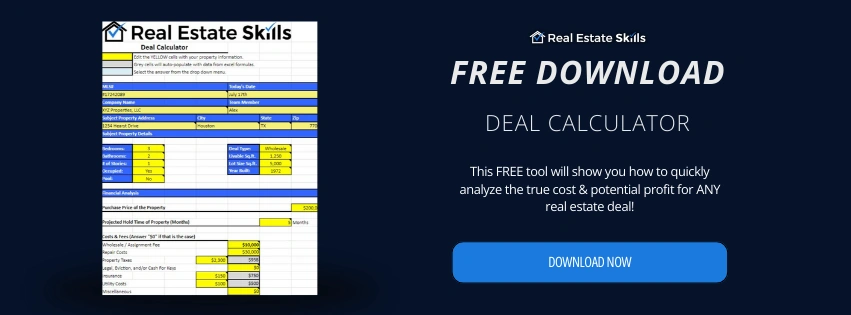
Every investor is asking the same thing: Is this deal real? The fastest way to prove it is with defensible numbers — your Maximum Allowable Offer, your spread, your all-in cost. Download our free Deal Calculator to reverse-engineer your MAO, factor in rehab and closing costs, and walk into any capital conversation with the exact figures that turn a skeptic into a funder.
The Credibility Stack For Beginners
The most common objection a first-timer hears isn't "I don't like the deal." It's "I don't know you." A track record answers that automatically, but beginners don't have one. What you can build is a credibility stack — a set of verifiable signals that show seriousness and preparation before a single deal has closed:
- Entity formation. An LLC costs between roughly $50 and $500, depending on your state and takes under a week to set up. Beyond looking professional, there's a practical reason: most hard money lenders won't lend to you in your personal name at all — they want you to close in a business entity. So the LLC is often a requirement to borrow, not just optics.
- A dedicated business bank account. Commingling personal and business money is the clearest signal that someone isn't treating this as a business. A business checking account in the LLC's name, even with a modest balance, shows operational legitimacy.
- Education or coaching documentation. Completion of a credible program, a coaching relationship, or verifiable mentorship that someone can call and confirm creates a reference before you have a deal history. Investors need evidence that someone experienced believes in your competence.
- A professional digital presence. A LinkedIn profile built around your investing focus, an active BiggerPockets profile, or a simple one-page site establishes that you exist in the professional world and aren't anonymous.
- The mentor reference. If you've worked with a coach or experienced investor, offer them as a reference outright. Most investors won't call — the offer itself is the signal.
| Credibility Layer | What It Signals | Cost / Time to Build | Substitutes For |
|---|---|---|---|
| LLC Formation | Permanence, professionalism | $50–$500 / under 1 week | Years of operating history |
| Business Bank Account | Financial discipline | Free / 1 day | Demonstrated cash management |
| Education / Coaching | Verified competence | Varies / ongoing | Closed deal track record |
| Digital Presence | Professional legitimacy | Free / 1–2 hours | Word-of-mouth reputation |
| Mentor Reference | Borrowed credibility | Free / relationship-dependent | Personal deal history |
If you're reading this thinking you have nothing to bring because you've never flipped a house, reframe what counts as experience. Completed flips are the gold standard, and a lender may well ask how many you've done — but that's not the only relevant experience. Bought your own home? You've been through escrow, taken out a mortgage, and made payments. Managed contractors, worked in sales or project management, or have a partner who's flipped before? Bring all of it. The point isn't to pretend — investors spot that instantly, and it's disqualifying. It's to honestly surface the relevant experience you already have. Confidence backed by preparation is available to you on day one.
Back Your ARV With Comps An Investor Won't Question
Your after-repair value is only as credible as the comparable sales behind it — and "I think it's worth this" doesn't fund deals. Download our free Comp Criteria Cheatsheet to pull and verify the right comps the way the pros do, so the ARV in your deal package holds up to the scrutiny of any lender or partner.

What Every Investor Actually Wants To Know
Underneath every investor conversation — whether it's a friend lending $50,000 or a hard money operation running 200 loans a month — are three questions. They're rarely asked out loud. But every follow-up, every hesitation, every "let me think about it" traces back to one of them:
- Can I trust you? Not your credit score — whether you've shown, through how you present yourself and your deal, that you do what you say you'll do. Professionalism, preparation, and transparency are the only tools a first-timer has here. You can't manufacture trust; you can only create the conditions for it.
- Is this deal real? Experienced investors have watched napkin-math deals fall apart in due diligence. Verified comps, a licensed contractor's scope, a real address, and a documented purchase price signal a deal that's been stress-tested, not invented. Conservative, defensible numbers build more confidence than aggressive ones that need everything to go right.
- How do I get my money back? Every investor pictures the exit before they commit. For a debt investor, that's a clear repayment timeline and what happens if it slips. For an equity investor, a defined disposition plan and how distributions work. Answer this proactively, in writing — investors who have to ask it themselves are already less confident than they need to be to say yes.
15 Best Ways To Get Investors For Real Estate
The best ways to find investors for real estate, roughly from most relationship-driven to most institutional: your personal network, hard money lenders, REIA clubs, self-directed IRA investors, real estate agents, property owners and managers, crowdfunding, bank financing, social media, financial advisors, online groups, mortgage brokers, foreclosure auctions, syndication, and a public track record.
Finding capital isn't a one-channel problem. The investors who fund deals consistently don't lean on a single source — they build a capital network across several channels at once, so when a deal surfaces, the funding conversation is already warm. What follows are fifteen specific ways to find investors for real estate, ordered roughly from the most relationship-driven to the most institutional, each with how it works, what it costs, and how to actually use it — including the commercial, flip, and partnership angles most guides leave out.
| Capital Source | Best Deal Type | Typical Rate / Terms | Speed | Credit Required |
|---|---|---|---|---|
| Personal Network | Any | Negotiated (often 6–10%) | Days | None |
| Hard Money Lenders | Fix-and-flip, distressed | 8–15%, 1–5 points | 5–10 days | Minimal (asset-based) |
| REIA / Investment Clubs | Any | Negotiated | Weeks | None |
| SDIRA Investors | Notes, rentals, LLCs | Negotiated (seeks 8–12%) | 2–4 weeks | None |
| Real Estate Agents | Any | Varies by referral | Varies | Varies |
| Crowdfunding Platforms | Larger acquisitions | Platform-dependent | Weeks–months | Varies |
| Bank Financing | Stabilized rentals | ~7–7.6% (2026) | 30–45 days | 640+ FICO, 15–25% down |
| Social Media | Any | Negotiated | Varies | None |
| Financial Advisors | Any | Negotiated | Varies | None |
| Property Owners & Managers | Rentals, buy-and-hold | Negotiated | Varies | None |
| Online Investment Groups | Any | Negotiated | Varies | None |
| Mortgage Brokers | Any | Varies by referral | Varies | Varies |
| Foreclosure Auctions | Fix-and-flip, distressed | Negotiated | Days–weeks | None |
| Syndication / Reg D | Multifamily, commercial | Preferred return + equity | Months | Accredited investors |
| Content / Track Record | Any | Negotiated | 3–12 months | None |
1. Personal Network & Community
The fastest capital for any investor, including a first-timer, is already inside their network. Private money is simply capital lent by an individual — a friend, colleague, or fellow investor — not a bank. Private lenders underwrite you and the deal, not your credit score, so terms are negotiable and funding can close in days.
The fastest money available to any investor — including a first-timer with zero closed deals — is already inside the network they have. Private money is just capital lent by an individual rather than an institution: a friend, a former colleague, a neighbor, anyone with idle savings looking for a better return than a CD pays. Private lenders don't underwrite your credit score; they underwrite you — your character, your preparation, and the quality of the deal. Because terms are negotiated directly, private money is often faster, more flexible, and cheaper than hard money once the relationship is right — frequently in the 6–10% range with little or nothing in points, though every arrangement is negotiated (as of 2026; terms vary).
The hard part is the conversation. Most people avoid it because asking someone they know for money feels uncomfortable. The reframe that changes everything: you're not asking for a favor. You're offering a secured investment with a fixed return and a defined exit. That's a completely different conversation, and it's one people have every day with the network they already have.
The approach that works is to educate, not ask. Tell people you're building a real estate investment business. Explain how private lending works — secured by the property, fixed interest, a defined term. Then ask whether they know anyone who might be interested in that kind of return. That question removes the social pressure of a direct ask and routinely produces either a referral or a quiet "actually, I might be interested." A piece of advice worth keeping in mind, passed down from a mentor: ask for money and you'll get advice; ask for advice and you'll often get money. And private lenders come from places beginners overlook — a seller of an inherited house who didn't need the cash will sometimes become a long-term private lender, financing deal after deal once they've seen you perform.
📓 From The Field — Stephanie's Two-Tier Stack
Stephanie, a Real Estate Skills student in Minneapolis, ran into the exact wall this strategy solves. On her third flip — bought for about $421,000 with an ARV near $700,000 — she didn't have the down payment, because her cash was tied up in another active project. Instead of passing, she called her local hard money lender and asked what her options were. They connected her directly with private money lenders they'd worked with. She picked one, layered that private money on top of the hard money loan to cover the down payment and gap, and closed with none of her own money in it. One honest caution from her experience: the private money in second position cost more than the hard money — second-position capital is riskier for the lender, so it commands a higher rate.
| Flip | Purchase | Rehab | Sale Price | Net Profit | Capital Source |
|---|---|---|---|---|---|
| Flip #1 | $180,000 | $102,000 | $380,000 | $40,000 | Hard money |
| Flip #2 | $85,000 | $205,000 | $380,000 | $35,000 | Hard money |
| Flip #3 | $421,000 | $135,000 | $705,000 | $35,000* | Hard money + private money (no money down) |
| Flip #4 | $480,000 | $220,000 | $900,000+ | $75,000+ (projected) | Hard money + private money |
*Flip #3 had a ~$150,000 gross spread; a 28-week hold (vs. a planned 16) driven by permit delays and a contractor running two projects at once compressed net profit to $35,000. Figures are real and self-reported; outcomes vary and are not a projection of returns.
How Stephanie Flipped 4 Houses & Built A Real Estate Business From Scratch
Real Estate Skills student Stephanie shares the real numbers, mistakes, and capital strategies behind four house flips in Minneapolis — including the two-tier private and hard money stack she used to close with no money out of pocket.

2. Hard Money Lenders
A hard money lender is a private, non-bank, asset-based lender making short-term loans to active investors, mostly for fix-and-flips. They underwrite the deal — purchase price, rehab budget, and ARV — not your W-2 or credit score, and can close in 5–10 days. As of 2026, expect roughly 8–15% interest plus 1–5 points.
There's a limiting belief that comes up more than any other after training thousands of investors: most people think money is their biggest obstacle. It isn't. The real bottleneck is consistent deal flow. Money chases good deals — so when you know how to find and structure great opportunities, the capital is essentially everywhere.
A hard money lender is a private, non-bank, asset-based lender that makes short-term loans to active real estate investors, most often for fix-and-flip deals. Unlike a bank, they don't focus on your W-2, tax returns, or debt-to-income ratio, and they don't run a 30-to-45-day approval. They focus on the deal: purchase price, renovation budget, and after-repair value. The loan is secured by the property itself — that's why it's called asset-based lending, and it's exactly why hard money exists, to fund distressed properties that need to close fast and won't qualify for a conventional loan. As of 2026, typical terms run roughly 8–15% interest, 1–5 origination points, and 6–18 month terms, with the lender funding a percentage of value — though every lender is different and rates move, so confirm current numbers.
A point worth internalizing if you're nervous about borrowing: hard money lenders are in the business of lending money to investors. They want the business. And because the loan is secured by the asset, many will lend to a beginner with little track record — worst case for them, they recover the property. Most hard money loans are also non-recourse and won't require you to personally guarantee your home or personal assets, meaning the loan is tied to that one property and not to everything else you own. (That's common but not universal — confirm whether a given loan is recourse or non-recourse, since some require a personal guarantee.) They're also typically interest-only, so even at a higher rate the monthly payment can be lower than an amortizing mortgage, which protects your cash flow during the rehab.
What Makes A Good Hard Money Lender
Not all hard money lenders are equal — the same deal can look very different depending on who funds it. Look for certainty of execution (terms that don't quietly change right before closing — a bait-and-switch can sink your deal), speed (a lender who decides quickly and closes in days, not weeks), strong leverage and loan structure (less cash out of your pocket, more deals at once), and communication and local knowledge (a lender who knows your market can help you avoid bad deals and introduce you to vendors). A rule of thumb that protects beginners: with the exception of an appraisal fee, you generally shouldn't be paying money out of pocket before closing. A lender asking for application or other upfront fees early is usually a red flag.
Understanding LTV And LTC (The Two Numbers That Decide Your Loan)
Two metrics determine how much a hard money lender will give you, and most lenders use both:
- LTV (loan-to-value) is the percentage of the property's value the lender will finance. Hard money LTVs commonly run 70–75%. At 70% LTV on a property valued at $500,000, the lender funds up to $350,000 and you bring the rest.
- LTC (loan-to-cost) is the percentage of the total project cost — purchase plus rehab — the lender will fund. LTCs commonly run 80–95%. On a $300,000 purchase plus $100,000 rehab (a $400,000 project), 85% LTC means they fund $340,000 and you bring $60,000, plus holding and closing costs.
The critical question, and a $60,000 swing on the same property: whether the lender's percentage applies to the after-repair value or the as-is value. If a property is worth $100,000 today but $200,000 after repairs, 80% of as-is is $80,000 — but 70% of ARV is $140,000. Same property, very different loan. Always confirm which one a lender means before you run your numbers. And if a lender doesn't fund all the cash you need, ask whether they allow second-position liens — that opens the door to a second lender covering your down payment or gap (the riskier, more expensive capital described in Stephanie's stack above). (All percentages are typical ranges as of 2026 and vary by lender.)
The Lender Stack Method: How To Find Hard Money Lenders For Free
Most investors rely on the one hard money lender they happened to get introduced to — and when you have only one lender, you have no leverage. The same deal submitted to several lenders can come back with very different rates, points, fees, and leverage — differences worth thousands per deal. The fix is a system we call the Lender Stack Method, which reverse-engineers the lenders already paying to be found:
- Search investor-specific keywords plus your location — "hard money lenders Denver," "fix-and-flip loans Denver," "real estate investor loans Denver." Each phrase surfaces different lenders, so use several.
- Skip the Google Business and Yelp listings; go to the organic results. Those map listings are often traditional mortgage lenders, not hard money.
- Go past page one. Some of the best boutique lenders with deep local knowledge aren't spending heavily on SEO — they sit on pages two through five.
- Vet for the right signals: lenders who specifically mention fix-and-flip loans, look active and professional, and have a verifiable physical presence (check the footer for office locations).
- Collect data first, call second. Build a spreadsheet — name, website, phone, LTV, LTC, terms — so you call later from a position of options.
For smaller or rural markets, think micro to macro: city, then county, then nearest metro, then statewide. And on the perennial question — deal first or lender first? — build the lender stack first. When you already know your lenders and their terms, you underwrite more accurately and make stronger offers.
📓 From The Field — How A Lender Sizes A Loan
On a recent San Diego fix-and-flip, our co-founder Ryan ran an actual loan application on a property he planned to buy for about $550,000, with a $65,000 rehab budget and an ARV around $750,000. The lender's quote showed exactly how leverage and rate trade off: the maximum-leverage option financed up to 95% of project cost and 80% of ARV but carried a higher rate (around 10.45%) plus an extra origination fee. Dialing the borrowed amount down — putting more of his own cash in — dropped the quoted rate to about 8.25% on a 12-month loan. Same property, same lender: more cash in, lower rate; more leverage, higher cost. That tradeoff, not the headline rate, is the number that decides your deal. (Real figures from one application as of 2026; your terms will differ by lender, market, and deal.)
How To Find Hard Money Lenders Online For Free
Ryan Zomorodi walks through the complete Lender Stack Method we use to find hard money lenders online — and how to build multiple lending options before you ever have a deal.

How To Talk To Hard Money Lenders: What To Ask
Finding the lender is half of it. If you don't know how to talk to one, they'll read you as inexperienced inside the first thirty seconds — and that costs you terms, speed, and respect. The goal of the call isn't to impress anyone; it's to evaluate a financial partner with structured questions. Open with something like: "Hi, this is [name], a real estate investor in [city]. I'm looking to establish a lending relationship for upcoming acquisitions and wanted to understand how you structure your loans. Do you mind if I ask a few questions?" That signals you're an active investor expecting multiple deals — exactly what a lender wants to hear. From there, a handful of questions separate professionals from beginners:
- "Are you a direct lender or a broker?" Direct lenders hold the capital, decide, and move fast; brokers add fees and middlemen. Confirm they lend in your state and are licensed there.
- "Do you lend on ARV or as-is value — and how do you calculate ARV?" This sets your leverage, and the valuation method (formal appraisal vs. desktop/BPO/in-house) tells you how fast they fund.
- "What are your rates, points, and total origination fees?" The rate alone is a trap — some lenders recover a low rate through draw, inspection, document, extension, prepayment, and exit fees. Ask for a line-itemized term sheet and model a six-month hold to get your all-in cost, the only fair way to compare lenders.
- The two questions that quietly save the most money: "Do you charge interest on committed rehab funds, or only on funds actually drawn?" and "Can interest accrue to the end instead of being paid monthly?" Most won't allow the latter, but one who does can be worth a slightly higher rate for the cash-flow relief.
- Speed, terms, and protection: "How fast can you close once I send a deal?" (5–10 days, 10–14 at most — three weeks-plus isn't hard money, it's slow capital), "What are your extension policies?", "Recourse or non-recourse, and do you require a personal guarantee?", "Can I close in an LLC?", and "What borrower qualifications — liquidity, credit score, net worth — should I be aware of?" Some require a minimum credit score (often a floor around the mid-600s).
- The bonus question: "What deals are you most excited to lend on right now, and what's working for your best clients?" It builds rapport and gives you real-time intelligence on what's getting funded.
Close like a professional: thank them, ask how to submit a deal when you have one, ask what they'd need up front to move quickly, and request the term sheet by email so you can compare it cleanly. That turns a cold call into a relationship. For the complete question-by-question version, our guide to working with hard money lenders walks through every line.
How To Talk To Hard Money Lenders Like A Sophisticated Investor
Ryan Zomorodi walks through the complete hard money lender call script — the exact questions to ask and how to evaluate a lender as a financial partner.

📓 From The Field — Rates Fall As You Grow
When our co-founder Alex got started, hard money rates were steep — in the range of 13–16%. As the industry matured and he built a track record over several years, the rates he was quoted came down to where they were competitive with private money, sometimes lower. The takeaway isn't a promise of any particular rate — rates move with the market and with your track record — but a reason to keep building relationships and a borrowing history: your cost of capital tends to fall as lenders see you perform. (Illustrative of one investor's experience; rates vary widely and aren't a prediction.)
3. Real Estate Investment Clubs & REIAs
Real estate investment clubs and local REIA chapters are rooms built to connect operators with capital. Nearly every attendee is deploying money, looking for deals, or both. Find your chapter through the National REIA directory at nationalreia.org — there's almost certainly one within driving distance.
Real estate investment clubs and local REIA (Real Estate Investors Association) chapters are among the highest-yield rooms for finding capital, because nearly everyone in them is either deploying money, looking for deals, or both. The National REIA directory at nationalreia.org lists chapters nationwide; there's almost certainly one within driving distance. Most follow the same format — a speaker for 30 to 45 minutes, with open networking before and after — and the networking is the point. These rooms are also where you'll meet hard money lenders directly, since they often sponsor the group specifically to reach investors. Before you go, prepare a thirty-second introduction:
📓 From The Field
In the early days of building Real Estate Skills, we attended three different REIA chapters within an hour-and-a-half drive every single month. Those rooms produced cash buyers we still work with today, private money lenders, brokers, and agents — MLS access came from a single conversation with a broker at a meeting. Feeling nervous your first time is normal; everyone there started where you are. The difference between people who leave with relationships and people who leave with a stack of cards is one thing: intentionality. Bring a 30-second intro, business cards, a deal package if you have a live deal, and follow up within 24 hours. One meeting produces introductions; six months of showing up produces a network.
4. Self-Directed IRA (SDIRA) Investors
Self-directed IRA holders can legally invest retirement funds in real estate — private notes, LLC interests, rentals, and hard money loans — and many actively seek above-market returns. Because their returns compound tax-advantaged, they'll often accept slightly lower rates than hard money lenders in exchange for security and a trustworthy operator.
This is one of the most underused capital sources in real estate and one almost no competing guide covers well. Large sums sit in self-directed IRAs held by individuals legally authorized to invest those funds in real estate — private mortgage notes, LLC membership interests, rental properties, and hard money loans. The IRS permits IRAs to hold real estate through a self-directed structure (see IRS guidance on IRAs and prohibited transactions), with a custodian — companies like Equity Trust, the Entrust Group, or Rocket Dollar — holding the investment while the owner directs it. Returns flow back into the IRA tax-deferred or tax-free depending on whether it's traditional or Roth.
The practical implication: SDIRA holders are motivated lenders with a mandate to deploy capital into qualifying investments, and they aren't bound by institutional underwriting. Because their returns compound inside a tax-advantaged account, they're often willing to accept a slightly lower rate than a hard money lender in exchange for security, consistency, and a trustworthy operator relationship. The hard part is finding them — SDIRA investors don't advertise. The best access points are REIA meetings, financial-advisor networks, and communities like BiggerPockets, where SDIRA holders actively post about seeking note investments and private lending opportunities.
This section is educational and is not tax or investment advice. Self-directed IRA rules, including prohibited-transaction rules, are complex — consult a qualified custodian or tax professional before structuring any SDIRA investment.
5. Real Estate Agents
A well-connected agent who works with investors keeps an informal list of active cash buyers and capital sources that's never published — it lives in their phone. Build a genuine relationship, call rather than text, and ask directly whether they work with private lenders or cash buyers looking for deals to fund.
An agent who works heavily with investors keeps something most people never see: an informal list of active cash buyers and capital sources — people who've funded deals before and are looking for the next one. It's not published anywhere; it lives in the agent's phone. The way to access it is to become the kind of investor that agent wants to bring opportunities to, and that starts with how you treat them from the first call.
Most investors never call listing agents at all — they text, email, or skip the conversation and offer off photos. That's what amateurs do. Professionals pick up the phone, build genuine rapport, and treat the agent as a potential long-term partner. If every other investor on a deal only texts and you're the one who calls, you're already in the lead. Ask directly: "Do you work with any private lenders or cash buyers who are actively looking for deals to fund? I've got a strong pipeline and I'm building my capital network." Agents who work with investors understand that question immediately.
There's also a capital angle most beginners completely miss: the agent themselves can be one of your best private money lenders. Agents know the numbers — they run values every day — so unlike a friend who's never funded a deal, an agent can look at a fix-and-flip and recognize a good one. And there's a structure that makes lending to you genuinely attractive: an agent who lends you the money at a lower rate (say 8–10%) can also earn the commission by listing the property when you sell. Add the commission to the interest and their effective annual return can climb well into the teens — a win for them and cheaper capital for you. It can go further: if you're short the down payment for a hard money loan, an agent's funds can serve as that down payment, with the agent in second position behind the hard money lender. Because second position is riskier, you'd offer a higher rate there — but combined with their commission, the return can be very attractive. (Rates and returns are illustrative and negotiated deal by deal; outcomes vary.)
📓 From The Field
At Real Estate Skills, we treat cash buyers as financing and capital partners, because that's what they are. An agent who lists distressed properties sits on a network of investors who fund deals. Build a genuine relationship with that agent — solve their problems, make their job easier, create win-win-win scenarios where the seller, the agent, and your capital partners all benefit — and they become one of the most valuable capital introduction sources in your network. An agent listing a fixer today will list one tomorrow; make sure they call you first.
6. Property Owners & Managers
Active property managers work daily with portfolio owners who have significant equity and a sophisticated grasp of real estate — many quietly lend capital or co-invest. Building relationships with two or three managers in your market opens a pipeline to experienced, capital-ready investors already in the business.
Active property managers and experienced owners are two of the most overlooked capital sources in real estate. Managers who oversee rental portfolios work daily with owners who have real equity, stable cash flow, and a sophisticated understanding of real estate as an asset class — and many of those owners quietly deploy capital into new deals, with the manager as the connector. Build relationships with two or three active managers in your target market and you've opened a pipeline to experienced, capital-ready investors. The conversation is natural: you're both professionals in the same market. Ask what their owners are focused on, ask whether any are looking for opportunities, and let the relationship develop before any ask. Owners themselves are candidates for private lending and seller-financing structures — someone who's held a paid-off rental for twenty years and is nearing retirement may prefer a secured note at a solid fixed rate to the ongoing headache of management.
7. Real Estate Crowdfunding Platforms
Real estate crowdfunding platforms like RealtyMogul, CrowdStreet, and Fundrise connect sponsors with accredited and, in some cases, non-accredited investors who've opted into real estate. They suit larger acquisitions, not single-family flips — and established platforms vet sponsors hard, so a track record usually comes first.
Crowdfunding platforms opened access to investor capital by creating regulated marketplaces where sponsors and investors connect at scale. For larger deals, platforms like RealtyMogul, CrowdStreet, and Fundrise provide access to investors who've specifically opted into real estate as an asset class. The regulatory framing matters: most operate under SEC exemptions that govern how money can be raised from the public, and both the offering limits and investor-eligibility rules depend on which exemption a platform uses. Under Regulation Crowdfunding, an issuer can raise up to $5 million in a 12-month period from both accredited and non-accredited investors; under Regulation A+ Tier 2, up to $75 million (figures as of 2026 — confirm current limits, which the SEC periodically revisits). For a beginner running a single-family flip, crowdfunding isn't the right tool. For a sponsor with a track record scaling into larger multifamily or commercial deals, it becomes a legitimate channel. The real barrier is credibility — established platforms apply meaningful due diligence to sponsors before listing a deal, so build the track record through private and hard money deals first.
8. Bank Financing
Conventional bank financing is the most familiar capital source and the worst starting point for most active investors. Banks underwrite the borrower — credit, income, tax returns — and take 30–45 days to close. It fits stabilized, performing rentals held long-term, or refinancing a completed BRRRR, not competitive acquisitions.
Conventional bank financing is the most familiar option and, for most active investors, the worst place to start. Banks underwrite the borrower, not the asset — income documentation, tax returns, debt-to-income ratios, and credit thresholds calibrated for homeowners, not operators running multiple deals at once. For investment properties, conventional lenders generally want a strong credit score, a down payment in the range of 15–25%, and cash reserves, and the approval-to-close timeline typically runs 30–45 days — a pace that loses competitive deals. As of 2026, investment-property mortgage rates run roughly 7–7.6%, about half a point to a point above primary-residence rates. (Rates and requirements vary by lender and move with the market; confirm current terms.) Where bank financing genuinely fits is stabilized, performing rental property held long-term. A BRRRR method investor who has rehabbed and tenanted a property and is refinancing into permanent debt is the right use case. The sequencing that makes banks useful without making them a bottleneck: acquire and renovate with hard or private money, then refinance into a conventional loan once the property is stabilized.
📓 From The Field
Max, an investor we've worked with, bought a single-family rental for about $78,000 — but he didn't put up the full amount. He used leverage: roughly 20% down (about $15,600), with a bank financing the rest at around a 7.5% rate. After all expenses, the property cash flows about $500 a month — roughly $6,000 a year in passive income from one stabilized rental. That's the bank's role done right: not for the fast, competitive acquisition, but for the long-term hold once the numbers are stable. (Max's figures are real and self-reported; rates and returns vary, and this isn't a projection.)
9. Social Media
LinkedIn, Facebook Groups, and Instagram aren't passive discovery tools — used with intention, they produce direct access to private lenders and equity partners. Posting specific deals, numbers, and lessons generates inbound conversations; posting generic content just generates followers. LinkedIn is the highest-yield platform for professional capital relationships.
Social platforms aren't passive investor-discovery tools — used with intention, they're active relationship builders that produce direct access to private lenders, equity partners, and co-investors. The distinction between passive and active use is everything: posting about real estate in general gets you followers, while posting about specific deals, specific numbers, and specific lessons gets you inbound conversations from people who want in. LinkedIn is the highest-yield platform for professional capital relationships. A profile that clearly identifies you as an investor with a specific market and deal focus, paired with consistent posts about deal analysis and market conditions, positions you as a credible operator in a room full of capital allocators. The outreach that works: connect with first-degree contacts in finance, law, accounting, and real estate, then send a brief message introducing your focus and asking whether they know anyone interested in private real estate lending. Don't pitch — start conversations.
10. Financial Advisors
Financial advisors manage capital for clients seeking yield, and a fee-only fiduciary with high-net-worth clients has a professional interest in alternatives that beat public markets. Approach them as a professional introduction, bring your deal package, and expect gatekeeping around their client relationships.
Financial advisors manage money for clients actively looking for yield, and an advisor with high-net-worth clients — particularly those with self-directed retirement accounts or concentrated positions in other assets — has a professional interest in alternatives offering better risk-adjusted returns than public markets. The approach is professional and direct: contact fee-only fiduciary advisors in your market and frame it as a professional introduction. You're a real estate operator with a documented deal pipeline, looking for relationships with advisors whose clients are interested in private real estate notes. Bring your deal package, leave materials, follow up in writing. The hard part is gatekeeping — advisors protect their client relationships and won't make introductions to operators they don't trust, so this is a slower, credibility-first channel.
11. Online Investment Groups
Beyond BiggerPockets, online investor communities — market- and strategy-specific Facebook Groups, Reddit, Slack groups, and niche LinkedIn Groups — contain operators, lenders, and equity partners at every stage. The winning approach is value-first: contribute genuine analysis for months before any capital ask.
Beyond BiggerPockets, the online investor landscape includes Facebook Groups organized by market and strategy, Reddit communities like r/realestateinvesting, Slack groups tied to investor networks and coaching programs, and niche LinkedIn Groups focused on things like BRRRR or creative financing. Each holds operators, lenders, and equity partners at various stages of deal activity. The tactical approach is value-first: post deal analysis, market data, and genuine questions before any capital ask. The investor who has answered fifty questions in a forum over six months gets more inbound capital inquiries than the one who posts a single "looking for private lenders" thread and waits. Credibility in these communities is built through contribution, not broadcasting.
12. Mortgage Brokers
Mortgage brokers who work with investors — originating hard money, DSCR, and bridge loans — hold direct relationships with the private lenders, family offices, and institutional sources that fund those products. They're matchmakers between operators and capital, and a warm introduction from one is worth far more than a cold call.
Mortgage brokers are a capital source almost no competing guide mentions. A broker who works heavily with real estate investors — originating hard money loans, DSCR loans (debt-service-coverage-ratio loans, which qualify the property's rental income rather than your personal income), and bridge financing — maintains direct relationships with the private lenders, family offices, and institutional capital behind those products. Functionally, they're a matchmaker between operators and capital. A broker who's placed ten loans for a particular private lending fund knows that fund's appetite, preferred deal profile, and decision-maker — and that warm introduction is worth far more than a cold call from an unknown operator. Identify two or three investor-focused brokers in your market, build the relationship around deal flow, and ask directly whether they have relationships with private lenders or capital sources open to co-investment or direct lending.
13. Networking At Foreclosure Auctions
County foreclosure auctions — courthouse-step and online platforms like Auction.com — are rooms populated entirely by active investors with capital ready to deploy. Every bidder is, by definition, a capital-ready investor. Attend consistently, introduce yourself, listen, and build familiarity over months.
County foreclosure auctions — both courthouse-step auctions and online platforms like Auction.com and Hubzu — are rooms populated almost entirely by active investors with capital deployed and ready. Every person bidding is, by definition, an investor with liquidity, deal experience, and a working capital network. There's no better room to build investor relationships from scratch. The approach is simple: attend regularly, introduce yourself to bidders, ask what they're focused on, and listen. Don't pitch on day one. The investor who sees you at the auction every month, hears you speak intelligently about values and rehab costs, and eventually learns you have a real pipeline is a completely different prospect than a cold message. The hard part is patience — showing up once produces introductions, showing up every month produces relationships, and relationships produce capital.
14. Real Estate Syndication & Regulation D
When a deal needs capital from multiple investors, a syndication pools their money under an LLC or LP, with you as the sponsor managing it. Syndications are securities offerings governed by federal law — most use SEC Regulation D exemptions. Consult a securities attorney before raising money from more than one unrelated investor.
When a single deal needs more capital than one or two investors can provide — a thirty-unit apartment building, a commercial acquisition, a ground-up development — syndication becomes the appropriate structure. A real estate syndication pools money from multiple passive investors, organized under an LLC or LP operating agreement, with a sponsor (you, the operator) managing the deal and investors receiving returns according to a defined structure.
Here's the part almost every competing guide gets dangerously wrong: a syndication is a securities offering, governed by federal securities law. Most are structured as private placements under SEC Regulation D. Under Rule 506(b), you can raise from an unlimited number of accredited investors plus up to 35 non-accredited (but financially sophisticated) investors — but you cannot generally solicit or publicly advertise the offering, including on social media. Under Rule 506(c), you can advertise, but every investor must be accredited and you must take reasonable steps to verify it. Getting this wrong — for example, posting "looking for investors for my apartment deal" on LinkedIn under the wrong exemption — can put you in violation of federal securities law, and the SEC does not distinguish between intentional and accidental violations. (Exemption details are current as of 2026; verify with counsel.)
So the rule is simple and non-negotiable: if you're raising capital from more than one unrelated investor for a single deal, talk to a securities attorney before you accept a dollar. The cost of that consultation is immaterial next to the legal exposure of an unregistered securities offering.
📍 Regulation D Is Not Optional
Most beginning syndicators don't know they're syndicating until they're already doing it — taking capital from multiple people for a single deal without an operating agreement, a PPM, or a Reg D filing. The SEC does not distinguish between intentional and accidental violations. If you are raising capital from more than one unrelated investor for a single deal, speak to a securities attorney before you take a dollar. The full requirements for Regulation D exempt offerings are detailed on SEC.gov.
This guide is educational and is not legal advice. Securities laws are complex and carry significant penalties — the specific exemptions, accredited-investor thresholds, and offering limits are exactly what a qualified securities attorney exists to handle for your situation.
15. Building A Public Track Record Through Content
Documenting your deals publicly — analysis, walkthroughs, honest post-mortems — builds trust at scale with an audience that self-selects for real estate. It's the slowest method (6–12 months to results) and the most durable: private lenders who've followed your content for months have done their due diligence before the first conversation.
This strategy takes the longest to produce results and builds the most durable investor pipeline on the list. The logic is simple: investors fund operators they trust, trust is built through demonstrated competence over time, and public documentation of that competence — deal breakdowns, market analysis, renovation updates, honest post-mortems on wins and losses — builds trust at scale with an audience that self-selects for interest in real estate. Operators who document their deals on YouTube, LinkedIn, and blogs consistently report that private lenders find them, not the other way around. Someone who's watched a dozen videos of you analyzing deals and accounting honestly for both wins and losses has a fundamentally different relationship with you than someone receiving a cold pitch — the due diligence is already done. The practical starting point: document every deal, even before you close one. The audience is small at first, but the investors in it are exactly the people you need. The hard part is consistency over a horizon that feels uncomfortable; most people quit at three months, while the ones who push to twelve find the pipeline becomes self-reinforcing.
How To Pitch Real Estate Investors
To pitch a real estate investor, lead with the deal, not yourself: state the opportunity, the numbers, the security, and the exit in about sixty seconds, then stop and let them ask questions. Your goal isn't to close them on the call — it's to earn permission to send your one-page deal package.
You've found the investor and you've done the preparation. The pitch is where the two meet — and it's where most beginners talk themselves out of a yes. The instinct is to lead with yourself: your background, your goals, why you're excited. An investor doesn't care yet. They care about the deal. Lead with the opportunity, prove it with numbers, address the risk before they raise it, and make the exit obvious. Do that and the conversation runs itself.
The 60-Second Pitch Formula
A strong first pitch is short on purpose. It conveys the four things every investor needs to hear and then gets out of the way:
| Pitch Component | What You Say | Why It Lands |
|---|---|---|
| The Opportunity | "I have a single-family flip under contract in [market] at [price] — about [X]% below ARV." | Opens with a real, specific deal, not your life story. |
| The Numbers | "ARV is [X], backed by three comps. Rehab is [Y] from a licensed contractor. All-in at [Z]." | Verified figures signal a deal that's been stress-tested. |
| The Security & Return | "I'm looking for [amount] secured by the property, at [rate]% over [term]." | Frames it as a secured investment with a fixed return, not a favor. |
| The Exit | "Exit is a sale in [X] months; here's how and when you're repaid." | Answers the question every investor asks: how do I get my money back? |
Then stop talking. The most common unforced error is filling silence with more talking — over-explaining, sweetening, hedging. You delivered the deal; let them respond. The goal of the first pitch isn't a signed check. It's a yes to one smaller question: "Can I send you the one-page summary?" Once your deal package is in their hands, the numbers do the persuading and the relationship has somewhere to go.
Answer The Three Silent Questions
Every pitch is really an answer to the three questions underneath every investor conversation — can I trust you, is this deal real, and how do I get my money back. Build the answers into the pitch itself instead of waiting to be asked. Trust comes through in how prepared and transparent you are. The deal's reality comes through in verified comps and a contractor's scope. The exit comes through in a clear repayment timeline. Answer all three before they're spoken and you've removed the friction that turns a "maybe" into a "let me think about it."
📓 From The Field
The single fastest way to lose an investor's confidence is to project certainty you don't have. New investors think admitting "I don't know" kills credibility — the opposite is true. An experienced lender has watched people overpromise and blow up deals, and a calibrated "I don't know yet, but here's how I'll find out" reads as more trustworthy than false confidence. If you don't know a property's exact rehab number, say you're getting a contractor's scope this week. Confidence is a fact you've verified; honesty about the rest is what makes the confidence believable.
Five Phrases That Kill The Conversation
A few words quietly tank more pitches than a bad deal does. Avoid these:
- "Trust me." The two words that produce the opposite of trust. Trust is demonstrated with documentation, never requested.
- "This is a guaranteed return." Nothing in real estate is guaranteed, and any experienced investor knows it. The word signals either naivety or dishonesty — both fatal.
- "I just need the money." Frames you as desperate and the investor as an ATM. They fund operators, not need.
- "I'll figure it out." About anything material — the rehab, the exit, the timeline — this signals you haven't done the work. "I'm confirming that this week" is the prepared version.
- "Everyone's investing in this." Herd-pressure language reads as a sales tactic, not a real estate deal. Let the numbers create the urgency.
You Know What To Say. Now Learn How To Find The Deals Worth Funding.
A perfect pitch is worthless without a real deal behind it — and investors fund the operator who brings them one. The investors who actually get capital follow a proven process from day one: finding discounted properties, locking them up, and bringing them to the lenders and partners they've built relationships with. Our FREE Training walks you through the entire system, the same one thousands of our students use. Watch it today, then go put it to work.
Watch The FREE Training →Getting Investors For Real Estate FAQs
Final Thoughts On Getting Investors For Real Estate
Getting investors for real estate comes down to a sequence most people get backwards. They look for money first and a deal second, when the investors who get funded do the opposite: they find the deal, document it until it's undeniable, identify the one type of capital it actually needs, and walk into the conversation already knowing the answers to the three questions every investor asks. The money was never the hard part. The preparation was.
That's the through-line of all fifteen strategies. Whether the capital comes from a friend, a hard money lender, a self-directed IRA, or a syndication, the same two things decide every yes: can I trust this person, and is this deal real. A one-page deal package and an honest, prepared conversation answer both — and they're available to you on your very first deal, before you have any track record at all.
So pick one channel and start this week. Build the lender stack, go to the REIA meeting, have the conversation with the person in your network who's been looking for a better return. Not every conversation turns into capital, and that's fine — you're building relationships before you need them, which is exactly the point. Do that consistently and the funding stops being the obstacle. It becomes the easy part.
Don't Spend Another Month Trying To Figure This Out Alone.
Knowing how to find and pitch investors is half the equation — the other half is having deals worth their capital and a system that turns the first funded deal into a business. Our FREE Training reveals the exact process our students use to find deals, secure funding, and close their first transaction, without spending a dollar on marketing or guessing what works. Watch it today, then go have the conversation.
Watch The FREE Training →
About The Author
Founder & CEO, Real Estate Skills
Alex Martinez is the Founder and CEO of Real Estate Skills. With more than a decade of investing experience and 33+ residential properties acquired, he has personally wholesaled and flipped houses across the country. Through Real Estate Skills, Alex and his team have helped thousands of students learn how to find deals, raise capital, and close profitable real estate transactions.
Real Estate Skills is not a law firm or a registered investment advisor, and the information in this article is provided for educational purposes only — it does not constitute legal, tax, financial, or investment advice. Real estate financing laws, securities regulations, lending terms, and interest rates vary by state and change over time. Real estate investing carries risk, including the loss of capital, and past results do not guarantee future outcomes. Always consult a licensed real estate attorney, securities attorney, and your own tax and financial advisors before raising capital, structuring an investment, or entering into any financing arrangement.

👉FREE Training
How To Consistently Wholesale, Flip Houses, & Invest In Rental Properties From The MLS
(Without Spending $1 On Marketing)

Alex Martinez, the founder of Real Estate Skills, is known for his strong, practical expertise in real estate, starting from a beginner with no family connections in the industry to acquiring over 55 real estate deals, including wholesale and flips, within his first year.
He has dedicated his career to providing cutting-edge education and resources for real estate professionals. He emphasizes the importance of self-taught knowledge through mentors, books, and hands-on experience.
His journey from earning a modest income to becoming a successful real estate entrepreneur and educator showcases his expertise and dedication to the field.

Ryan Zomorodi, co-founder and COO of Real Estate Skills, leverages his experience from a diverse background in real estate investment, construction management, and entrepreneurship to provide comprehensive education in the real estate sector.
His expertise is rooted in hands-on experience, extensive industry knowledge, and a commitment to empowering others through education.
Ryan's journey reflects a blend of practical experience and entrepreneurial success, contributing to his role in developing a platform that educates and supports aspiring real estate professionals.
Read Ryan's Full Bio >>
