
How To Calculate ARV: Free After-Repair Value Calculator
Jun 18, 2026

Written by
Alex Martinez — Founder & CEO, Real Estate Skills. Has wholesaled and flipped houses for over a decade, personally acquiring 33+ residential investment properties.
Reviewed by
Ryan Zomorodi — Co-Founder & COO, Real Estate Skills. Reviewed and verified the valuation methods, comp criteria, and 70% rule math in this guide before publication.
An ARV calculator estimates a property's after-repair value — what it will sell for once fully renovated — by pulling recent comparable sales, then works backward to your maximum offer. The free ARV calculator below does both: enter your comps and repair budget, and it returns your ARV, your maximum allowable offer, and your projected profit. Most deals turn on getting this one number right, and a wrong ARV is what wipes out a profit margin before the work even starts.
Free Tool
ARV & Maximum Offer Calculator
Step 1
Build your ARV from comps
Enter the sold price and square footage for each renovated comparable sale. The tool finds each comp's price per square foot, averages them, and applies that to your subject property. Use 2–5 comps that already match your property's post-renovation condition. For a sharper number, open Adjust this comp to add or subtract value for differences in beds, baths, garage, or other features — the way an appraiser does, instead of blind-averaging.
Estimated ARV
Add comps and your square footage to calculate.
—
Already have an ARV from an appraisal or broker? Override it here.
Step 2
Set your repair budget and your rule
70% is the standard floor. Tighten toward 80–85% only in premium markets where the gross dollars still work.
Estimates only, for educational use. A comp-based ARV is a starting point, not an appraisal — adjust each comp for differences in size, condition, and features, and confirm with a local professional before you make an offer. Outcomes vary by market and are not guaranteed.
Here's the problem with most ARV calculators: they ask you to enter your ARV. But the ARV is the hard part — it's the number you came here to figure out. So this one starts where the work actually starts, with comps, and builds your after-repair value from there before it ever touches the 70% rule.
That distinction matters more than it sounds. The formula floating around the internet says ARV equals your purchase price plus the cost of your renovations. That's wrong, and it's an expensive kind of wrong. Cost doesn't equal value. If you buy a house for $500,000 and put $100,000 into it, you do not have a $600,000 house — you have a house worth whatever the best renovated comparable on that street recently sold for, and not a dollar more. The neighborhood sets the ceiling. Your construction budget doesn't.
So a real ARV is built the way a bank's appraiser builds it: from sold, renovated comparable properties near the subject, adjusted for the differences between them and your house. That's the entire method, and it's what the calculator above runs and what the rest of this guide walks through, step by step, for a complete beginner.
A quick story on why this is worth getting right. Early in my investing career, I bought a flip based on a comp that looked perfect on paper — same square footage, same bed and bath count, a few streets away. What I didn't weigh was that those few streets crossed a major freeway. To me, a minor detail. To the buyer's appraiser, six months later, it was a different market entirely. They threw the comp out, the appraisal came in low, and the profit I'd penciled in disappeared. That's the whole lesson of ARV in one deal: you cannot value a property on what you hope it sells for, and you cannot lean on an automated online estimate to do the work. You have to evaluate it the way the underwriter will — because the underwriter gets the final say on resale.
What Is ARV In Real Estate?
ARV stands for after-repair value — the price a property will sell for once it's fully renovated to the standard of its neighborhood. It's not what you paid, and it's not your current value plus your renovation cost. It's the future resale price, set by comparable sold homes.
The key word is future. ARV isn't what the distressed house is worth today, and it has nothing to do with active listing prices, which only tell you what sellers are hoping for. ARV is the number a licensed appraiser will assign once the rehab is done — which is exactly why it's built from sold, renovated comparable sales rather than from your own budget or your optimism.
That last point is where beginners lose money. Standing in a trashed house, your brain wants the highest number it can find to justify the deal — the active listing three streets over priced to the moon, the nicest comp in a better subdivision. Resist it. The ARV is the clinical number: what fully-renovated homes just like yours, in your immediate neighborhood, actually sold for. Anchor to that, and the math protects you. Inflate it, and you've talked yourself into a loss before you've signed anything. This is the value that matters most on a distressed property, where the gap between today's condition and the renovated comp is the entire opportunity.
For a deeper breakdown of what ARV is, who relies on it, and how lenders use it, see our full guide to after-repair value in real estate. This page stays focused on the part you came for: calculating it, and turning it into an offer.
The ARV Formula
The accurate ARV formula is: ARV = the sold price of comparable renovated homes, adjusted for the differences between them and your property. The popular "purchase price + renovation cost = ARV" formula is wrong — cost doesn't equal value. Appraisers use the sales comparison approach, and so should you.
You'll see the cost-plus formula everywhere: ARV = what you paid + what you spend. Ignore it. It's the formula written by people who haven't done a deal, and following it is how you end up with a house you've put more into than it's worth.
Here's the version that matches reality. Find comparable sold homes — "comps" — that have been renovated to the level you're aiming for, then use their sold prices to establish what your finished property will fetch. The quickest working method is price per square foot: take each comp's sold price divided by its square footage, average those across your comps, and multiply by your subject property's square footage. A cleaner version adjusts each comp first — adding or subtracting value for differences in beds, baths, garage, lot, or condition — before you average, which is exactly what an appraiser does and what the calculator above lets you do.
This isn't a trick or an investor shortcut. It's how every property in the country gets valued. When your renovated flip resells, the buyer's lender sends an appraiser, and that appraiser sets the price using comps within about a half-mile, sold in the last six months, similar in size and bed/bath count, in the same area. Run your ARV the same way, and you're not guessing — you're previewing the exact number the appraiser will land on. Run it any other way, and you're doing yourself a disservice. It's also why your ARV drives everything downstream: lenders size their loans off it, since hard money and private money lenders typically lend a percentage of the after-repair value, not the purchase price.
How To Calculate ARV Of A Property
To calculate ARV: (1) pull at least three sold, renovated comps within a half-mile, sold in the last 90–180 days, within 10% of your square footage and matching your bed/bath count; (2) adjust each comp's price for feature differences; (3) average the adjusted prices to set your after-repair value.
Three steps, and the discipline is in step one.
Step 1 — Pull strict comps. The criteria below aren't arbitrary; they're the same filters a bank appraiser uses, which is the whole point. These are the real estate comps criteria we've used for over a decade to value flips and wholesale deals:
- Sold, not active. Asking prices are hope. Sold prices are what a buyer actually paid. Build ARV only on closed sales.
- Renovated condition. You're estimating what your house sells for after the rehab, so comp against finished, renovated homes — ideally other flips. (You can often spot a flip in the price history: bought low, relisted months later much higher, with immaculate photos.)
- Recent — within 90 days if you can, 6 months at the outside. Markets move. And remember: a comp that's six months old today will be nearly a year old by the time you renovate and relist, and the appraiser may toss it. Weight the most recent sales the heaviest.
- Within a half-mile, same city and zip. Tighten to a quarter-mile in dense, block-by-block markets; expand toward a mile only if you must, and never cross a major physical barrier — a freeway, a river, train tracks — because values can change completely on the other side.
- Within 10% of your square footage (some investors use ±20% when matches are scarce), same bed and bath count. Compare apples to apples — a 3/2 to other 3/2s, not to a 5-bath.
Step 2 — Adjust each comp individually. Don't just average three sold prices and call it done — that ignores real differences. If a comp has a pool or a view and yours doesn't, adjust its price down to reflect your property. If yours is superior, adjust up. The point is to make each comp an apples-to-apples stand-in for your finished house before you average.
Step 3 — Average the adjusted prices. That weighted, adjusted average is your baseline ARV. Lean on the most recent and most similar comps. If your comps cluster tightly — say three renovated homes on nearby streets all sold around $325,000 — you can hold that number with real confidence. If they're scattered, you've got more work to do, and we cover exactly what to do when comps are messy or missing further down.
Comping takes practice to master — it's simple, but it isn't easy, and nobody's good at it on day one. The more properties you run, the faster and sharper you get.
The other two methods (and when to use them): Most residential flips and wholesale deals use the sales comparison approach above — it's the only one that matters for single-family houses. Two other valuation methods exist, and using the wrong one for your strategy will throw your numbers off completely:
- Income approach — for multi-family and commercial rentals. Value is driven by the income the property produces: ARV = net operating income ÷ cap rate. Use it for buy-and-hold income property, not a single-family flip.
- Cost approach — for brand-new construction or special-use properties (churches, schools) where real comps don't exist. It values the land plus the cost to rebuild the structure, minus depreciation. Overkill — and misleading — for a standard suburban flip.
Pick the method that matches your exit. For nearly everyone reading this, that's the sales comparison approach.
Pull Comps Like A Professional Appraiser
Your entire ARV stands or falls on the comps you choose. Get the distance, recency, square-footage, and condition filters wrong, and every number downstream is fiction. Download our free Comp Criteria Cheatsheet to keep the exact parameters the pros use right next to you while you work, so you pull defensible comps the same way a bank appraiser will, every single time.
Can You Calculate ARV By Address?
Not accurately — not for free, and not from the address alone. No free tool pulls live, condition-adjusted comps to produce a true ARV from just an address. Automated estimates like Zillow's Zestimate give an as-is ballpark, not an after-repair value, and they're often off by enough to sink a deal. The reliable method is comp-based.
This is the question more people search for than almost any other, so let's answer it straight. You want to type in an address and get an after-repair value. It makes sense — it'd be fast, and it's how you'd want the world to work. But no honest free tool does it, and understanding why will make you a better investor than any address box ever could.
Start with what the automated estimates actually are. A Zillow Zestimate, a Redfin Estimate — these are automated valuation models, and they're built to approximate a property's value as it sits today, not what it'll be worth after a renovation. Zillow publishes its own accuracy: a median error rate around 7% for off-market homes, which is the category most distressed properties fall into. On a $300,000 house, a 7% miss is $21,000 in either direction — and that's the median, meaning half the time it's worse. An automated number can't see the cracked slab, the dated kitchen, the smell in the carpet, or the busy road out front. It's working from stale public records and bed/bath/square-footage math. For a coffee-table guess, fine. For a number you're about to risk real money on, not a chance.
There's a deeper reason, too. ARV is inherently a forward number — it's the value of a house that doesn't exist yet, the renovated version of the distressed property in front of you. No algorithm can reliably price a renovation it can't see, to a finish level it doesn't know, against a neighborhood ceiling it doesn't weigh. That's a judgment call, and right now it's still a human one.
So here's what to actually do with an address — which is most of what people mean when they search for an "ARV calculator by address":
- Pull your own comps from the address. Drop the address into Redfin or Zillow, filter to sold homes, set your bed/bath and a tight radius, and look only at renovated sales. That's the real version of "ARV by address," and it takes about ten minutes. Free sites like Redfin mirror the local MLS in most markets within minutes of a listing going live.
- Use the address to walk the neighborhood virtually. Google Street View lets you check the things a number can't — curb appeal, whether the comp backs to a busy 45-mph road, how the block feels a few doors down. A house on a loud street can be worth 10–20% less than the same house on a quiet cul-de-sac, and you'll only catch that by looking.
- In non-disclosure states (Texas, for example), sold prices aren't public, so the free sites won't show them. You'll need Multiple Listing Service access through an agent, or a paid tool like Privy that licenses MLS data, to see what properties actually closed at.
Then take those comps and run them through the calculator at the top of this page. That's the honest path from an address to an ARV: the address gets you the comps; the comps — adjusted, the way an appraiser does it — get you the number. There's no shortcut that's also accurate, and anyone selling you a one-click ARV from an address is selling you a guess with a confidence problem.
What Is The 70% Rule In Real Estate?
The 70% rule says pay no more than 70% of a property's ARV, minus repair costs, for a fix-and-flip. The formula: Maximum Allowable Offer = (ARV × 70%) − repairs. The 30% gap covers holding costs, closing costs, selling costs, and profit. It's a fast screening tool — a floor, not a law.
Once you have an ARV, the 70% rule turns it into a maximum offer. Say a property's ARV is $300,000 and it needs $50,000 in repairs. Run the rule: $300,000 × 70% = $210,000, minus $50,000 in repairs = a $160,000 maximum allowable offer. Offer a dollar more and, by this rule, the deal no longer pencils. That's the whole formula, and it's genuinely useful for one job: screening deals fast so you don't waste hours analyzing a property that was never going to work.
The maximum allowable offer — MAO — is the ceiling. ARV is the finished resale value; MAO works backward from it by carving out the repair budget and a margin, to land on the most you can pay and still make money. For a wholesaler, you carve out one more slice: your assignment fee. If that $160,000 MAO is what the end buyer can pay, and you want a $10,000 fee, you get the property under contract at $150,000 or below. The calculator at the top does this for you — enter your fee and it back-solves the contract price.
Here's where the standard advice gets it wrong, though. The 70% rule is rigid, and rigid loses deals.
The 70% rule is a floor, not a law. That 30% gap assumes your buyer needs a 30% cushion. But in a competitive market, the investor who's fine with a 20% margin will outbid you every time if you're locked at 70%. In premium coastal markets, strictly offering 70% of ARV means you'll almost never win a property — veteran investors there routinely operate at 80–85%, because the gross dollar profit on an expensive flip still justifies the tighter percentage spread. That's why the calculator above has an adjustable rule, not a fixed 70%: 70% is the conservative floor that protects a beginner, and you tighten toward 80–85% only when the deal and the market genuinely support it.
The deeper move is to stop guessing the percentage entirely and reverse-engineer the offer from what your buyer actually needs. Experienced cash buyers don't think in a single blanket percentage — they screen on two numbers: a minimum net profit in dollars and a minimum return on investment as a percentage. One buyer might require both a $25,000 net profit and a 15% ROI before they'll touch a deal. Know those two numbers, and you don't need the 70% rule at all — you work backward from the buyer's criteria to the exact most you can offer. That's why net profit alone isn't enough to judge a deal: a $50,000 profit on a million dollars of cash tied up is a thin return you could beat with a savings account. The calculator's profit-and-ROI panel shows you both, so you're pricing like the buyer, not guessing.
📓 From The Field
On a real San Diego-area deal, Alex ran the same property two ways. The rigid 70% rule produced a maximum offer around $350,000 — the number most wholesalers, taught only the rule, would have submitted. But by knowing his cash buyer's actual numbers and reverse-engineering from them, he could offer $445,000 and still lock in a $10,000 assignment fee — about $95,000 higher than the 70%-rule offer, on the same property. The lesson isn't "pay more." It's that a blanket percentage is paper-napkin math; the investor who prices to the real numbers wins the deal the napkin-math investor never even gets a callback on. (Illustrative example; outcomes vary by deal, market, and buyer.)
How To Analyze Wholesale Deals & Calculate Your Offer Price
Alex Martinez walks through analyzing a wholesale deal end to end — finding the ARV from comps, estimating repairs, and reverse-engineering the maximum offer that still leaves room for a profit.

Want To Model The Whole Deal Offline? Get The Spreadsheet.
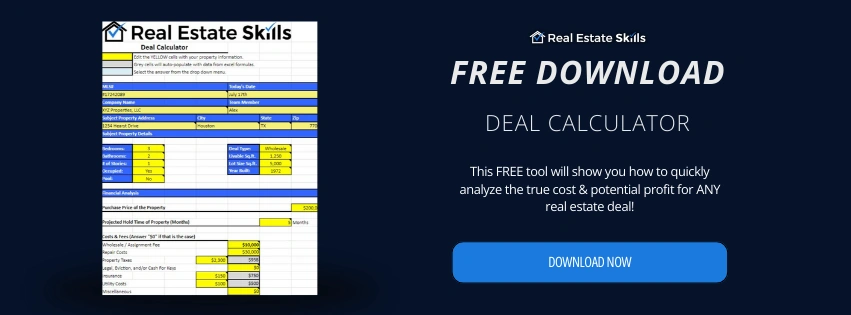
The calculator at the top of this page gives you a fast offer in seconds. When you're ready to go deeper, our free Deal Calculator spreadsheet lets you reverse-engineer the full profit spread, factor in holding and closing costs, and dial your Maximum Allowable Offer to the dollar before you ever pick up the phone. It's the same tool our students use to price every wholesale and flip deal.
How To Estimate Repair Costs
Estimate repairs by building a line-item scope of work, not a blind square-footage guess. A quick screen: use a per-square-foot rule for cosmetic work, then add big-ticket items — roof, foundation, systems — separately on top. Always add a 10–20% contingency for the problems you can't see until walls open.
Your ARV can be perfect and the deal can still blow up if your repair number is wrong. Repairs are the other half of the offer formula, and they're where new investors get hurt most — they underestimate the budget, overestimate the ARV, and the gap between the two eats their profit. Get this input right and the calculator's offer is trustworthy. Get it wrong and every number downstream is fiction.
Here's how to estimate it the way it's actually done.
The quick screen: cosmetic per-square-foot, then big items à la carte. For a fast first pass — the kind you run before you've even seen the property in person — use a per-square-foot rule for the cosmetic work, then add structural and system items separately. A purely cosmetic fixer (paint, flooring, cabinets, landscaping, fixtures — lipstick, not moving walls) might run somewhere in the range of $20–$30 a square foot; a full gut with new kitchen, baths, and mechanicals can climb to $60–$80+ a square foot. Those are ranges, not gospel — and that's the important part. The right number depends on your market, the finish level the neighborhood demands, and crucially, who's doing the work: a high-volume flipper with their own crews might renovate at $35 a square foot, while a newer investor without those relationships pays $60 for the same job. Which is exactly why the smartest move is to ask your cash buyers what they use, and build a range from several answers rather than trusting a number off the internet.
Then handle the expensive stuff separately. If the house needs a cosmetic refresh plus a new roof, a cracked slab, or a full electrical rewire, you don't fold those into the per-square-foot number — you price the cosmetic work with the rule of thumb and add the big-ticket items on top. A cosmetic budget of $40,000 plus a $20,000 slab repair is a $60,000 job. These structural items — foundation, roof, sewer lines, mold — are the deal-killers, the ones that hide behind walls and turn a thin deal into a loss, so they get their own line.
The accurate method: a line-item scope of work. The per-square-foot rule is for screening. Before you commit real money, walk the property with a licensed general contractor — ideally more than one — and build a granular, line-item scope of work. Get multiple bids; a single contractor's "ballpark" often comes in well under the final invoice, and three estimates give you a real range and flag the outliers. As a wholesaler you usually don't pay for repairs — your cash buyer does — so you can often let them walk the property and confirm the number, which is also how virtual and out-of-state deals get done.
Always carry a contingency. Whatever you land on, add 10–20% for the unknowns. Something always turns up once the walls are open. The contingency is what keeps a surprise from becoming a loss.
One discipline point that's worth more than any formula: the renovation number is the renovation number. A common, costly mistake — even among experienced flippers — is talking yourself into a lower repair figure just to make a deal pencil. You're $5,000 apart with a seller, so you quietly tell yourself you'll get the rehab done for $5,000 less. It almost never works, and it comes back to bite you. If the numbers don't work at the honest repair figure, the move is to negotiate the purchase price down or walk — not to shrink the budget on paper. Sometimes the best deal is the one you don't do.
Don't Let A Missed Repair Wreck Your ARV
A perfect ARV means nothing if your repair number is wrong, and the gap between profit and loss is often a single line item nobody priced. Download our free Scope of Work Template to itemize every repair from the roof to the foundation, hand contractors a clear plan, and get accurate, hard bids before you ever make an offer.

What If There Are No Comps? Valuing Hard-To-Comp Properties
When you can't find clean comps, widen your criteria in steps — quarter-mile, then half, then up to a mile, staying in the same neighborhood — before falling back to a price-per-square-foot estimate against the market ceiling. If no real sales support the value at all, that's usually a sign to walk away.
Perfect comps are a luxury. Often you'll find sales that are close but not identical, or a distressed property in an area where nothing comparable has sold renovated. Here's how to handle the messy cases without breaking the one rule that keeps you safe: never break the comps — never assume your property will sell for more than the market has actually shown it will pay.
When comps are inconsistent, expand in steps. Start tight and loosen deliberately. If there's nothing renovated within a quarter-mile, widen to a half-mile, then up to a mile if you must — but stay inside the same neighborhood, and keep matching property type and bed/bath count. If you still can't find renovated matches, shift to a price-per-square-foot model: find the highest price per square foot a similar property in that market has commanded, treat that as the ceiling, and then adjust down for the features your property lacks (no pool, no view, a busier street). You'll land on a conservative, defensible number built from real data rather than hope.
When the property's configuration has no match, look at what you can change. Say your subject is a 2-bed/1-bath in an area where everything sold is a 3-bed/2-bath. You can't comp a 2/1 against 3/2s as-is — but if the property has the space to add a bedroom and a bath, you can comp it against those 3/2s as the finished product, because that's what it'll become. The renovation, not just the cosmetics, is what makes the comp valid.
When there are genuinely no sales at all, that's information. If nothing comparable has sold in the area, ask why. Usually it means there's no real market there — and if a fix-and-flipper can't establish an ARV, they have no reason to take on the risk, so you'll struggle to wholesale it anyway. The honest answer is often to move on to a deal with a clear exit. The exception is when your value doesn't depend on comps at all — a buy-and-hold where the income justifies the price regardless — but that's a different strategy with a different calculation, and not the fix-and-flip ARV this page is about.
📓 From The Field
Ryan once bought a property with truly no comps — a single-family house far larger than anything else in its zip code, with no model matches anywhere nearby. He valued it on price per square foot rather than direct comps, and bought it well below what comparable square footage was selling for. But here's the part worth remembering: when the appraisal came in, the appraiser had to reach into other zip codes to find anything similar, and the property appraised for tens of thousands less than the purchase price. He had to cover that gap out of pocket to close. The lesson cuts both ways — price per square foot can rescue a no-comp deal, but a thin comp set is also exactly how an appraisal gap blindsides you. The fewer real comps behind your number, the more room there is for the appraiser to disagree with it.
This is the appraisal gap, and it's worth understanding because it can kill a deal at the finish line even after you've found a buyer. An appraisal gap happens when your ARV — or your contract price — comes in higher than the value a bank's appraiser will assign. The buyer's lender won't lend on a number the appraiser won't support, so the deal stalls or the buyer has to bring extra cash. The most common causes are exactly the comp mistakes this guide warns against: pulling comps from a superior, more expensive subdivision, crossing a major barrier like a freeway, or ignoring a floor-plan flaw the appraiser will penalize. Stay on the right side of barriers, comp against true matches, and anchor to hard sold data, and you close the gap before it opens.
Common ARV Mistakes (And How To Avoid Them)
The most expensive ARV mistakes are overestimating value by pricing in appreciation or leaning on superior comps, and over-improving past the neighborhood's price ceiling. Both come from the same root error: letting optimism override what comparable sold homes actually show. Anchor every ARV to recent, true comps and renovate only to what the area demands.
Most money lost on a deal traces back to the ARV, and the mistakes are predictable enough that you can sidestep them once you know the shape of them. These aren't beginner-only errors, either — experienced investors make them too, usually when a hot streak makes them overconfident. The two below are the costliest, and they come straight from deals that didn't go to plan.
Mistake 1: Overestimating the ARV. This is the big one. It happens when you convince yourself the property will sell for more than the comps support — usually by pricing in future appreciation ("the market's been climbing, so by the time I finish it'll be worth more") or by anchoring to a comp from a nicer pocket of the neighborhood. The fix is mechanical: base your ARV strictly on what comparable homes sold for in the last 90 days to six months, and do not try to predict what the house will be worth by the time you finish the renovation. The market that exists when you buy is the only one you can underwrite. Anything beyond that is speculation, and speculation is how a profitable-looking deal turns into a break-even one — or worse.
📓 From The Field
Stan, a Real Estate Skills partner who's flipped hundreds of houses, got caught by this one in San Diego, on a project on Adams Avenue. The numbers were a little tight going in, but his last few flips had each sold for more than he'd projected — so he told himself this one would beat its comps too. Then the market cooled at exactly the wrong moment, unexpected repairs ran the budget up, and he barely broke even on a deal he'd penciled as a winner. His takeaway, in his own words: base your ARV on the comps in front of you, not on the trend you're hoping continues. (Real outcome described by the investor; results vary by deal and market.)
Mistake 2: Over-improving past the neighborhood ceiling. Every neighborhood has a price ceiling — a number above which buyers simply go shopping in a nicer area instead of overpaying for the best house on your block. Pour granite-and-marble finishes into a laminate-countertop neighborhood and you don't get that money back; you've spent more to sell for the same price the comps were always going to cap you at. New investors do this out of excitement; experienced ones do it out of overconfidence in their own brand of work. The fix is to renovate to the comps — match the finish level the neighborhood's recent sales actually rewarded, and not a dollar past it.
📓 From The Field
When Stan moved from San Diego to South Carolina and renovated his first home there, he built to the standard he knew — San Diego-level finishes, in a market priced at a fraction of California's. The result: he made the nicest house in the neighborhood, and it sold for no more than the highest comp on the block. All that extra finish, none of it returned. The neighborhood ceiling doesn't care how good the work is. Renovate to what local buyers are actually paying for, which you find the same way you find ARV — in the recent comparable sales. (Real outcome described by the investor; results vary by deal and market.)
The thread connecting both: look at the comps, and believe them. Overestimating ARV is refusing to believe the comps on the way in; over-improving is ignoring what the comps tell you buyers will pay. The discipline is the same one this whole guide is built on — and it's why the smartest investors have someone else double-check their numbers before they commit. A second set of eyes on your ARV and your repair figure catches the optimism you can't see in your own deal.
A Real Wholesale Deal, Start To Finish
Here's how the full ARV-to-offer process played out on a real wholesale deal: a Fort Worth student found a distressed listing, estimated the ARV from comps and the repairs from a discovery call, made a disciplined offer, and used a buyer's inspection findings to renegotiate the price down before closing — turning the numbers into a real assignment fee.
Every concept on this page — ARV from comps, repairs estimated honestly, the maximum offer, the renegotiation when reality differs from the listing — comes together on real deals. Here's one, walked through start to finish.
Sabbir, a Real Estate Skills student in the Dallas–Fort Worth market, found a distressed single-family house in Fort Worth listed at $199,000. On his discovery call with the listing agent, he asked the questions that drive the repair estimate — foundation, roof, HVAC, plumbing, any known structural issues — and got enough to analyze the deal from his computer.
The numbers he worked with:
- ARV: roughly $250,000–$260,000, based on comparable sales in the area. (Note how he held this loosely — around $250k to $260k, a range, not a falsely precise single figure. That's the honest way to carry an ARV when the comps give you a span.)
- Estimated repairs: about $30,000. The house was dated but structurally sound — mostly cosmetic, the kind of work a flipper in that area would keep lean.
Run the conservative screen on those numbers and you can see the logic. The 70% rule on a $260,000 ARV is $182,000, minus $30,000 in repairs leaves roughly $152,000 as a maximum allowable offer under the strictest version of the rule. (That's the article's own illustrative math, to show where the rule would point — not a figure Sabbir quoted.) He offered $175,000 — above the rigid-rule number, because, as the earlier sections explain, the 70% rule is a floor, not a law, and he was pricing to what his buyer could actually work with, not to a blanket percentage.
The agent accepted, and here's where the deal got real. His cash buyer sent someone to physically inspect the property — and the inspection turned up problems the listing photos didn't show: heavy odors in the carpet, condition issues throughout. The buyer came back wanting a meaningful discount. Rather than let the deal collapse, Sabbir used the inspection findings as honest leverage with the seller's agent: the property genuinely wasn't in the condition the price assumed. He put up earnest money to signal he was a serious buyer, and negotiated from his $175,000 contract down — the seller countered at $165,000, and they closed at $160,000. His assignment fee on the deal was $10,000. (A real outcome; assignment fees vary widely by deal, market, and experience, and results are not typical or guaranteed.)
In his interview with Peter at Real Estate Skills, Sabbir walks through this deal and the others he closed around the same stretch. The video's title figure of $22,000 reflects what his deals added up to across that period, not this single transaction — this Fort Worth deal paid the $10,000 fee above. Worth keeping straight, since the difference between a per-deal number and a multi-deal total is exactly the kind of thing this page asks you to be careful about everywhere else.
Wholesaling Real Estate In Texas: How Sabbir Made $22,000!
Sabbir, a Real Estate Skills student in the Dallas–Fort Worth market, breaks down the real ARV, repair estimate, and inspection-driven renegotiation behind his wholesale deals with coach Peter.

The lesson isn't the fee — it's the process. Notice what actually happened: a defensible ARV held as a range, an honest repair estimate, an offer priced to the buyer rather than to a rigid formula, and then a renegotiation driven by real inspection findings rather than wishful thinking. The inspection didn't kill the deal; it repriced it to the truth, and the disciplined number is what let everyone still make money. That's the entire method this page teaches, running on a real house. For the full step-by-step on the strategy itself, see our guide to wholesaling houses.
One honest footnote, because it matters: Sabbir himself admits that on this deal he pushed his ARV toward the higher end of his range — past where his coaching told him to land — to make the offer competitive. It worked this time, because the property was solid and a buyer wanted it. But it's exactly the over-optimistic-ARV temptation the mistakes section warns about, and even he frames it as a gamble that happened to pay off, not a habit to build. The discipline is to price to the comps; getting away with stretching once is luck, not method.
Sabbir Started Exactly Where You Are Now.
The difference between reading about a deal like this and closing one yourself is a repeatable process. The investors who actually get paid follow a proven system from day one: finding discounted properties, running an appraiser-grade ARV, and turning the numbers into profitable deals without spending a dollar on marketing. Our FREE Training walks you through the entire system, the same one thousands of our students use. Watch it today and go run your first deal.
Watch The FREE Training →Tips For Calculating ARV Accurately
A few habits separate a reliable ARV from a hopeful one:
- Pull more comps than you think you need. Three is the minimum; five or six gives you confidence and exposes the outliers. The more real sales behind your number, the harder it is for an appraiser to disagree with it.
- Weight the most recent sales heaviest. A comp from last month reflects today's market; one from ten months ago may already be stale by the time you renovate and relist.
- Drive the comps, even virtually. Use Street View to check what a spreadsheet can't — a busy road, a power line, a comp that backs to a commercial lot. These are the details that move value 10–20%.
- Adjust, don't just average. A raw average of three sold prices ignores the pool, the view, the extra bath. Adjust each comp to your property first.
- Anchor to sold, never active. Listing prices are what sellers hope for. Only closed sales tell you what buyers actually paid.
- Get a second set of eyes. Have a contractor sanity-check your repair number and an agent or partner check your ARV. The optimism you can't see in your own deal is obvious to someone else.
Pros And Cons Of Using An ARV Calculator
An ARV calculator is a powerful screening and structuring tool — but it's only as good as the inputs you give it. Here's the honest balance:
| Pros | Cons |
|---|---|
| Speed. Turns a pile of comps and a repair estimate into a maximum offer in seconds, so you can analyze more deals and submit more offers. | Garbage in, garbage out. It can't pull your comps or judge condition for you; a bad ARV or a lowballed repair figure produces a confident, wrong answer. |
| Discipline. Forces the real formula — comp-based ARV, repairs, margin, fee — instead of back-of-the-napkin math, and shows profit and ROI so you price like the buyer. | No tool sees the property. Smells, a cracked slab, a neighborhood ceiling — these need human eyes, not a formula. |
| Consistency. Run every deal through the same process and your numbers get sharper and more comparable over time. | A starting point, not a verdict. The final number comes from real comps, real bids, and your cash buyer's actual criteria — the calculator structures that judgment, it doesn't replace it. |
Lenders lean on ARV the same way you should — as a disciplined estimate, not a guess. It's why hard money lenders size their loans against a defensible after-repair value, and why getting the number right is the first real skill of becoming a real estate investor.
ARV Calculator FAQs
Final Thoughts
The after-repair value is the number every other number on a deal depends on, and the investors who consistently make money are the ones who treat it as a clinical estimate built from real comparable sales — not a hopeful figure they reverse-engineer to justify a deal they already want. Get the ARV right and everything downstream, your maximum offer, your repair budget, your margin, falls into place. Get it wrong and no formula can save you.
Use the calculator at the top of this page to run your own deal: pull your comps, enter your repair estimate, and let it work backward to a maximum offer that leaves room for profit. Then go validate the inputs the way this guide describes — sold comps, honest repairs, a second set of eyes — and you'll be analyzing properties the way professionals do, the way the appraiser will, the way that actually protects your money. For more on the tools behind a deal, see our guide to the best real estate investment calculators.
You've Got The Formula. Now Go Close Your First Deal.
Knowing how to calculate ARV is the foundation — but finding the deal, locking it up, and getting paid is the part that changes your life. Our FREE Training walks you through the entire system thousands of our students use to consistently find discounted properties, run the numbers, and close deals without spending a dollar on marketing. Watch it today, then go put your ARV skills to work.
Watch The FREE Training →
About The Author
Founder & CEO, Real Estate Skills
Alex Martinez is the Founder and CEO of Real Estate Skills. With more than a decade of investing experience and 33+ residential properties acquired, he has personally wholesaled and flipped houses across the country — valuing every deal with the same comp-based, appraiser-grade ARV process taught in this guide. Through Real Estate Skills, Alex and his team have helped thousands of students learn how to find deals, run the numbers, and close profitable real estate transactions.
Real Estate Skills is not a law firm, and the information in this article is provided for educational purposes only — it does not constitute legal, tax, or financial advice. After-repair value is always an estimate, and real estate investing carries risk. Deal outcomes, assignment fees, and profits vary widely by market, property, and experience; the examples here are illustrative and are not typical, promised, or guaranteed results. Always confirm your numbers with local comparable sales, licensed contractors, and a licensed appraiser or real estate attorney before making an offer or entering into any contract. See our full earnings and income disclaimers.

👉FREE Training
How To Consistently Wholesale, Flip Houses, & Invest In Rental Properties From The MLS
(Without Spending $1 On Marketing)
Alex Martinez, the founder of Real Estate Skills, is known for his strong, practical expertise in real estate, starting from a beginner with no family connections in the industry to completing over 50 real estate deals, including wholesale and flips, within his first year.
He has dedicated his career to providing cutting-edge education and resources for real estate professionals. He emphasizes the importance of self-taught knowledge through mentors, books, and hands-on experience.
His journey from earning a modest income to becoming a successful real estate entrepreneur and educator showcases his expertise and dedication to the field.

Ryan Zomorodi, co-founder and COO of Real Estate Skills, leverages his experience from a diverse background in real estate investment, construction management, and entrepreneurship to provide comprehensive education in the real estate sector.
His expertise is rooted in hands-on experience, extensive industry knowledge, and a commitment to empowering others through education.
Ryan's journey reflects a blend of practical experience and entrepreneurial success, contributing to his role in developing a platform that educates and supports aspiring real estate professionals.
Read Ryan's Full Bio >>
