
How to RECOVER From BURNOUT: 3 Essential Steps from CEOs
Dec 11, 2025
Today on Real Estate Skills, we’re excited to welcome Trevor Mauch, CEO of Carrot. Trevor joins us to tackle a critical issue: why 90% of real estate investors and wholesalers experience burnout—and how to fix it. Together, Alex and Trevor explore strategies to reclaim energy, clarity, and momentum in your real estate business.
Trevor expressed his excitement to be on the show and reconnect with Alex. They’ve collaborated on various business and real estate projects, and Alex is eager to dive into Trevor’s insights. Trevor also praised Alex’s expertise in content creation and shared his enthusiasm for the value this conversation will bring to viewers and listeners.
- Why Most Real Estate Investors Burn Out
- The Business Lifecycle & Burnout Patterns
- 3 Core Functions Your Business Should Fulfill
- Impact, Purpose & Avoiding Ego-Driven Growth
- The Four Paths Framework
- The Decline into Frustration and Drift
- How To Recover From Burnout in 3 Steps
- The Momentum Meter: Rest vs. Work
- Daily Habits to Regain Energy & Clarity
- Slingshot into Transformation
- Final Thoughts on How To Recover From Burnout
If you’re serious about doing your first real estate deal, don’t waste time guessing what works. Our FREE Training walks you through how to consistently find deals, flip houses, and build passive income—without expensive marketing or trial and error.
This FREE Training gives you the same system our students use to start fast and scale smart. Watch it today—so you can stop wondering and start closing.
Why Most Real Estate Investors Burn Out
First off, we both help real estate investors and wholesalers build successful businesses and get deals. But let’s be honest — a lot of people say they want to be real estate investors, wholesalers, or fix-and-flippers, and six, twelve, or twenty-four months later, you can’t find them. They’re not doing the thing they committed to originally. They’re burning out. They’re struggling.
Let’s diagnose why that’s happening. I want to hear from your experience working with thousands of real estate investors and helping them build successful businesses. That way, the people listening — whether they’re struggling or just starting out with rose-colored glasses — can get clarity on the right path before going too far down the wrong one.
I’m going to dive into some stuff I’ve been working on for years. I coach a bunch of high-level investors doing between $300k and about $13 million a year. The biggest guy I coach does 500+ deals a year.
Here’s the wild thing: it doesn’t matter how big or small an investor you are — we’re all going through the same lifecycle. So first, I’m going to walk you through how to think about business from the start. Most of us begin with one intent, and two to three years later we realize, “Wow, I don’t like this business as much as I thought I would,” or as much as we did when it was new and fresh.
Then we’ll dig into what happens when you start feeling stuck, like momentum is moving slow or even backward, or like your energy is being zapped most days. You reach the end of the week thinking, “Man, I hustled and worked a lot, but I don’t feel any closer to my goal.” Or you think, “I worked so much, but I can't even tell what actually moved forward,” and your energy is drained.
If you're in that bucket — where you can’t wait for the weekend — there’s something fundamentally wrong with your business. You should be excited for Monday when you build a business that serves you, rather than you serving the business.
So the first thing we need to walk through is this: when someone is in burnout, we have to pull back and ask, “What did you hire this business to do for you?”
That question first popped up for me five or six years ago, and again just two or three years ago when I was going through one of those seasons. Sometimes the business owns you more than you own it. It happens slowly over time, and all of a sudden you wake up thinking, “I don’t want to work today. I’m not excited about this.”
We hire employees, contractors, and consultants to do a job and produce a result. If they don’t do the job, we coach them, adjust something, or make a change. But when our business stops doing the job we hired it to do for our lives, we often just let it linger.
So I asked myself, “What did I hire my business to do for me?” Because you are hiring your business to do a job for your life — and over time we forget that. We let the business hire us. Our schedule gets owned. We stop enjoying the work and the business we thought would give us freedom.
The Business Lifecycle & Burnout Patterns
No matter how big or small of an investor you are, we all go through the same business lifecycle. Early on, most of us start a business with excitement and clear intent. But two to three years in, that excitement can fade, and you might find yourself thinking, “I don’t enjoy this as much as I did in the first six months.”
This is when momentum can slow, energy gets drained, and by the end of the week, you may feel like you worked hard but didn’t really move closer to your goals. If you’re in that place—looking forward to the weekend just to recover—something is fundamentally off. A business should serve you, not the other way around.
The first step to addressing burnout is to ask: “What did I hire this business to do for me?” Just like you hire employees, contractors, or consultants to fulfill specific roles, your business is hired to deliver results in your life. When it fails to do that, we often let it linger instead of adjusting, coaching, or changing the approach. Over time, we forget that the business is meant to serve us. Instead, we end up working for it, our schedules get hijacked, and the very work that was supposed to bring freedom starts to feel draining.
This question is crucial for anyone feeling stuck: What did I hire my business to do for me? For Trevor, the answer came down to three core functions that every business should fulfill.
3 Core Functions Your Business Should Fulfill
The first thing is building a business we never want to retire from. That means building a business with purpose — one we hire to do what we want.
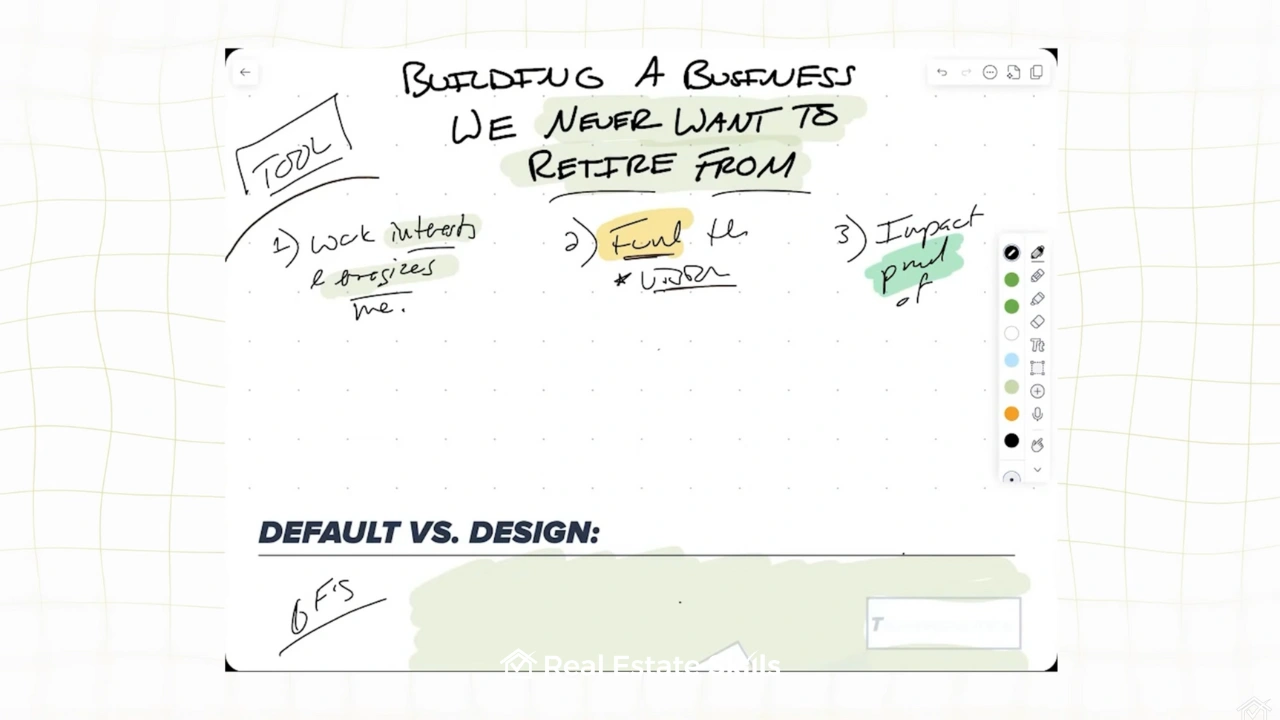
Those three things are:
1. Your business should give you work that interests and energizes you.
You don’t have to be passionate about the topic (like mountain biking), but your business should enable you to do more of what you’re passionate about. And inside the business, more of your work should energize you than drain you.
For example, podcasts like this give me energy. I can’t directly attribute them to revenue, but they give me energy — and when I put more energy-giving activities in my schedule, I do better in work and life.
2. Your business should fund your vision.
This is where many people get burned out. I was talking with someone earlier today who has a successful business but keeps pushing and pushing, wondering why he feels what I call “anxious striving.”
Anxious striving is when no matter what goal you hit, it doesn’t fill the void. There’s always a cloud over you, preventing peace. That usually happens when we build a business based on ego or what others think, rather than building it to fund the life we actually want.
You need to define your ideal average day and put a number to it. Hire the business to fulfill that number — not more. Many people overbuild their business and overfund their lifestyle, chasing numbers that don’t actually matter.
3. Your business should give you impact you’re proud of.
When we’re not guided by purpose, we chase ego, recognition, growth, and external rewards. That’s what leads to burnout — working hard and not knowing why.
Impact, Purpose & Avoiding Ego-Driven Growth
If we don’t run our business with these three things in mind — energizing work, funding the vision, and meaningful impact — we drift toward ego-driven growth. That’s how burnout creeps in.
I’ve chased the accolades: the big bank accounts, the Inc. 5000 awards, the real estate, the millions in revenue. And after hitting all those things, I learned they don’t fill the void.
Once you get clarity on the job your business is supposed to do, you can evaluate whether it’s actually doing that job. That’s where we move into the framework I call The Four Paths.
The Four Paths Framework
At any given time, we are all on one of four paths — either above the line or below the line.
Above the line feels good. There’s momentum and progress.
Below the line feels heavy. There’s stagnation, anxious striving, and frustration.
Burnout happens when we move back and forth between two specific paths below the line: distraction and busywork.
I’ve got something called the Momentum Meter that I’ll break down later — and when people follow it, they get out of burnout within one to two weeks. Their mind becomes clear, and momentum picks up. We’ll end this segment with that.
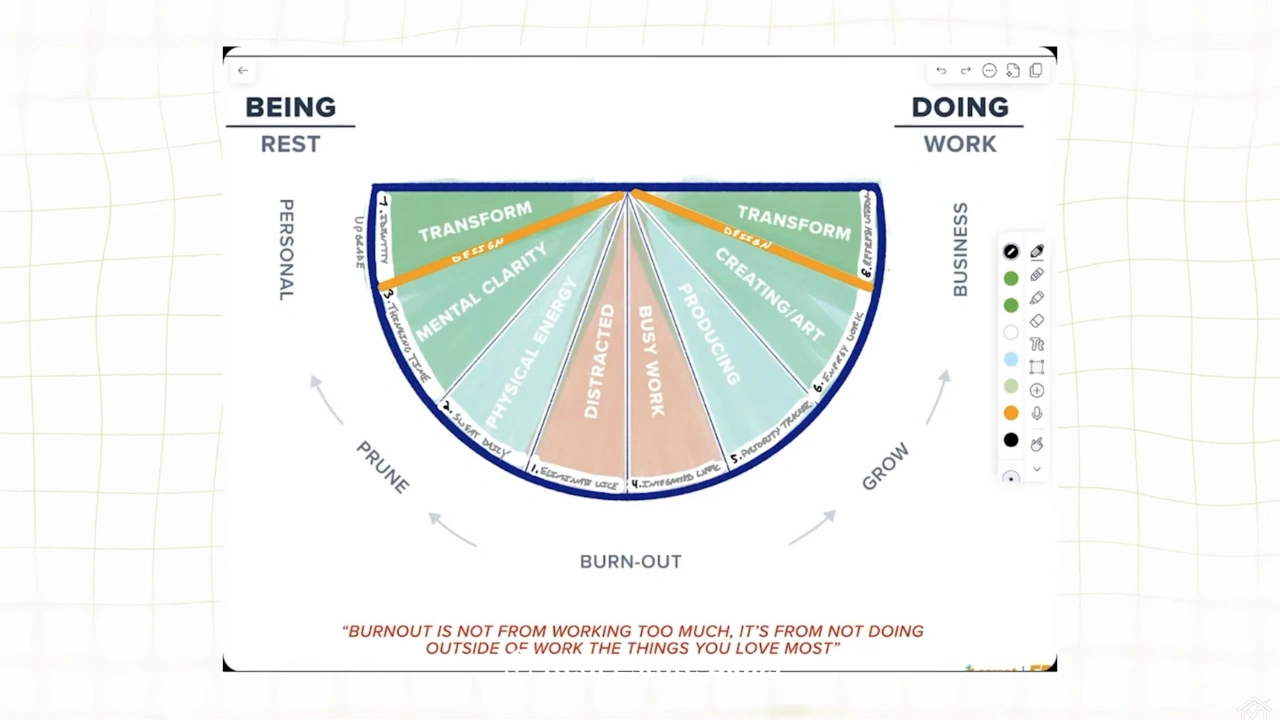
For now, let’s break down the four paths.
1. Burnout: Distraction & Busy Work Cycle
Burnout is literally cycling between distraction and busywork.
Distraction → Busy Work → Distraction → Busy Work.
You feel like you’re working hard, but not moving forward. You’re drained, fuzzy, and constantly trying to get through the week just to escape into the weekend.
2. Transformation (Above the Line)
Transformation is when you fundamentally grow in one area of your life. My framework uses the “Six Fs”: faith, family, friends, fitness, finances, and fun.
Transformation requires a vision. If you want to level up your fitness, finances, or business, you need to know what you’re trying to build. Without vision, you can’t transform.
You might transform one to three areas per year, depending on your pace. It feels great — full of momentum.
4. Success (Above the Line)
Success is where most people want to live. But many people mistake society’s definition — big bank accounts, awards, accolades — for true success.
I chased all of those and learned they don’t fill the void. Success has to be defined internally, not externally.
Most of us stay in success until something shifts.
4. Default Mode → The Start of Decline
After a period of success, we often settle into default mode. The business is working, so we don’t want to change too much. We fear disrupting what’s working, so we avoid decisions.
Default mode feels comfortable but slowly leads to stagnation. Metrics soften. We “work harder” doing the same things. We tweak little things but avoid big decisions.
Stagnation feels like slow burnout.
The Decline into Frustration and Drift
Default mode doesn’t happen all of a sudden. You start to see some of your metrics soften a little, and you think, “Well, let’s just work a little harder next month doing the same things that got us here and see if that changes it.” Then you make little tweaks here and there hoping things will improve. Usually, they don’t.
So you start to get frustrated. This is the first level below the line. You stay in default mode too long, things aren’t working the way they used to, and you start stacking losses. Earlier, you were stacking wins and it built confidence. You felt on top of the world because what you were doing was working. Down here, you start stacking L’s, which lowers confidence.
When you start losing confidence, you get hesitant. You start stacking ideas, letting fear creep in, feeling apprehensive. Your ego gets hit. Limiting beliefs pop up. And you stop doing one thing: making decisions. You fall into indecision.
What takes us above the line is actually decision. The reason you grew and started transforming in your business is because you made a decision: “I’m going to do this and not do that.” You moved. But when you’re below the line, you stack ideas and stop making decisions.
When you’ve been frustrated long enough, you drift. This is where burnout begins. I don’t want to go surface-level—I’m going deep because this is where it gets real, and this is how you’ll solve it. I’m going to give you three steps that will solve it if you follow them. And once you understand the model and the path, you’ll know how to solve burnout forever.
When you drift, you drift into your vices. Vices are anything that distract from the day-to-day, anything numbing or draining, anything that gives you a temporary reprieve from the dullness—but becomes destructive when done repeatedly.
Identifying and Eliminating Vices
A vice is something that becomes destructive when repeated. Not every reprieve is a vice. If it’s healthy and repeated, do more of it. But if repeated use becomes destructive, it’s a vice.
Examples include doom-scrolling, porn, drugs, alcohol, or even obsessively checking Slack or email to get a quick dopamine fix. Vices give you a temporary “hit” because you’re not getting joy from your day-to-day work—you’re in default mode and frustration.
When burnout hits, we start eliminating the very things that give us the most joy because we think, “I just need to work harder.” We cut workouts. We cut weekly mountain-bike rides. We cut basketball with friends. We cut date nights. We say, “I’ll pick that back up next month. I need to put my head down and grind.”
I worked with an eight-figure client who was deep in burnout and couldn’t figure out why. When you stay here, you lose confidence. You lose vision. You can’t think big. You start pressing down your dreams because every time you reach for a vice, it lowers confidence and erodes momentum.
How To Recover From Burnout in 3 Steps
Step 1: Eliminate the vice.
With my eight-figure client, we identified two vices he’d been reaching into. I told him: until those vices are eliminated, he wouldn’t get out of burnout or regain momentum. You can’t think clearly while reaching into your vice. Even “just one hour” of doom scrolling clouds judgment. You will never get above the line until the vice is gone.
I have a process called the Vice Elimination Process—DM me on Instagram (@TrevorTrou*) and I’ll share it. But the key is: eliminate the vice ruthlessly.
Step 2: Once the vice is gone, the brain fog lifts within a week or two.
Now we step back into design. Dream again. Pick one area of your life or business. Create a basic vision for where you want to grow.
Step 3: Make decisions.
Ask: What will I start doing that brings joy and moves me toward this vision? What will I stop doing? Decisions must be followed by calendar changes. No decision is real unless your calendar changes.
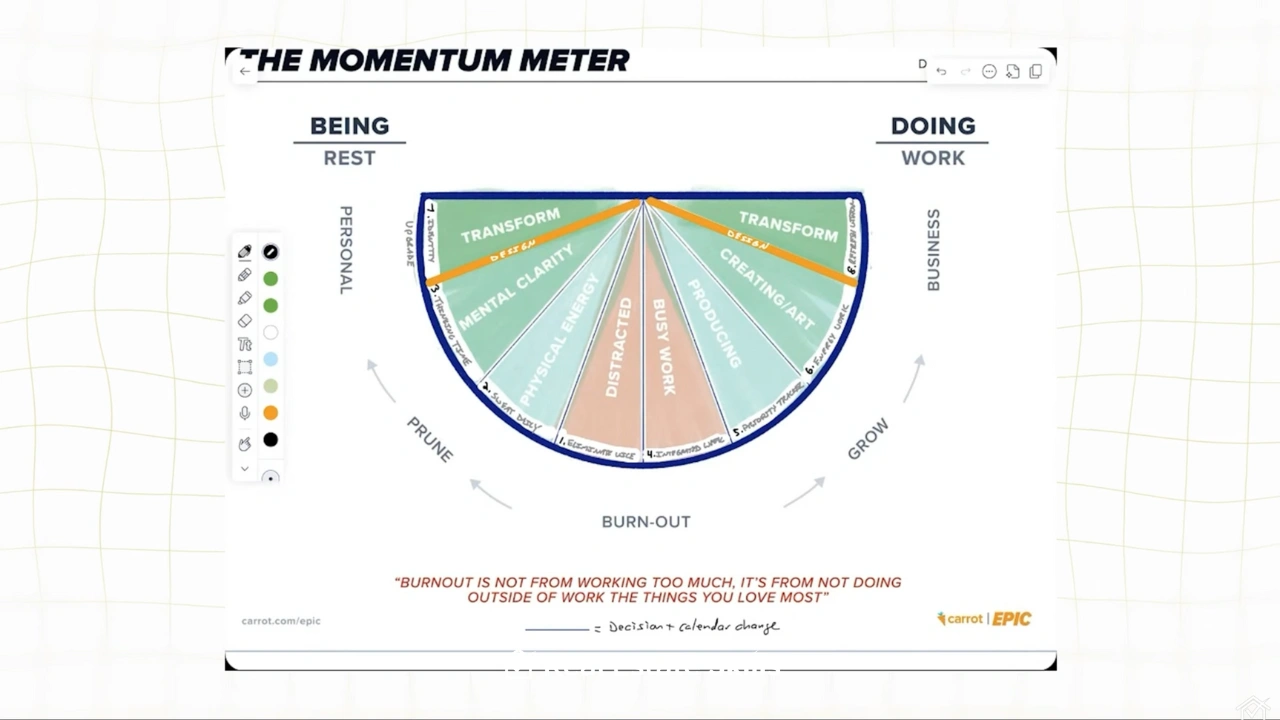
This is the foundation of what I call the Momentum Meter.
The Momentum Meter: Rest vs. Work
The Momentum Meter visualizes two parts of life: being (rest) and doing (work). If something gets hard, our instinct is to push harder, work more, grind more. But that’s the opposite of what lifts burnout.
Burnout isn’t caused by working too much—it’s caused by eliminating the things outside of work that bring you the most joy.
This is a pendulum. When you pull the pendulum too far into work, the only way out is to swing in the opposite direction—toward joy, rest, and energy.
When you cut out the things that give you energy, your subconscious associates hard times with losing joy. That creates anxiety. But if instead, you double down on the things that energize you during hard times, your brain learns the opposite: when things get tough, you get more life.
That fuels you to solve problems with energy instead of exhaustion.
This is why, even during challenges, I stay positive: I still work out every day. I still do two Bible studies a week. I still do date mornings every Tuesday. I still take my kids to school. I still go on quarterly retreats. I still take thinking time. Those don’t get cut out. You need those more when times are hard—not less.
Burnout Isn't Working Too Much, It's Losing Joy
You’re going through the furnace to remove those impurities. You’re going through the furnace to remove those limiting beliefs, to remove those bad habits and those vices, to remove what I call “dirty fuel”—the ego, the stuff you need to release so others can see you in a different light. Remove all that crap. This is for you, okay? It’s not happening to you.
You’re going through the fire, and that’s a good thing. Let it refine you. But you’ve got to remove the impurities in the process. That’s how you do it.
So the Momentum Meter shows these two parts of life: the being, or rest side, and the doing, or work side. We are beings—we need to rest. And then we are doing—we’re called to work, too. Even in scripture, we’re called to that.
But when things get really hard and you’re in burnout mode, what do we do? We think, “I just need to push through this. I’ll put my head down and work. I’ll cancel all the things I love to do and just grind.” But the answer is not to work more. That’s actually the opposite of what will pull you out of burnout.
Think of it like a pendulum. When you pull a pendulum far up in one direction, it swings to the equal and opposite side. Life works the same way. Burnout isn’t from working too much. Burnout comes from not doing the things outside of work that you love the most.
Adding Joy Back into Your Calendar
When things got busy, hard, or you slipped into default mode and frustration, you cut all the things in your schedule that gave you the most joy and energy. You told yourself, “I’ll get back to these later.” That’s the real problem.
Your answer is not to work more. Your answer is to put more things in your calendar today that give you energy and life.
Because what happens if every time something gets hard, you cut the things you love the most? Subconsciously, that creates anxiety. It creates a pit in your stomach. Hard times become associated with losing joy. And your reaction to struggles becomes: cut joy, work harder, feel worse.
But what if, instead, when things got hard, you doubled down on the things that give you life and joy outside of work? That fuels you. That gives you positive energy to solve the work problems in front of you.
People ask, “Dude, we’re going through a big challenge right now—how are you even this positive? How do you have this energy?” It’s because I don’t cut out the things that feed me. I still work out every day. I do two Bible studies a week—one with customers, one with friends. I do date mornings every Tuesday from 8–11 with my wife. Those don’t get cut out.
We take quarterly retreats together—those don’t get cut out. I pick up my kids from school on Fridays. I take them to school every day. That doesn’t get cut out. I schedule thinking time in my week—also not cut out.
You need these things more when it’s hard, not less.

Daily Habits to Regain Energy & Clarity
If you're in burnout, your rest is probably only happening through distraction. Real rest includes:
- Eliminating distraction
- Physical energy
- Mental clarity
- Transformation
To get out of burnout:
- Eliminate the vice completely. Zero chance for relapse. Use blockers, remove access, create accountability, go extreme.
- Add daily physical energy. Not to get abs—energy comes from movement. Work out daily if you want energy daily.
- Add mental clarity. Walks without podcasts, massages, reading, thinking time. When you gain mental clarity, you slingshot forward.
Do this long enough, and momentum kicks in. You transform personally—and your business must grow because businesses can never outgrow the identity of their owner.
Slingshot into Transformation
Once you’ve eliminated vices and restored physical energy, you start to gain clarity on your priorities. This clarity allows you to create a seven-figure income, and with consistent mental focus, you can scale even higher—into higher seven figures or eight figures.
Daily habits like thinking time, massages, walks, and quiet reflection help maintain mental clarity. Trevor shares, “I do two to three walks a week, sometimes walking talks, or just walking with no distractions. I also have regular massages, spend time on my porch reading, and I read 10 pages of a book every day. I also study the Bible daily. These routines help me get mental clarity.”
When mental clarity is established, everything else slingshots forward. You start creating your “art”—the work that feels effortless and produces the most value. Over time, this momentum fuels transformation, both personally and professionally. Your vision expands, confidence grows, and your business has no choice but to transform alongside you.
Final Thoughts on How To Recover From Burnout
If you're in distraction → busy work → distraction → busy work, you're in burnout. You must eliminate the vice and rise into clarity.
You may feel dirty, exhausted, unclear—but like gold, you’re simply in the refining fire. The furnace feels painful, but it removes impurities so you can become valuable and useful again. The trial is not happening to you but for you.
Be on the lookout for the next series. And if you want to build a hyperprofitable wholesaling and flipping business, then check out my full- in-depth training at real estateskills.com/watch. See you there and happy wholesaling!
If you’re serious about doing your first real estate deal, don’t waste time guessing what works. Our FREE Training walks you through how to consistently find deals, flip houses, and build passive income—without expensive marketing or trial and error.
This FREE Training gives you the same system our students use to start fast and scale smart. Watch it today—so you can stop wondering and start closing.
*Disclosure: Real Estate Skills is not a law firm, and the information contained here does not constitute legal advice. You should consult with an attorney before making any legal conclusions. The information presented here is educational in nature. All investments involve risks, and the past performance of an investment, industry, sector, and/or market does not guarantee future returns or results. Investors are responsible for any investment decision they make. Such decisions should be based on an evaluation of their financial situation, investment objectives, risk tolerance, and liquidity needs.

👉FREE Training
How To Consistently Wholesale, Flip Houses, & Invest In Rental Properties From The MLS
(Without Spending $1 On Marketing)

Alex Martinez, the founder of Real Estate Skills, is known for his strong, practical expertise in real estate, starting from a beginner with no family connections in the industry to acquiring over 55 real estate deals, including wholesale and flips, within his first year.
He has dedicated his career to providing cutting-edge education and resources for real estate professionals. He emphasizes the importance of self-taught knowledge through mentors, books, and hands-on experience.
His journey from earning a modest income to becoming a successful real estate entrepreneur and educator showcases his expertise and dedication to the field.

Ryan Zomorodi, co-founder and COO of Real Estate Skills, leverages his experience from a diverse background in real estate investment, construction management, and entrepreneurship to provide comprehensive education in the real estate sector.
His expertise is rooted in hands-on experience, extensive industry knowledge, and a commitment to empowering others through education.
Ryan's journey reflects a blend of practical experience and entrepreneurial success, contributing to his role in developing a platform that educates and supports aspiring real estate professionals.
Read Ryan's Full Bio >>
