
How To Flip Commercial Real Estate: The Step-By-Step Guide (2026)
Feb 02, 2026
Key Takeaways: How To Flip Commercial Real Estate
- The Opportunity: In residential real estate, value is subjective (comps). In commercial real estate, value is objective (math). If you increase the income, you automatically force the value up.
- The "Trap": Most investors look for physical distress (broken windows). You must look for financial distress (below-market rents, high vacancies, and bloated expenses).
- The Strategy: You don't flip the building; you flip the Net Operating Income (NOI). Buy a messy P&L statement, stabilize the operations, and sell the cash flow to an institutional buyer.
What You’ll Learn: The "Value-Add" methodology for sourcing, funding, and flipping commercial assets without using your own cash.
Flipping houses is a visual game. How to flip commercial real estate is a financial game. When you flip a single-family home, you are betting that a family will fall in love with your renovation. When you flip a commercial property—whether it is a multifamily apartment complex, a retail strip center, or an industrial warehouse—you are proving to an investor that the asset generates more profit today than it did yesterday.
Most beginners fail because they treat commercial assets like big houses. They look for "curb appeal" potential. We look for "operational inefficiency." Commercial flipping is not about physical renovation; it is about operational optimization. You are flipping the Net Operating Income, not just the building. By purchasing an asset with a broken P&L and fixing the revenue stream, you manufacture equity out of thin air.
Here is what we will cover:
- The Math-First Mindset: Valuation vs. Comps
- The 5-Step Commercial Flipping Blueprint
- The NOI Multiplier Effect
- Case Study: The 10-Unit Turnaround
- The 3 Hidden Deal Killers
- Commercial Flipping FAQ
Ready to start your real estate investing journey? You don't need millions in the bank or a degree in finance to succeed. Our FREE Training reveals the proven path to launch your investing business and close your first deal with confidence—even if you're starting from scratch.
The Missing Link: How To Find The Deal
Why watch this? You cannot flip a commercial property if you can't find one at a discount. While this video focuses on wholesaling, the sourcing engines described here are the exact same ones we use to acquire multifamily and commercial assets. If you want to bypass the brokers and find sellers directly, this is your blueprint.
The Math-First Mindset: Valuation vs. Comps
The hardest part for investors transitioning from residential to commercial is unlearning the "Comparable Sales" approach. In residential real estate, your house is worth what the neighbor's house sold for. If they have granite countertops and you have granite countertops, the value is roughly the same. This is subjective valuation.
Related Reading: How to Flip a House Step-by-Step (No Experience Needed)
Learning how to flip commercial real estate requires an objective mindset. Your building is not worth what the building next door sold for; it is worth exactly what it earns. This is known as the Income Approach. The value of any commercial asset is derived from a simple, non-negotiable formula: the Net Operating Income (NOI) divided by the market Capitalization Rate (Cap Rate).
Net Operating Income (NOI) / Cap Rate = Property Value
The NOI is your total revenue minus operating expenses (excluding mortgage payments). The Cap Rate is the rate of return the market expects for that specific asset class and location. This formula reveals the "Multiplier Effect" that makes commercial flipping so lucrative.
In a residential flip, a $10,000 renovation might add $10,000 or $15,000 to the home's value. In commercial real estate, because of the Cap Rate divisor, a $10,000 increase in annual income increases the property value exponentially. If you are in a market with a 5% Cap Rate, every single dollar you add to the bottom line increases the asset's value by $20 ($1 / 0.05 = $20).
This means if you raise rents by just $10,000 across the entire building, you have instantly forced $200,000 in equity. You did not need the market to appreciate. You used math to force the value up. In commercial real estate, the market determines the Cap Rate, but the investor determines the Net Operating Income. This is your leverage.
To flip a commercial property, you do not focus on cosmetic repairs unless they directly allow you to raise rent. Every renovation dollar must have a direct line of sight to an NOI increase.
The Blueprint: 5 Steps to Flip Commercial Assets
Executing a commercial flip requires military precision. You are dealing with longer timelines, stricter lenders, and professional tenants. Unlike residential flipping, where a mistake costs you a few thousand dollars in holding costs, a mistake in commercial due diligence can bankrupt the deal before you even close. Here is the process map we use to navigate these waters.
Step 1: Sourcing (The "Off-Market" Mandate)
Most beginners fail here because they look for deals on LoopNet or Crexi. In the industry, we call LoopNet the "graveyard where deals go to die." By the time a value-add opportunity hits the public market, the listing broker has already pitched it to their top five "pocket buyers." If those buyers passed, there is usually a reason.
To successfully learn how to flip commercial real estate, you must source opportunities before they are listed. You are looking for tired landlords, out-of-state owners, or assets with high vacancy rates. You must build a direct-to-seller marketing funnel or network with "deal finders" (wholesalers) who specialize in commercial assets. You cannot pay retail and expect to flip for a profit.
Related Reading: 12 Best Ways To Find Off-Market Properties
Step 2: The Audit (Due Diligence)
In residential, you inspect the roof and foundation. In commercial, you inspect the leases. The physical condition matters, but the legal condition of the income stream is paramount. Sellers will often present a "Pro Forma," which is a document showing what the building could make in a perfect world. You must ignore this. You need the "T-12" (Trailing 12-Month Financials) and the Rent Roll. You are looking for discrepancies between what the lease says and what the bank deposits show.
Beyond the financials, you must protect yourself from environmental liability. You never close on a commercial asset without a Phase I Environmental Site Assessment (ESA). If the building was once a dry cleaner or gas station, you could be liable for millions in soil remediation. The Phase I ESA is your insurance policy against buying a toxic asset.
The Estoppel Trap: Why You Never Close Without It
- The Risk: A seller claims a tenant pays $5,000/month. You buy the building, and the tenant says, "No, I have a side agreement to pay $3,000," or "The landlord owes me $10,000 in tenant improvements."
- The Fix: Demand Tenant Estoppel Certificates. This is a document signed by the tenant confirming the lease terms, rent amount, and that the landlord owes them nothing. If a tenant signs it, they are legally bound to it.
Step 3: The Bridge (Financing the Gap)
Traditional banks (Fannie Mae/Freddie Mac) hate risk. They want stabilized, fully occupied buildings with a proven history of income. Since you are buying a distressed asset to flip, you cannot use traditional financing. You need speed and flexibility, not low interest rates.
You will likely use Bridge Debt (also known as private money or hard money). These loans "bridge" the gap between the distressed purchase and the stabilized exit.
Expect the terms to be higher than market rates, often interest-only, with a term of 12 to 24 months. While expensive, these loans often cover up to 75% of the purchase price and 100% of the renovation costs. The lender is betting on the asset's potential, not your personal income.
Step 4: The Value-Add (Forcing the Equity)
This is where the work happens. Your goal is to drive NOI up. You do this through two specific levers: Revenue Expansion and Expense Compression.
Revenue expansion is not just about raising rent. You can implement RUBS (Ratio Utility Billing Systems) to bill water, sewer, and trash costs back to the tenants, instantly decreasing your expenses. It’s not just about raising the rent. You need to hunt for 'dead' square footage you can turn into cash flow. Can you drop storage lockers in the unused basement? Install covered parking spots? Add coin-op laundry?
Then, go on the defensive. Sub-meter the utilities so you aren't paying for tenants' long showers. Fight the property tax assessment immediately. Bid out the landscaping and dumpster contracts. Remember, every single dollar you cut from the operating budget forces your equity upward.
Step 5: The Exit (Flip or Refi)
Once the property is stabilized (meaning occupancy is high and rents are at market rates), you have created a sellable product. You now have two choices. First, you can sell the asset. Institutional buyers, REITs, and syndications will pay a premium for a "turnkey" cash-flowing asset because they need to deploy capital but don't want to do the renovation work.
Second, you can execute the BRRRR strategy (Buy, Rehab, Rent, Refinance, Repeat). You refinance out of your high-interest Bridge Loan into a long-term, low-interest commercial loan. If you bought right and forced enough appreciation, the new loan pays off the bridge debt and returns your original down payment, allowing you to keep the cash-flowing building for "infinite" returns.
Related Reading: The BRRRR Method: Formula, Strategy, & Examples In Real Estate
Stop Guessing Your Returns: The Math Doesn't Lie
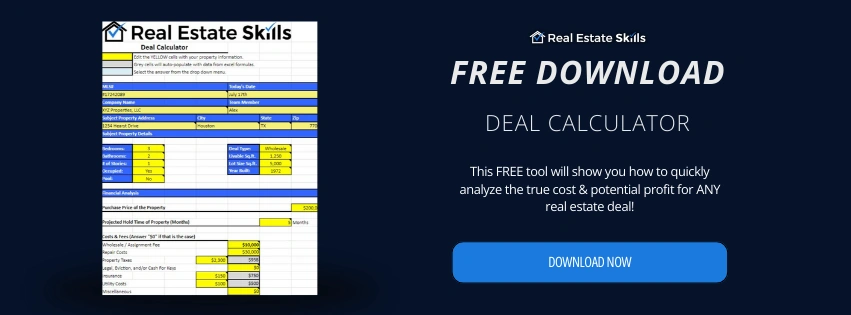
In commercial flipping, a 0.5% miscalculation in your Exit Cap Rate can wipe out your entire profit. You cannot underwrite these deals on a napkin. We built a professional-grade calculator that lets you plug in the T-12 financials, project your "Value-Add" NOI increases, and instantly see if the deal pencils out. Download the tool we use to determine our Maximum Allowable Offer (MAO) and avoid "negative leverage" before you make an offer.
The Economics: The "NOI Multiplier" Matrix
To understand why commercial flipping is so potent, you must grasp the math behind the "Multiplier Effect." In a residential flip, dollar-for-dollar value creation is rare. In commercial real estate, every dollar of income you add creates multiple dollars of equity.
The magnitude of this multiplier depends on the market Cap Rate. Counterintuitively, "expensive" markets with low Cap Rates offer the highest profit potential for value-add investors. The lower the Cap Rate, the more valuable your income stream becomes. This concept is often referred to as commercial real estate math or cap rate sensitivity analysis.
The table below demonstrates the equity created by adding just $10,000 in annual Net Operating Income across different market conditions.
| Market Cap Rate | The "Multiplier" | Equity Created |
|---|---|---|
| 10% Cap Rate | 10x | $100,000 |
| 8% Cap Rate | 12.5x | $125,000 |
| 6% Cap Rate | 16.6x | $166,667 |
| 4% Cap Rate | 25x | $250,000 |
Think about the leverage here. In a hot market with a 4% Cap Rate, every single dollar you trim from the expenses adds $25 to the building's value. This is why the pros fight for every penny on the P&L. They aren't just trying to save money—they are using the multiplier to print equity.
Case Study: The 10-Unit Turnaround (The Math In Action)
Theory is useful, but real estate is played in the real world. To fully grasp how to flip commercial real estate, let’s walk through a hypothetical "Value-Add" deal on a small apartment complex. This scenario illustrates exactly how a rent increase translates into a six-figure check.
The Asset: "Sunset Apartments"
You find a 10-unit apartment building owned by a "tired landlord" who hasn't raised rents in five years.
The Purchase Price: $1,000,000.
The Market Cap Rate: 6%.
The Problem (The Opportunity)
The current rents are $800/month per unit. However, market research shows that renovated units in the area are renting for $1,100/month. The landlord is leaving $300 per unit, per month, on the table. This is "loss to lease," and it is your profit margin.
The Value-Add Plan
You secure a Bridge Loan to cover the purchase and the renovation. You plan to spend $15,000 per unit ($150,000 total) to install new flooring, paint, and fixtures. This allows you to raise rents to the market rate of $1,100.
The Result: Forced Appreciation
Here is how that $300 rent increase alters the valuation of the building at a 6% Cap Rate.
| Metric | Before (Purchase) | After (Stabilized) |
|---|---|---|
| Monthly Rent (Per Unit) | $800 | $1,100 |
| Total Annual Income | $96,000 | $132,000 |
| Expenses (40%) | ($38,400) | ($52,800) |
| Net Operating Income (NOI) | $57,600 | $79,200 |
| Valuation (NOI / 6% Cap) | $960,000 | $1,320,000 |
The Profit Check:
By increasing the NOI by just $21,600 per year, you forced the property value up by $360,000.
New Value: $1,320,000
(-) Purchase Price: $1,000,000
(-) Reno Cost: $150,000
(=) Gross Profit: $170,000
You didn't wait for the market to go up. You created $170,000 in equity by managing the asset better than the previous owner. That is the power of commercial flipping.
The 3 Hidden Deal Killers (Read Before You Buy)
In residential flipping, the worst thing that happens is you go over budget on repairs. In commercial flipping, the pitfalls are legal and structural. If you miss one of these during due diligence, no amount of renovation will save the deal.
1. The "Yield Maintenance" Trap (Prepayment Penalties)
This is the number one rookie mistake. Many commercial loans come with a "Prepayment Penalty" or "Yield Maintenance" clause. This guarantees the lender a set profit.
- The Trap: You buy a building, renovate it in 12 months, and try to sell it. The bank says, "Fine, but you owe us a $150,000 penalty for paying the loan off early."
- The Fix: You must ensure your Bridge Debt has no prepayment penalty. You need the flexibility to sell or refinance the moment the asset is stabilized.
2. Losing "Grandfathered" Status
Many older commercial buildings are "Legal Non-Conforming." For example, a 10-unit apartment building in a zone that now only allows 4-unit buildings.
- The Trap: You gut-renovate the property. The city deems this a "new construction" project and forces you to comply with current zoning codes. Suddenly, you are forced to reduce your unit count from 10 to 4, destroying your NOI.
- The Fix: Check the "Renovation Threshold" with the city planning department. Often, if you alter more than 50% of the structure, you lose your grandfathered status.
3. The "Recourse" Nightmare
- The Trap: You sign a "Recourse Loan." This means if the deal fails, the lender can come after your personal house, your car, and your bank accounts.
- The Fix: Always aim for Non-Recourse Debt. In a non-recourse loan, the collateral is the property itself, not your personal life. If the deal goes south, you hand the keys back to the bank and walk away with your personal assets untouched.
Commercial Flipping FAQ
Transitioning from residential to commercial investing involves a new vocabulary and a different set of rules. Here are the direct answers to the most frequent questions we receive regarding licenses, capital requirements, and asset classifications.
Final Thoughts On Commercial Flipping
Commercial flipping isn't just about chasing bigger numbers; it’s about having better mechanics. With a house, you’re often just crossing your fingers and hoping the market cooperates. Commercial puts you in the driver's seat. You control the revenue, you control the expenses, and that means you—not the market—get to decide what the property is worth.
The "Value-Add" strategy is the closest thing to a cheat code in real estate investing. It allows you to manufacture equity regardless of what the economy is doing. If you are tired of the residential rat race and ready to build wealth through simple, scalable math, the commercial sector is waiting.
Your Next Step: Do not just read about it. Prove the math to yourself. Download our Deal Calculator, find a listing on LoopNet (just for practice), and see exactly how a $50 rent increase changes the valuation. The numbers will tell you everything you need to know.
Ready to start your real estate investing journey? You don't need millions in the bank or a degree in finance to succeed. Our FREE Training reveals the proven path to launch your investing business and close your first deal with confidence—even if you're starting from scratch.
*Disclosure: Real Estate Skills is not a law firm, and the information contained here does not constitute legal advice. You should consult with an attorney before making any legal conclusions. The information presented here is educational in nature. All investments involve risks, and the past performance of an investment, industry, sector, and/or market does not guarantee future returns or results. Investors are responsible for any investment decision they make. Such decisions should be based on an evaluation of their financial situation, investment objectives, risk tolerance, and liquidity needs.

👉FREE Training
How To Consistently Wholesale, Flip Houses, & Invest In Rental Properties From The MLS
(Without Spending $1 On Marketing)

Alex Martinez, the founder of Real Estate Skills, is known for his strong, practical expertise in real estate, starting from a beginner with no family connections in the industry to acquiring over 55 real estate deals, including wholesale and flips, within his first year.
He has dedicated his career to providing cutting-edge education and resources for real estate professionals. He emphasizes the importance of self-taught knowledge through mentors, books, and hands-on experience.
His journey from earning a modest income to becoming a successful real estate entrepreneur and educator showcases his expertise and dedication to the field.

Ryan Zomorodi, co-founder and COO of Real Estate Skills, leverages his experience from a diverse background in real estate investment, construction management, and entrepreneurship to provide comprehensive education in the real estate sector.
His expertise is rooted in hands-on experience, extensive industry knowledge, and a commitment to empowering others through education.
Ryan's journey reflects a blend of practical experience and entrepreneurial success, contributing to his role in developing a platform that educates and supports aspiring real estate professionals.
Read Ryan's Full Bio >>
