
Rehab Calculator: How To Estimate Repair Costs (2026 System)
Jan 14, 2026
Key Takeaways: Rehab Calculator
- What: A dynamic "3-Tier System" (Napkin, Square Footage, and Line-Item) for estimating renovation costs.
- Why: Accurate estimating is the only way to avoid the "money pit" scenario and protect your hard-earned capital.
- How: By matching the depth of your calculation to the specific stage of the deal—screening, offering, or closing.
What You’ll Learn: How to predict construction costs with professional accuracy, even if you have never picked up a hammer.
A rehab calculator is the only barrier between a profitable flip and a bankruptcy filing. In the high-stakes world of house flipping, the difference between a home run and a financial disaster often comes down to a single spreadsheet cell.
Whether you are wholesaling or fixing and flipping, you need a process that adapts to the speed of the market. Drawing from the principles in our Ultimate Guide To Start Real Estate Investing, we have developed a tiered estimation system that prevents you from overpaying for properties while ensuring you never spend hours analyzing a deal that isn't real.
Here is what we will cover:
- The 3-Tier Estimation System
- Tier 1: The Napkin Test (Screening)
- Tier 2: The Square Footage Method (Soft Offer)
- Tier 3: The Line-Item Bid (Due Diligence)
- How to "Audit-Proof" Your Calculator
- Frequently Asked Questions
If you’re serious about doing your first real estate deal, don’t waste time guessing what works. Our FREE Training walks you through how to consistently find deals, flip houses, and build passive income—without expensive marketing or trial and error.
This FREE Training gives you the same system our students use to start fast and scale smart. Watch it today—so you can stop wondering and start closing.
The 3-Tier Estimation System
The biggest mistake new investors make isn't miscalculating specific rehab costs; it's knowing what to do with the numbers they get and where to apply them with confidence. If you spend countless hours building a renovation budget template or typing too many numbers into a calculator that you're not confident in, you are wasting your time. Conversely, if you rely on a "napkin number" to sign a closing statement, you are committing financial negligence.
A professional rehab calculator is not a single tool. It is a workflow. You need different levels of fidelity depending on how "real" the deal is.
We use a specific 3-Tier System to move from "lead" to "contract" to "closing" without getting stuck in analysis paralysis.
| Tier Level | Goal | Time Required | Accuracy |
|---|---|---|---|
| Tier 1: The Napkin Test | Filter out bad leads immediately. | < 2 Minutes | Low (Broad Estimate) |
| Tier 2: Sq. Ft. Method | Submit a "Soft Offer." | 10-15 Minutes | Medium (Market Avg) |
| Tier 3: Line-Item Bid | Verify costs during due diligence. | 2-3 Days | High (Contractor Bids) |
Most real estate deal analysis software tries to force you into Tier 3 immediately. That is a trap. You should only escalate to the next tier of calculation once the seller has passed the previous test. This protects your time and ensures you are only doing deep work on deals that actually have profit potential.
Tier 1: The Napkin Test (Speed & Screening)
The "Napkin Test" is designed for one thing: speed. When you have 50 leads on your desk, you cannot afford to run a full construction analysis on every single one. You need a fast way to throw out the trash so you can focus on the gold.
For this stage, we use the 70% Rule. This is a "back-of-the-envelope" calculation that helps you determine the Maximum Allowable Offer (MAO) in about 60 seconds. It assumes that if you buy a property at 70% of its future value—minus repairs—you will have enough margin for holding costs, transfer taxes, lender points, and profit.
(After Repair Value x 0.70) – Estimated Repairs = Maximum Allowable Offer (MAO)
Warning: Do not buy a house based on this number alone.
The 70% Rule is a sledgehammer, not a scalpel. It is a filtering mechanism. If a seller wants $300,000, but your 70% rule calculator says the max offer is $190,000, you don't need to worry about the cost of the roof. The gap is too wide. You make a verbal "lowball" offer and move on. If they accept or counter near your range, then you graduate the deal to Tier 2.
Here is how we use this math in real-time to analyze wholesale deals quickly:
Tier 2: The Square Footage Method (The "Soft Offer")
Once a seller passes the Napkin Test and expresses interest, you need a sharper number. You are not ready to hire a contractor yet, but you need to be accurate enough to sign a Purchase and Sale Agreement (PSA) with an inspection contingency.
This is where the Square Footage Method comes in. It allows you to estimate repairs remotely by categorizing the property into one of three "Scope Levels" and multiplying the total square footage by a set dollar amount.
In 2026, labor rates and material costs have shifted. Depending on your market, a cosmetic rehab cost that was $20 per square foot three years ago might be closer to $35 today. Below are the ranges we are seeing in most metro markets.
2026 Renovation Cost Ranges (National Averages)
- Light Rehab (Cosmetic): $25 – $40 per sq. ft.
Includes: Interior/exterior paint, new flooring (LVP/carpet), light fixtures, landscaping cleanup, and minor repairs. No layout changes. - Medium Rehab (Value-Add): $50 – $75 per sq. ft.
Includes: All cosmetic items plus kitchen remodel (cabinets/counters), bathroom updates, new windows, and minor electrical/plumbing updates. - Heavy Rehab (Full Gut): $90 – $135+ per sq. ft.
Includes: Stripping to the studs. New roof, HVAC, electrical panel, plumbing, structural repairs, framing, and drywall. Essentially building a new house inside an old shell.
The "Soft Offer" Strategy:
If you are looking at a 1,500 sq. ft. house that needs a kitchen update and new floors (Medium Rehab), the math is simple:
1,500 sq. ft. x $60 (Avg Medium Cost) = $90,000 Estimated Rehab.
Use this number to populate your initial rehab calculator. It gives you enough confidence to get the property under contract. Once you have the deal secured, you enter the due diligence period, which is where you bring in the professionals to verify your math.
Stop Guessing and Start Analyzing Deals Today
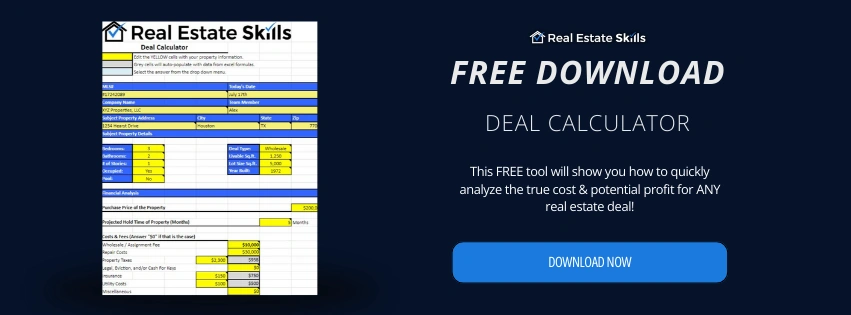
Success in the 2026 market is built on speed and mathematical precision. If you want to start analyzing a deal today, we have a professional-grade calculator ready for you right now. Don't let a "maybe" deal sit on your desk; use our proven wholesale real estate calculator to reverse-engineer your profit spread and lock in your assignment fee before the competition even opens their spreadsheet.
Tier 3: The Line-Item Bid (Due Diligence)
Once you sign the contract, the real work begins. You usually have a 7 to 10-day inspection window to confirm your numbers. This is the difference between guessing and knowing.
At this point, a broad "cost per square foot" estimate isn't good enough. You need a detailed renovation budget template that accounts for every dumpster load and permit fee. If you are wholesaling, your buyers need to see this level of detail to trust your deal. If you are flipping, this budget is your roadmap to profit.
We break our final budget down into six distinct phases. If you leave a line item blank, make sure it is because the house doesn't need it, not because you forgot to check.
The Master Rehab Checklist
Phase 1: The Exterior (Curb Appeal)
- Roofing: Tear-off, new shingles, decking repair, flashing, gutters/downspouts.
- Siding & Paint: Power wash, repair rot, full exterior paint, or new vinyl/hardie siding.
- Windows & Doors: Replacement windows, sliding glass doors, front entry door, garage doors + motors.
- Landscaping: Tree trimming, sod/seed, mulch, edging, fence repair.
- Hardscape: Driveway patching/sealing, sidewalk repair, deck/patio structural repair.
Phase 2: The Systems (The Guts)
- HVAC: Furnace, A/C condenser, new ductwork, thermostat, vents/returns.
- Electrical: Panel upgrade (200 amp), rewire (remove knob-and-tube), GFCI outlets, smoke detectors.
- Plumbing: Water heater, re-pipe (PEX/Copper), main line snake/replacement, gas lines.
- Foundation: Crack sealing, piering, waterproofing basement, sump pump.
Phase 3: The Interior Build
- Demolition: Labor, dumpster fees, hauling.
- Framing: Opening walls, fixing layouts, adding closets.
- Insulation: Attic blow-in, wall batts, crawlspace encapsulation.
- Drywall: Hang, tape, mud, texture (smooth/orange peel).
Phase 4: The Money Rooms (Kitchen & Bath)
- Kitchen: Cabinets (uppers/lowers), hardware, countertops (Quartz/Granite), backsplash, island installation.
- Appliances: Stainless steel package (Fridge, Range, Dishwasher, Microwave).
- Bathrooms: Vanities, mirrors, toilets, tub reglazing or replacement, custom shower tile surround.
Phase 5: The Finish Line
- Flooring: LVP (Luxury Vinyl Plank), carpet/pad in bedrooms, tile in wet areas.
- Trim & Paint: Baseboards, crown molding, interior doors, door casings, full interior paint.
- Fixtures: Ceiling fans, chandeliers, vanity lights, recessed (can) lighting.
- Final Polish: Deep cleaning, blinds/curtains, punch list items.
Phase 6: The "Invisible" Soft Costs
- Permits & Plans: Architectural drawings, city permit fees, expediter costs.
- Logistics: Portable toilets, temporary fencing, lockboxes.
- Holding Costs: Property taxes, hazard insurance, utility bills (water/electric/gas), lawn maintenance during rehab.
- Financing: Hard money origination points, monthly interest payments, appraisal fees.
| Line Item | Low Estimate | High Estimate |
|---|---|---|
| New Roof (Asphalt Shingle) | $8,000 | $15,000+ |
| Full HVAC Replacement | $7,500 | $12,000 |
| Kitchen Remodel (Mid-Range) | $15,000 | $30,000 |
| Bathroom Remodel (Full) | $6,000 | $12,000 |
| Flooring (LVP - Per Sq Ft) | $4.50 / sq ft | $7.00 / sq ft |
A professional construction cost breakdown protects you. During this phase, you should walk the property with your General Contractor to get firm bids. If your initial estimate was $50,000 but the contractor says it will take $75,000, you have the data you need to go back to the seller and renegotiate before your inspection period ends.
How to "Audit-Proof" Your Calculator (Risk Management)
You can have the most sophisticated house-flipping spreadsheet in the world, but if your inputs are wrong, you will lose money. A rehab calculator is only as good as the data you feed it.
The most dangerous phase of a flip is the moment you think you "know" the numbers. That is usually when the expensive surprises are hiding in plain sight. We audit-proof our deals by assuming our math is wrong until a professional proves otherwise.
1. The Contractor Verification
Never trust your own estimate. Unless you are a licensed General Contractor, your numbers are just a hypothesis. You must use your inspection period to bring a pro to the property.
Your goal is to turn your "estimate" into a "firm bid." If your rehab budget management plan says $40,000, but the contractor says they can't do it for less than $55,000, you have to use their number. The market does not care what you want the renovation to cost.
2. The Mandatory 15% Buffer
Construction never goes according to plan. You will open a wall and find termite damage. You will pull up carpet and find rot. This is why you must include a construction contingency.
We add a non-negotiable 15% buffer to every budget. If the renovation is estimated at $50,000, the budget is actually $57,500. If the deal no longer makes sense with that extra 15%, walk away. It is not a deal; it is a gamble.
3. The "Optimism" Trap
New investors tend to budget for the best-case scenario. Pros budget for the worst.
If the roof "looks like" it has a few years left, budget for a replacement. If the HVAC is old but "still running," budget for a new unit. It is always better to be pleasantly surprised by coming in under budget than to be blindsided by a capital expenditure you tried to ignore.
4. The "Dollar-for-Dollar" Rule
One of the hardest lessons to learn is that not every renovation adds value. Just because you spent $10,000 on a travertine stone patio doesn't mean the house is worth $10,000 more.
We use the Dollar-for-Dollar Rule: For every $1 you spend on renovation, you should aim to make at least $1 in net profit. If a $40,000 renovation only increases the property value by $40,000, you have actually lost money (due to time, effort, and holding costs). Use your calculator to ensure the renovation forces appreciation far beyond the cost of materials.
Pro Tip: The "Draw Schedule" Trap
- The Problem: Most Hard Money Lenders work on a reimbursement basis. They don't give you the rehab money upfront; they give it to you after the work is verified complete.
- The Risk: If your calculator says the rehab is $50,000, you still need access to roughly $15,000–$20,000 of your own cash to float the first phase of construction before the lender reimburses you.
- The Fix: Ensure your personal "liquid cash" reserves in your calculator account for these floating costs, or your project will stall out in Week 3.
Frequently Asked Questions About Rehab Calculators
Here are the most common questions new investors ask when trying to estimate renovation costs for the first time.
Final Thoughts: Let The Numbers Make The Decision
Real estate investing is not about emotions; it is about cold, hard logic. Your rehab calculator is the ultimate shield against bad deals. It strips away the excitement of a "cute" property and forces you to look at the raw profitability.
The best advice we can give you is this: Don't fall in love with the house; fall in love with the numbers. If the math works, you buy it. If the math doesn't work, you walk away. There is always another deal, but you only have one reputation and one bank account to protect.
If you’re serious about doing your first real estate deal, don’t waste time guessing what works. Our FREE Training walks you through how to consistently find deals, flip houses, and build passive income—without expensive marketing or trial and error.
This FREE Training gives you the same system our students use to start fast and scale smart. Watch it today—so you can stop wondering and start closing.
*Disclosure: Real Estate Skills is not a law firm, and the information contained here does not constitute legal advice. You should consult with an attorney before making any legal conclusions. The information presented here is educational in nature. All investments involve risks, and the past performance of an investment, industry, sector, and/or market does not guarantee future returns or results. Investors are responsible for any investment decision they make. Such decisions should be based on an evaluation of their financial situation, investment objectives, risk tolerance, and liquidity needs.

👉FREE Training
How To Consistently Wholesale, Flip Houses, & Invest In Rental Properties From The MLS
(Without Spending $1 On Marketing)

Alex Martinez, the founder of Real Estate Skills, is known for his strong, practical expertise in real estate, starting from a beginner with no family connections in the industry to acquiring over 55 real estate deals, including wholesale and flips, within his first year.
He has dedicated his career to providing cutting-edge education and resources for real estate professionals. He emphasizes the importance of self-taught knowledge through mentors, books, and hands-on experience.
His journey from earning a modest income to becoming a successful real estate entrepreneur and educator showcases his expertise and dedication to the field.

Ryan Zomorodi, co-founder and COO of Real Estate Skills, leverages his experience from a diverse background in real estate investment, construction management, and entrepreneurship to provide comprehensive education in the real estate sector.
His expertise is rooted in hands-on experience, extensive industry knowledge, and a commitment to empowering others through education.
Ryan's journey reflects a blend of practical experience and entrepreneurial success, contributing to his role in developing a platform that educates and supports aspiring real estate professionals.
Read Ryan's Full Bio >>
