
Real Estate Leads Pay At Closing: Fees, Sources & Requirements (2026)
Jul 24, 2026

Written by
Alex Martinez — Founder & CEO, Real Estate Skills. Has wholesaled and flipped houses for over a decade, personally acquiring 33+ residential investment properties.
Reviewed by
Ryan Zomorodi — Co-Founder & COO, Real Estate Skills. Reviewed and verified the referral-fee figures, platform eligibility requirements, and licensing guidance in this guide before publication.
Publication history: Originally published December 6, 2023. Updated July 2026 with current referral-fee data for eight platforms, corrected platform names, a new licensing-requirements section, and updated cost and conversion benchmarks. Reviewed and verified by Ryan Zomorodi, Co-Founder & COO of Real Estate Skills.
Real estate leads pay at closing means you receive leads with no upfront cost and pay a referral fee only after a deal closes — typically 25% to 40% of your commission. Most platforms require an active real estate license, and several are invite-only or restricted to experienced agents.
Here's what nobody tells you until you're already in: "no upfront cost" and "free" are not the same thing.
Pay-at-closing platforms don't charge you to receive a lead. They charge you when the deal closes, and the standard rate across the category runs 25% to 40% of your gross commission. On a $500,000 sale at 3%, a 35% referral fee sends $5,250 to the platform. You keep $9,750 — and that's before your brokerage split and expenses. So the question isn't whether it costs anything. It's whether that's a good trade for you.
The second thing worth knowing before you spend an hour on applications: you may not qualify. Zillow Preferred (renamed from Zillow Flex) is invite-only. HomeLight and ReferralExchange filter for production history. ReadyConnect Concierge enrolls at the brokerage level, not the individual agent level. And nearly all of them require an active license — which is a legal requirement, not a preference, because most states prohibit paying referral fees to unlicensed people.
That last part matters most if you're an investor rather than an agent, and I'll cover exactly where that line sits later on. This guide gives you the current fee for every major platform, who actually qualifies for each, the math on what a referral fee costs in real dollars, and what to do if you don't qualify or don't want to hand over a third of every check. Some of it is going to sound discouraging. It's accurate, which is more useful.
What Are Pay-At-Closing Real Estate Leads?
Pay-at-closing real estate leads are referrals you receive at no upfront cost, paying the provider a percentage of your commission only after the transaction closes. The provider acts as a licensed referring broker, and the fee is paid broker-to-broker at settlement — typically 25% to 40% of your gross commission.
The mechanics are simpler than the marketing makes them sound.
A consumer lands on a platform's website and fills out a form — they want to sell a house, or buy one. The platform screens them, then hands that person to an agent in its network. If that agent closes the deal, the platform takes a cut of the commission at settlement. If the deal never closes, the platform gets nothing.
That's it. You're not buying a lead. You're accepting a referral and agreeing in advance to split the commission if it works out.
The word "referral" is doing real legal work there. These platforms are licensed real estate brokerages — Rocket Homes, for instance, operates as a licensed Michigan brokerage. They have to be, because a referral fee tied to a closed transaction is a real estate commission, and in most states only a licensed broker can receive one. That single fact explains most of the eligibility rules you'll run into later, and it's why the paperwork is a broker-to-broker referral agreement signed by your broker, not a subscription you sign up for yourself. Worth knowing if you're weighing this: the difference between a Realtor and a real estate agent also affects which referral networks you can join, since some require NAR membership.
How This Differs From Buying Leads
Traditional lead generation is the opposite arrangement. You pay Zillow Premier Agent or run Google Ads, money leaves your account whether or not anyone ever closes, and every lead you paid for is yours.
The tradeoff is real in both directions:
- Pay-at-closing: No money at risk. But you pay far more per closed deal, you don't control lead flow, and you're building someone else's asset. When the platform changes its rules or drops you, your pipeline disappears with it.
- Paid leads: Money at risk up front with no guarantee. But the cost is fixed and knowable, and the contact list is yours permanently.
The industry framing is renting versus owning your pipeline, and that's roughly right. Rented pipelines are cheap to start and expensive to keep. Owned ones are the reverse.
One Thing Agents Miss
The fee usually isn't a one-time charge on one deal.
Most referral agreements cover future business with that same client. If you close their purchase this year and they list with you in three years, that second transaction may still owe a referral fee. Some agreements run for a defined window; some don't. This is a question worth asking in writing before you sign, because the long-term cost of a referral relationship can be several times what the first closing suggests.
Ask specifically: does the fee apply to repeat transactions with this client, and if so, for how long?
What Pay-At-Closing Leads Actually Cost
Pay-at-closing referral fees typically run 25% to 40% of your gross commission, with most major platforms landing near 30% to 35%. On a $500,000 sale at 3% commission, a 35% fee costs $5,250 — deducted before your brokerage split, not after.
The fee is a percentage of your commission, not the sale price. That distinction matters, and it cuts both ways: it sounds smaller than it is, and it's calculated before everything else comes out.
Here's the current picture across the major platforms.
| Platform | Referral Fee | Who Qualifies |
|---|---|---|
| Zillow Preferred (formerly Flex) | 15%–40%, scales with price | Invite-only; existing Premier Agent partners in select markets |
| HomeLight | ~33% | Strong transaction history and client reviews |
| Rocket Homes | 25% of commission or 1% of sale price, whichever is higher | 24+ months full-time; eligible brokerage |
| UpNest by Realtor.com | 30% listing / 15% buyer's agent | 3+ years, 6+ transactions in 12 months |
| Agent Pronto | 25%–35% | Recent transaction history and reviews |
| ReferralExchange | ~25% | Invite-only; experienced agents |
| ReadyConnect Concierge (formerly Opcity) | Not publicly disclosed | Enrollment at brokerage or team level |
| Clever | Not publicly disclosed | 5+ years; must offer discounted listing fee |
Fees current as of 2026 — confirm directly with each platform before signing, as terms change.
Two things stand out. UpNest's buyer-side rate of 15% is the lowest in the category and it isn't advertised prominently. And several platforms won't publish a number at all, which tells you the rate is negotiated per agreement.
The Math On A Real Deal
Percentages get abstract fast. Run one:
💡 What A 35% Referral Fee Actually Costs
- Sale price: $500,000
- Commission to your side at 3%: $15,000
- Referral fee at 35%: $5,250 to the platform
- You keep: $9,750
- After a 70/30 brokerage split: roughly $6,825 — before taxes and expenses
So a $15,000 commission became roughly $6,800. Whether that's a good deal depends entirely on what the alternative was. If the alternative was no deal at all, it's excellent. If the alternative was a client from your own database, you just paid $5,250 for something you could have had for free.
That's the actual decision, and it's why "no upfront cost" is the wrong frame. The right question is cost per closed deal.
How That Compares To Paying Up Front
Paid leads look cheaper per unit and are often more expensive per closing.
Cost per lead varies enormously by channel. Recent 2026 benchmarks put the blended average across all channels near $448, with paid social as low as $5 to $30, Google buyer-intent leads around $20 to $60, and portal leads like Zillow at $139 to $300 or more.
But cost per lead is close to meaningless without conversion. Portal and internet leads convert at roughly 0.4% to 1.2% on average, with top performers reaching 3% to 5%. At 1% conversion, 100 leads at $50 each is $5,000 spent to produce one closing — which lands in the same neighborhood as a single 35% referral fee, except you paid it whether or not anyone closed.
That's the honest comparison. Pay-at-closing shifts risk off you and onto the provider, and you pay a premium for that. It isn't obviously worse. It's a different bet.
Conversion and cost figures reflect 2026 industry benchmarks and vary widely by market, channel, and follow-up systems — treat them as reference points, not projections.
8 Best Pay-At-Closing Real Estate Lead Sources
The main pay-at-closing lead sources in 2026 are Zillow Preferred, HomeLight, Rocket Homes, UpNest, Agent Pronto, ReferralExchange, ReadyConnect Concierge, and Clever. All charge a referral fee only after closing, but they differ sharply on cost, eligibility, and whether you can join as an individual agent.
The category has consolidated. Two of the biggest names changed identity in the last two years, and the practical effect is that a lot of the advice still circulating online points at programs that no longer exist under those names.
Here's where each one actually stands.
1. Zillow Preferred (Formerly Zillow Flex)
Zillow renamed Flex to Zillow Preferred in late 2025. Same core model — high-intent leads with no upfront cost, pay only on closing — with added tools and performance incentives layered on.
It remains invite-only, and that's the part most agents run into. You generally need to already be a Zillow Premier Agent partner in an eligible market before Preferred is on the table. Our full Zillow Premier Agent review breaks down what that program costs and whether it's worth the spend as a prerequisite. Zillow has also signaled that its newer Zillow Pro product will become the primary qualification path going forward, which means the entry route is actively changing.
The fee scales with transaction price rather than sitting at a flat rate, running roughly 15% to 40% depending on the deal and market. Smaller transactions cost you proportionally less, which is a genuinely sensible structure.
Best for: agents already inside the Zillow ecosystem with fast response times and a real follow-up system. Skip it if: you're not already a Premier Agent, or you're not in an eligible ZIP.
2. HomeLight
HomeLight matches agents to buyers and sellers using transaction history, client reviews, and local market data. The referral fee is around 33%, and it's one of the more transparent programs about what it charges.
The catch is the same as the appeal: the matching is data-driven, so it favors agents who already have production to show. Newer agents struggle to break in. HomeLight also runs Cash Offer and Trade-In programs that no direct competitor matches, which can be a real differentiator when you're competing for a listing.
Best for: experienced agents with a strong closed-transaction record in a defined market. Skip it if: you're in your first year or two with a thin transaction history.
3. Rocket Homes
Rocket Homes charges 25% of your commission or 1% of the sale price, whichever is higher — the only major platform using a "whichever is higher" formula, which means the effective rate climbs on lower-commission deals. Leads are typically buyers pre-approved through Rocket Mortgage, so financial vetting is genuinely done before you get the call.
The context that matters: Rocket completed its acquisition of Redfin on July 1, 2025, in a deal valued around $1.75 billion. That puts Rocket Mortgage, Rocket Homes, and Redfin's brokerage under one roof. What that eventually means for the partner agent network isn't settled yet, and it's worth watching if you're building a pipeline on it.
Requirements: minimum 24 months as a full-time agent and an eligible brokerage.
Best for: agents who want financially pre-vetted buyers and can absorb the higher-of formula. Skip it if: you work primarily low-price-point deals, where 1% of sale price can exceed 25% of commission.
4. UpNest by Realtor.com
UpNest runs a proposal marketplace — consumers submit a request, multiple agents send competing proposals with their rates and pitch, and the consumer picks. Move, Inc. (Realtor.com's parent) acquired it in June 2022.
The fee structure has a detail worth knowing: listing agents pay around 30%, but buyer's agents pay around 15% — the lowest buyer-side referral fee among the major networks, and not something UpNest advertises loudly.
Two cautions. The competitive proposal model can push agents to undercut each other on commission, so you may win the client and lose the margin. And UpNest announced its agent mobile app would be retired in May 2026, which — combined with a small team relative to competitors — raises fair questions about how independently the product will operate long term.
Requirements: roughly 3 years' experience and 6+ transactions in the prior 12 months.
Best for: buyer's agents who can compete on value rather than price. Skip it if: you're not willing to write custom proposals for deals you may not win.
5. Agent Pronto
Agent Pronto sends referral alerts by text with the client's first name, city, and estimated price point. You accept or decline. The referral fee runs 25% to 35%.
The mechanic agents like is the control — you see enough to judge fit before committing, and declining costs you nothing. The tradeoff is that leads may be matched to multiple agents, so speed matters.
Best for: agents who want to filter referrals themselves and move fast. Skip it if: you need guaranteed exclusivity.
6. ReferralExchange
Invite-only, built around agent-to-agent referrals rather than cold internet leads, with a fee around 25%. A licensed service team nurtures leads before handing them over, which tends to produce better-qualified handoffs than raw form fills.
Volume is lower than the portals. That's the deliberate tradeoff — fewer leads, better ones, less competition per lead.
Best for: established agents who'd rather work five good referrals than fifty cold ones. Skip it if: you need volume or you're newer to the business.
7. ReadyConnect Concierge (Formerly Opcity)
This is Realtor.com's referral program, and it carries the most name confusion in the category — it was Opcity, and a lot of older articles still call it that. Concierge staff qualify prospects by phone and can live-transfer them to you, which is about as warm as a referral gets.
The structural limitation: enrollment happens at the brokerage or team level, not the individual agent level. If you're a solo agent, you generally can't sign up on your own. Referral fees aren't publicly disclosed and are set in the brokerage agreement.
Best for: teams and brokerages with the systems to handle live transfers. Skip it if: you're solo, or your brokerage isn't enrolled.
8. Clever
Clever matches agents with buyers and sellers it attracts by offering consumers discounted commissions. There's no fee to join and no upfront cost.
The condition is the whole story: agents agree to a reduced listing commission — Clever's model caps it well below typical rates. So you're paying twice, in a sense: a discounted commission and then a referral fee on what's left. Clever also looks for experienced agents with strong reviews.
Best for: agents in slow markets who'd rather take a discounted deal than no deal. Skip it if: discounting your commission undermines how you position yourself.
One Pattern Worth Noticing
Read those eight together and something becomes obvious: the better the program, the harder it is to get into.
Zillow Preferred is invite-only. ReferralExchange is invite-only. HomeLight and Agent Pronto screen on production. UpNest wants six transactions in twelve months. ReadyConnect needs your brokerage to enroll.
The agents who most need leads — new, no budget, no track record — are the ones these platforms are least likely to accept. That's not a flaw in the model; it's the model working as designed, since the platform only gets paid if you close. But it means "pay at closing" is not the beginner's on-ramp it's often marketed as, and if you're reading this because you don't have a marketing budget, this section may have just told you something inconvenient.
There are other ways in. That's what the rest of this guide covers.
Do You Need A License To Use Pay-At-Closing Leads?
Yes, in nearly all cases. Pay-at-closing referral fees are real estate commissions, and most states prohibit paying them to unlicensed individuals. Federal law under RESPA adds a second restriction on residential transactions. Real estate investors without a license generally cannot participate in these programs.
This section explains how referral-fee laws generally work and is educational, not legal advice. Licensing rules vary significantly by state and change over time. Confirm your state's current requirements with a real estate attorney or your state licensing commission before entering any referral arrangement.
This is the question that decides whether the rest of this article is useful to you, and almost nobody answers it directly.
A referral fee paid out of a commission when a transaction closes is, legally, a real estate commission. Not a marketing fee. Not a finder's payment. A commission. And in most states, only a licensed real estate broker or salesperson can receive one.
That's why every platform in the previous section asks for your license number and routes the paperwork through your broker.
What State Law Says
Texas is the clearest example. Texas law requires that anyone expecting valuable consideration for a real estate referral hold an active Texas license at the time the referral is made. The requirement comes from the Texas Occupations Code §1101.002, which defines a "broker" to include a person who, for compensation, procures or assists in procuring a prospect to effect a sale, exchange, or lease of real estate.
The consequences run both directions. An unlicensed person receiving a referral fee can face a charge of unlicensed activity — a class A misdemeanor in Texas — and TREC can issue a cease-and-desist. The license holder who paid the fee can face administrative action too. Both parties are exposed, which is precisely why a licensed agent will decline to pay you.
New Jersey takes the same position: paying a referral or finder's fee to an unlicensed person in a real estate transaction is not permitted. New Jersey does offer a route — a separate referral agent license category, created in 2010, for people whose real estate activity is limited to referring prospects to their sponsoring broker.
Pennsylvania limits referral fees to licensees as well, though it permits payment to active licensees in other states.
California is the notable outlier and the one most often misread. California does allow a broker to pay a referral fee to an unlicensed person — but only within a narrow lane. The California Attorney General's opinion holds that this is permissible only where the person did nothing beyond making an introduction. The moment someone solicits clients, discusses terms, or participates in the transaction, they're performing licensed activity and can't be compensated without a license.
So even in the most permissive state, the exception covers handing over a name and phone number. It does not cover running a lead generation business.
The Federal Layer
State law isn't the end of it. On residential transactions involving a federally related mortgage loan, the Real Estate Settlement Procedures Act applies — specifically 12 CFR §1024.14, which prohibits giving or accepting any fee or thing of value for the referral of settlement service business.
This is the part that catches people who think they've found a state-law workaround. You can satisfy California's rule and still violate federal law. RESPA applies regardless of what you call the payment, and courts and regulators look at the substance of the arrangement, not its label.
RESPA's reach isn't unlimited — it governs residential transactions involving federally related loans, so all-cash deals, commercial property, and vacant land sit outside it. But that's a narrow set of exceptions, and assuming you're inside one without checking is a bad bet.
What This Means If You're An Investor
If you're a real estate investor without a license, the practical answer is that the platforms in this article aren't available to you. Not because they've decided to exclude investors, but because the compensation structure they use is one you can't legally be paid through.
You'll occasionally see this framed as investors "just needing to find the right platform." That's not the issue. The issue is the statute.
There are two legitimate paths forward.
- Get licensed. A license opens the referral networks, MLS access, and the ability to earn commission on your own transactions. Plenty of active investors carry one for exactly these reasons. It costs time and money and comes with continuing education and brokerage affiliation — worth it for some people, not for others.
- Source deals directly instead. Buying property from a seller is not a referral. You're a principal in your own transaction, not an intermediary being compensated for an introduction, and no license is required to buy real estate. The entire referral-fee framework simply doesn't apply. If you're weighing that route, start with how to become a real estate investor.
That second path is where most investors end up, and it's what the next sections cover — including a method that costs nothing and takes under a minute to run in any market in the country.
When Pay-At-Closing Leads Are Worth It
Pay-at-closing leads are worth it when you have no marketing budget, convert well, and would otherwise get no leads at all. A 35% referral fee on a closed deal beats 100% of nothing. They're a poor fit if you already have steady referral flow or a working lead source.
I've spent most of this article explaining what these platforms cost and who they exclude. Here's the other side, and it's stronger than the skeptics allow.
The fee is only expensive relative to an alternative you actually have. An agent with a full pipeline giving up 35% is losing money. An agent with an empty calendar giving up 35% is gaining a client, a closing, a review, and a name in their database. Those aren't the same transaction. The referral fee looks outrageous on a spreadsheet and reasonable in a quarter where nothing else closed.
Your downside is genuinely capped. This is the real structural advantage and it gets undersold. With paid leads, you can spend $3,000 in a month and close nothing — that money is gone. With pay-at-closing, a dead lead costs you time and nothing else. For anyone whose cash flow can't absorb a bad month of ad spend, that's not a minor difference. It's the difference between trying and not trying.
The first deal usually isn't the whole value. A closed client generates reviews, referrals, and repeat business. If a $5,250 referral fee produces a client who sends you two more over three years, the effective cost per relationship drops sharply. Agents who've worked these programs consistently make this point — the fee stings on deal one and looks different by deal three. Just confirm whether your agreement charges a fee on those repeat transactions, because that changes the math considerably.
Speed to a track record matters when you're new. Production history is the currency that unlocks everything else in this business — better splits, better platforms, better referral partners. Closing three deals through a referral network in year one, even at a 35% haircut, puts you in a materially better position than closing zero at full commission.
Where They're A Clear Fit
- You're a strong closer with weak lead flow — you convert what you get, you just don't get enough
- You have no marketing budget and can't absorb a bad ad month
- You're new and need transactions on the board more than you need maximum margin
- Your market has slowed and your usual sources have dried up
- You want a supplemental channel, not a primary one
Where They're A Poor Fit
- You already have steady referral and repeat business — you'd be paying for what you'd get free
- You convert poorly, since a bad conversion rate wastes the leads and the fee is irrelevant because nothing closes
- You work low-price-point deals where fixed-formula fees like "1% of sale price, whichever is higher" bite hardest
- You need to control lead flow and client data for a long-term business
- You're unlicensed, in which case this isn't a preference question — see the previous section
The Rule I'd Actually Apply
Use pay-at-closing leads as a supplement, never as the foundation.
Every agent I've seen get hurt by these programs made the same mistake: they let the platform become the business. When the rules changed, the market shifted, or the invite got pulled, there was nothing underneath. Zillow's own recent restructuring of Flex into Preferred is a reminder that the terms are not yours to set.
Use the referral network to fill gaps and generate cash flow while you build something you own — a database, a sphere, an agent network, a direct-to-seller pipeline. That's a strategy. Renting your entire pipeline is a position, and positions get changed by whoever owns the platform.
Free Alternatives To Pay-At-Closing Leads
The strongest free alternative is going directly to sellers who are already asking for offers. A keyword filter on Zillow surfaces listings where agents have flagged the seller as motivated — no software, no cold outreach, and no referral fee on anything you close.
Every option in this article so far costs you a quarter to 40% of a commission. Here's what costs nothing.
The premise most agents and investors operate under is that leads are scarce and must be bought. That's true for one category of lead — the anonymous internet form fill — and false for another. Some sellers are publicly, deliberately advertising that they want offers. Nobody has to generate those leads. They just have to be found and contacted.
The Zillow Keyword Filter
Ryan Zomorodi, Co-Founder of Real Estate Skills, walks through this method in the video below. The mechanics take under a minute:
- Open Zillow and enter your market
- Click More, then open the filters panel
- Scroll to Keywords and type motivated
- Hit Apply
That's it. The filter searches listing descriptions for the word and returns only properties where the agent wrote it.
Running this on Chicago in the video, the market showed 4,656 active listings. After the filter: 76. Those 76 are properties where the listing agent has told the market, in writing, that the seller wants to make a deal.
How To Find FREE Motivated Seller Leads on Zillow
Ryan Zomorodi demonstrates the exact filter, how to read a listing for motivation signals, and how to contact the listing agent to make an offer.
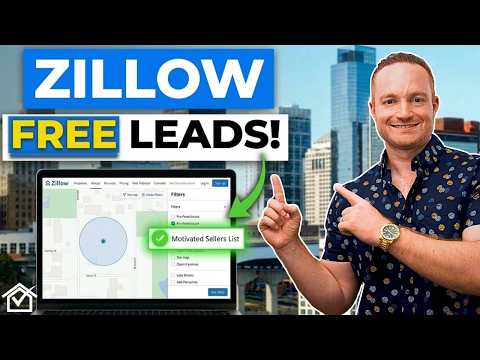
The filter isn't limited to one word. The same technique surfaces inherited properties, short sales, pre-foreclosures, tired landlords, and absentee owners, depending on the term you search. In Ryan's experience across markets in 12 states, roughly 1% to 2% of active listings in a given market surface as motivated. Results vary by market and season — a hot market yields fewer, a slow one more. For the full range of free and paid approaches, see our guide to finding motivated seller leads.
That percentage sounds small until you compare it to the alternative. Pull 10,000 off-market records from a data platform and you'd be fortunate if 1% respond at all, let alone entertain an offer. These 76 already asked.
Reading A Listing Like An Investor
Finding the listing is the easy part. The signal is in the details, and this is where most people stop too early.
- The description. Listing agents say more than they realize. Language like bring your offer, great opportunity to add value, or being sold as-is tells you what the seller cares about. Read past the adjectives to what's actually being conceded. Knowing how to identify and negotiate with motivated sellers is what turns a filtered list into contracts.
- Days on market. The longer a property sits, the more flexible the seller gets. It's the most reliable motivation signal available and it's free to check.
- Price history. This is the one people skip. A property in the video had been listed at $624,000, reduced to $600,000, then reduced again to $545,000 — a $79,000 cut over roughly seven months, and 232 days on market. No description language required. The price history said everything.
When you see that pattern, you're not hoping the seller is motivated. You're reading a documented record of it.
The Part That Makes It Work
The listing agent's name and phone number are on the listing.
There's no skip tracing, no wrong numbers, no chasing an owner who never asked to hear from you. You know exactly who to call, and they are professionally obligated to bring offers to their client.
That last point matters more than it sounds. Cold outreach to off-market owners occupies genuinely complicated legal territory — text blasting and cold calling carry real compliance exposure. Calling a listing agent about a property that is publicly for sale does not. They listed it because they want offers.
Know Exactly What To Say When You Call
Finding the listing is the easy part. The call is where most people freeze. Download our free Discovery Call Script — the exact questions our team uses to open a conversation with a listing agent, uncover what the seller actually needs, and position yourself as a serious buyer instead of a tire-kicker.
What This Costs And What It Doesn't
Making an offer costs nothing. That's the entire economic argument.
Ryan's framing: wholesaling and investing aren't lead generation businesses, they're offer businesses. If you're not making offers, you're not doing deals. Across a decade of transactions, his experience is that roughly one in every five to fifteen offers gets accepted. That ratio varies enormously by market, price point, and how well the offers are constructed — treat it as one practitioner's pattern, not a benchmark.
Set that against the referral math from earlier: a 35% fee on a $15,000 commission is $5,250. Making fifty offers on motivated listings costs zero.
Building An Agent Network That Feeds You
Here's the compounding part, and it's what turns a tactic into a pipeline.
When you call a listing agent and submit a real, serious offer, you register as a buyer who actually transacts. Even when that specific deal dies — and most will — you've made an impression on someone who talks to sellers all day.
Do that repeatedly and agents start bringing you properties before they hit the market. Pocket listings. Deals where the seller wants a quiet, fast sale. You end up on the short list agents call first.
That's a referral network you own. No fee, no application, no invite required. The difference between that and a pay-at-closing platform is that nobody can revoke it.
📓 From The Field
Lee, a Real Estate Skills student in Columbus, Ohio, had been a licensed agent for over two years without closing a single transaction — twelve clients, none ready to buy. His first closed deal came from an agent relationship, not a lead platform. A licensed agent friend called him about a distressed single-family property matching his criteria. He got it under contract at $75,000, then renegotiated to $56,000 after a contractor found more damage than the photos showed, and assigned it to a cash buyer at $70,000. City liens and taxes came off the top, leaving him $4,665 — well short of the $10,000 he'd targeted, and about six weeks from contract to close. It cost him nothing out of pocket. He immediately went back to that agent asking for more off-market inventory, and started working a second agent the same way. Individual results vary; this reflects one student's experience and is not a projection of typical outcomes.
The Honest Tradeoff
This path is slower and it's more work.
A referral network hands you a screened, motivated client with a phone number. This hands you a list of addresses and a phone you have to pick up. You'll make offers that get rejected, call agents who don't call back, and analyze deals that don't pencil. Lee's first deal took four years of starting and stopping to arrive at, and it paid less than half what he wanted.
If you want leads delivered without prospecting, and you qualify for a referral network, use one. That's a legitimate choice and this article isn't trying to talk you out of it.
But if you don't qualify, don't have a budget, or don't want to hand over a third of every commission indefinitely — this works, it costs nothing, and what you build stays yours.
How To Evaluate Any Lead Source
Judge any lead source on cost per closed deal, not cost per lead. Ask what you qualify for, what the fee covers, whether repeat transactions are charged, and who owns the client afterward. A cheap lead that never closes costs more than an expensive one that does.
Platforms rename themselves, get acquired, and change their terms. Zillow Flex became Zillow Preferred. Opcity became ReadyConnect Concierge. Rocket bought Redfin. Any list of specific companies has a shelf life.
What doesn't expire is knowing how to judge one.
The Only Number That Matters
Cost per lead is the metric everyone quotes and it's close to useless on its own.
A $10 lead that converts at 0.2% costs $5,000 per closing. A $200 lead that converts at 5% costs $4,000 per closing. The cheaper lead is more expensive. Portal and internet leads convert at roughly 0.4% to 1.2% on average, so the gap between headline price and real cost is usually enormous.
Run every source through the same calculation: what does one closed deal cost me here, all in? That's the number that pays your bills.
Six Questions To Ask Before You Sign
- 1. Do I actually qualify? Check this first — it saves the most time. Invite-only, production minimums, brokerage-level enrollment, and license requirements eliminate most agents from most programs before any other question matters.
- 2. What's the fee, and on what base? Percentage of gross commission? Of your post-split take? A formula like "25% or 1% of sale price, whichever is higher"? These produce very different numbers on the same deal. Get it in writing.
- 3. Does the fee apply to repeat business? The question almost nobody asks. If your agreement covers future transactions with the same client, the lifetime cost may be several times the first closing. Ask how long the obligation runs.
- 4. Are these leads exclusive? Being one of five agents racing to call the same person is a different product than being the only one. It changes your conversion rate, which changes your cost per closed deal.
- 5. Who owns the relationship afterward? Can you market to this client later? Add them to your database? If the answer is no, you rented a transaction rather than gaining a client, and the fee should be judged accordingly.
- 6. What happens if the platform changes its terms? Not if — when. Every program in this article has restructured, rebranded, or been acquired in the last two years. If losing this source tomorrow would end your business, it's too large a share of your pipeline.
The Portfolio Rule
No single source should carry your business.
The agents who get hurt are the ones running on one channel when it changes. A durable pipeline usually has three components: something you rent for immediate flow, something you own that compounds, and something free that costs only effort.
Referral platforms are the rented layer. A database, a website, and long-term relationships are the owned layer. Direct outreach to motivated sellers and an agent network are the free layer. Any one of them alone is fragile.
A Simple Test
Before committing to a lead source, ask: if this disappeared tomorrow, what would I still have?
With a referral platform, the answer is usually nothing — the leads stop and the clients were never yours. With a database you built, an agent network you cultivated, or a repeatable method for finding motivated sellers, the answer is everything.
That's not an argument against renting. Renting is fine and sometimes necessary. It's an argument against renting exclusively.
Real Estate Leads Pay At Closing: FAQs
Final Thoughts On Real Estate Leads Pay At Closing
Pay-at-closing leads are a real tool with a real price. The price is 25% to 40% of every commission they produce, and the entry requirement is a license plus, usually, a track record you may not have yet.
If you qualify and you're short on leads, use them. A referral fee on a closed deal beats a full commission on a deal that never happened, and the capped downside is genuinely valuable when a bad month of ad spend would hurt.
What I'd push back on is treating them as the foundation. Every platform in this article has rebranded, been acquired, or restructured in the last two years. Flex became Preferred. Opcity became ReadyConnect. Rocket bought Redfin. None of those changes were announced to the agents building on them in advance, and none of them were negotiable.
The agents and investors who last aren't the ones who found the best lead source. They're the ones who built something nobody could take away — a database, an agent network, a repeatable method for finding sellers who want to sell. Rent leads while you build that. Just don't mistake the rental for the asset.
And if you're reading this because you don't qualify for any of these programs, that's not the dead end it feels like. The sellers advertising for offers are public, the listing agents' phone numbers are published, and an offer costs nothing to make. Open Zillow, filter your market for the word motivated, and call the first listing agent on the list. That's a real pipeline, it starts today, and every deal it produces is entirely yours.
You Just Learned What Leads Cost. Now Learn How To Stop Paying For Them.
Every referral network in this guide takes 25% to 40% of your commission, and most of them won't let you in without a license and a track record. The investors and agents who build something lasting go straight to the source instead — finding motivated sellers, locking up discounted properties, and getting paid without handing a third of it to a platform. Our FREE Training walks you through the entire system, the same one thousands of our students use. Watch it today, then go find your first deal.
Watch The FREE Training →
About The Author
Founder & CEO, Real Estate Skills
Alex Martinez is the Founder and CEO of Real Estate Skills. With more than a decade of investing experience and 33+ residential properties acquired, he has personally wholesaled and flipped houses across the country. Through Real Estate Skills, Alex and his team have helped thousands of students learn how to find deals, work with agents and sellers directly, and close profitable real estate transactions.
Real Estate Skills is not a law firm, and the information in this article is provided for educational purposes only — it does not constitute legal, tax, or financial advice. Real estate licensing laws, referral-fee regulations, and platform terms vary by state and change over time; referral fees and program requirements cited here reflect publicly available information as of 2026 and should be confirmed directly with each provider. Real estate investing carries risk, and past results do not guarantee future outcomes. Always consult a licensed real estate attorney and your own tax and financial advisors before entering into any referral agreement or transaction.

👉FREE Training
How To Consistently Wholesale, Flip Houses, & Invest In Rental Properties From The MLS
(Without Spending $1 On Marketing)

Alex Martinez, the founder of Real Estate Skills, is known for his strong, practical expertise in real estate, starting from a beginner with no family connections in the industry to acquiring over 55 real estate deals, including wholesale and flips, within his first year.
He has dedicated his career to providing cutting-edge education and resources for real estate professionals. He emphasizes the importance of self-taught knowledge through mentors, books, and hands-on experience.
His journey from earning a modest income to becoming a successful real estate entrepreneur and educator showcases his expertise and dedication to the field.

Ryan Zomorodi, co-founder and COO of Real Estate Skills, leverages his experience from a diverse background in real estate investment, construction management, and entrepreneurship to provide comprehensive education in the real estate sector.
His expertise is rooted in hands-on experience, extensive industry knowledge, and a commitment to empowering others through education.
Ryan's journey reflects a blend of practical experience and entrepreneurial success, contributing to his role in developing a platform that educates and supports aspiring real estate professionals.
Read Ryan's Full Bio >>
