
How to Flip Houses for a Living (2026 Full-Time Guide)
Feb 11, 2026
Key Takeaways: How to flip houses for a living
- The Opportunity: Capitalizing on the 130% construction premium gap by delivering renovated inventory to a starved retail market.
- The "Trap": Falling into the IRS "Dealer" classification, which triggers ordinary income tax rates and self-employment taxes.
- The Strategy: Implementing the Velocity Matrix to outrun 12% interest burn through 45-day renovation cycles.
What You’ll Learn: How to transition from a 9-to-5 to a full-time flipping business using professional underwriting and gap funding strategies.
If you want to know how to flip houses for a living in 2026, you can forget everything you saw on reality TV. The 70% rule is functionally dead, and 12% hard money interest will eat your lunch if your project management is slow. You aren't just fixing up a house anymore. You are running a high-velocity inventory business where speed is the only thing protecting your profit margin. The hardest part is finding the sweet spot where you buy deep enough to survive the inventory squeeze while meeting the demands of retail buyers who have zero patience for sloppy work.
Most beginners fail here because they treat flipping like a hobby instead of a technical operation. You have to understand the IRS dealer classification and how gap funding actually works if you want to stay liquid during a career transition. We focus on the exact operational protocols used to scale a firm without getting crushed by monthly holding costs. If you cannot manage a 45-day visual turn, the market volatility will wipe out your net profit before you even list the property. This is about professional-grade underwriting and boots-on-the-ground execution.
Here is what we will cover:
- How To Flip Houses For A Living Without Getting Burned
- Avoiding the IRS Dealer Trap When You Learn How To Flip Houses For A Living
- Technical Underwriting: How To Flip Houses For A Living With 12% Capital
- Strategic Timeline For How To Flip Houses For A Living
- How To Flip Houses For A Living To FHA Buyers
- FAQ: Critical Questions On How To Flip Houses For A Living
Turning real estate into a career requires a professional-grade acquisition engine. If you are ready to learn how to flip houses for a living and leave the 9-to-5 behind, you need a system that finds deals before the competition even knows they exist. Our FREE Training breaks down the exact framework we use to secure high-margin, off-market properties in any market condition.
Step-by-Step Mastery: The Full-Time Flipping Blueprint
Success in this industry isn't about luck; it is about following a repeatable, technical process. In this masterclass, Alex Martinez breaks down the exact 15-step framework required to master how to flip houses for a living, moving from amateur projects to a professional-grade investment operation.
Watch the full breakdown to understand the operational standards required to scale your house flipping business.
How To Flip Houses For A Living Without Getting Burned
Flipping houses for a living is a volume-based inventory business. Success depends on exploiting the 130% construction premium gap. By delivering renovated stock at a lower price point than new builds, flippers solve the inventory squeeze for retail buyers priced out of the new-home market.
Look, the current market is essentially a stalemate for new builders. When it costs 130% more to build a house from the ground up than to purchase one that's already on the market, it's easy to see why homebuilders neglect the entry-level sector. The math just doesn't make sense to them from a financial perspective. That said, their ability to overlook certain homes is your profit margin.
To master how to flip houses for a living right now, you have to realize you are the only source of "new" feeling homes for the average buyer. You find the distressed assets, do the heavy lifting to modernize them, and provide the move-in-ready inventory that the big developers can’t afford to build anymore.
The hardest part is the 6.3% mortgage environment. We use this 6.3% threshold as our primary deal filter because buyers in this rate environment are extremely risk-averse. They no longer overlook dated floor plans or deferred maintenance. Most beginners fail because they underestimate the friction of high buyer standards. If your visual turn isn't flawless, your property will sit. At 12% hard money interest, every extra week on the market aggressively erodes your net profit margin.
[Renovation Cost Per Sq Ft] ÷ [New Construction Cost Per Sq Ft] = Market Dominance Index
Benchmark: An Index score below 0.70 (70%) indicates a high-safety margin for 2026 flips.
It is about keeping your total cost—the "Finished Basis"—well below what it would cost to build that same house today. In the 2026 market, being precise with your numbers before you buy is the only thing that keeps you safe from shifting home values.
Flipping houses for a living requires exploiting the gap between dilapidated inventory and the high cost of new construction, essentially acting as the bridge for retail buyers who are priced out of new builds but demand high-efficiency, modern finishes.
Daniel’s Journey: From Corporate America to 100+ Flips
Getting started in real estate can seem overwhelming, but the reality is that how to flip houses for a living is a skill that can be taught. You don’t need to be born into the industry or have a background in construction. Daniel is proof of that. He was a student of ours in Massachusetts who was tired of the corporate grind and the long hours that came with it. By plugging into a repeatable system, he managed to scale his business to a point most people only dream of.
Proven Systems: From Solo Hustle to 100+ Deals
Daniel started where most of us do—grinding a 9-to-5 while trying to figure out the flipping game. We showed him the exact systems we use to find and exit deals at scale, and he’s now surpassed the 100-home milestone.
Watch Daniel’s journey and see the technical systems required to handle high-volume flipping.
Avoiding the IRS "Dealer" Trap When You Learn How To Flip Houses For A Living
When you flip houses for a living, the IRS often reclassifies you from an "Investor" to a "Dealer." The change in how the IRS views your status coincides with. change in how you are taxed. In particular, when you become recognized as a dealer, your profits are taxed as ordinary income (up to 37%) rather than capital gains. Subsequently, your dealer status will tack on an additional 15.3% self-employment tax. The shift is real, and must be accounted for.
Transitioning from a casual flipper to a professional means your properties are no longer capital assets—they are inventory. This distinction is where most career transitions fail. If you aren't careful, you can lose nearly half of your net profit to the "Tax Cliff." The IRS uses the "Intent Test" to determine your status: if your primary purpose is to sell property to customers in the ordinary course of business, you are a dealer.
The hardest part is managing the 15.3% self-employment tax on top of your marginal tax bracket. We use this exact threshold to determine when to switch from a standard LLC to an S-Corp election. Most beginners fail because they don't account for the 15.3% self-employment tax. They see a $50,000 profit on a HUD settlement statement and assume that is what hits their bank account. In reality, without the right "Technical Friction" in your accounting, the IRS will take a massive bite out of that margin before you can reinvest in your next deal.
The 2026 Tax Shield Script
- Entity Selection: Once your net profit consistently exceeds $50,000 annually, an S-Corp election is often the most efficient way to lower your tax burden.
- Reasonable Salary: By paying yourself a W-2 wage and taking the remaining profit as a distribution, you avoid self-employment tax on the distribution portion.
- Segregation of Assets: Never hold your long-term rentals in the same entity as your how to flip houses for a living inventory; doing so risks losing your capital gains treatment on the rentals.
You must also understand that, as a dealer, you cannot use the installment sale method to defer taxes, and you are generally prohibited from performing 1031 exchanges on your flip inventory. Every dollar made is treated like a salary from a standard job, just with higher overhead. Friction exists here because you must capitalize your carrying costs—such as interest, taxes, and insurance—rather than deducting them in the year they are paid. This effectively traps your cash until the property sells, making liquidity management the pulse of your business.
Technical Underwriting: How To Flip Houses For A Living With 12% Capital
Underwriting a flip in 2026 requires a "Loan-to-Cost" (LTC) focus rather than simple "Loan-to-Value." To flip houses for a living, you must secure 80-90% LTC financing from hard money lenders and bridge the remaining 10-20% with gap funding to preserve cash for high-velocity visual turns.
In the current 12% interest rate environment, your underwriting cannot be "back-of-the-napkin." Most beginners fail here because they calculate their margin based on the purchase price rather than the total project cost. We use a strict LTC model because it accounts for the actual cash you need to deploy to get the property to the finish line. If you are paying 12% on a $300,000 loan, you are burning $3,000 a month in interest alone. This means that a project delay isn't just an inconvenience—it is a direct hit to your salary.
To flip houses for a living successfully, you must manage your capital with the same intensity as your construction crew. You need to ensure that your gap funding—often sourced from private individuals—is ready to wire at the same time as the institutional hard money to avoid losing out on competitive deals.
Stop Guessing and Start Underwriting Like a Pro
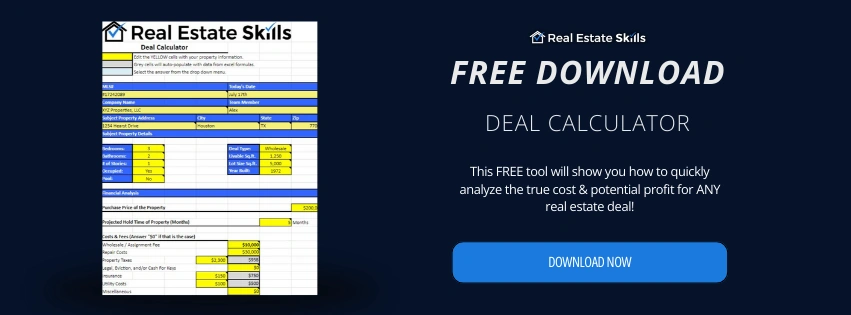
When you how to flip houses for a living, "guesstimating" your profit is the fastest way to go broke. In the 2026 market, with 12% interest rates and tight margins, you need to know your exact walk-away number before you ever sign a contract. We have developed a professional-grade Deal Calculator that allows you to plug in your acquisition costs, renovation budget, and holding costs to see your true net profit in seconds. Download the exact tool we use to audit every deal and ensure your career transition is backed by data, not hope.
Strategic Timeline For How To Flip Houses For A Living
To successfully flip houses for a living in 2026, you must master the "Daily Burn" rate. At 12% interest, every 24 hours costs you between $50 and $150. Maintaining a 20%+ ROI requires a 35-to-45 day renovation window to minimize holding costs and maximize capital velocity.
The hardest part of professional flipping isn't the hammer and nails; it's the calendar. We use a strict 35-day renovation window because day 36 is where the profit margin starts to bleed. If you want to know how to flip houses for a living, you have to stop thinking in months and start thinking in hours. Most beginners fail because they allow "contractor drift"—those small three-day delays that eventually stretch a six-week project into a three-month nightmare.
To hit these marks, you must order all long-lead items—like cabinets and specialized windows—the moment you go under contract, not the day you close. We use this exact naming convention in our project management software to ensure subs know exactly when they are expected on-site. If the flooring team isn't ready to walk in the door the hour the painters finish, your project management has failed. For a career flipper, time is literally money.
A 2026 project burn rate at 12% interest consumes approximately $50–$150 per day in interest alone, necessitating a high-velocity renovation cycle of 45 days or less to maintain a 20%+ ROI and insulate the deal from market fluctuations.
How To Flip Houses For A Living To FHA Buyers
Successfully learning how to flip houses for a living requires mastering the FHA 90-day rule.
The 90-day seasoning requirement is the most common reason deals fall apart in escrow. If you are flipping houses for a living, you are likely targeting the first-time homebuyer segment, which is heavily reliant on FHA financing. The Federal Housing Administration is aggressive about preventing price gouging. If you attempt to sell a property within 90 days of your purchase, the FHA will not insure the new buyer’s mortgage. This "Technical Friction" can force you to hold a completed property for an extra month, effectively bleeding your profit through interest burn.
Furthermore, if your resale price is 100% or more over your purchase price, a second independent appraisal is mandatory. We use this exact naming convention—the "Double Appraisal Audit"—to prepare our files. You must provide a line-itemized list of every renovation performed to justify the value increase. If the second appraiser doesn't see the "meat" in the renovation, they will low-ball the valuation, and you will be forced to either drop your price or lose the buyer.
The 90-Day Exit Checklist
- Seasoning Audit: Verify the deed recording date. The buyer’s contract date must be at least 91 days after your purchase date to qualify for FHA.
- Rehab Documentation: Keep all permits, contractor invoices, and "before and after" photos in a digital vault for the appraiser.
- Value Justification: If the price jump is over 100%, prepare a professional cover letter explaining the "forced equity" created through structural or mechanical upgrades.
FAQ: Critical Questions On How to Flip Houses for a Living
Navigating the transition to a full-time investment career often leads to complex technical questions regarding logistics and legalities. Here we address the most common inquiries about how to flip houses for a living to ensure your business foundation is audit-proof and profitable.
Final Thoughts on Learning How To Flip Houses For A Living
Transitioning into a full-time real estate career is about more than just aesthetics; it is about mastering the technical systems of a high-velocity business. Learning how to flip houses for a living in 2026 means you are the solution to the modern inventory crisis. The path to a new career is open for those willing to treat it as a technical operation. It is time to stop watching from the sidelines and start building your legacy.
Turning real estate into a career requires a professional-grade acquisition engine. If you are ready to learn how to flip houses for a living and leave the 9-to-5 behind, you need a system that finds deals before the competition even knows they exist. Our FREE Training breaks down the exact framework we use to secure high-margin, off-market properties in any market condition.
*Disclosure: Real Estate Skills is not a law firm, and the information contained here does not constitute legal advice. You should consult with an attorney before making any legal conclusions. The information presented here is educational in nature. All investments involve risks, and the past performance of an investment, industry, sector, and/or market does not guarantee future returns or results. Investors are responsible for any investment decision they make. Such decisions should be based on an evaluation of their financial situation, investment objectives, risk tolerance, and liquidity needs.

👉FREE Training
How To Consistently Wholesale, Flip Houses, & Invest In Rental Properties From The MLS
(Without Spending $1 On Marketing)

Alex Martinez, the founder of Real Estate Skills, is known for his strong, practical expertise in real estate, starting from a beginner with no family connections in the industry to acquiring over 55 real estate deals, including wholesale and flips, within his first year.
He has dedicated his career to providing cutting-edge education and resources for real estate professionals. He emphasizes the importance of self-taught knowledge through mentors, books, and hands-on experience.
His journey from earning a modest income to becoming a successful real estate entrepreneur and educator showcases his expertise and dedication to the field.

Ryan Zomorodi, co-founder and COO of Real Estate Skills, leverages his experience from a diverse background in real estate investment, construction management, and entrepreneurship to provide comprehensive education in the real estate sector.
His expertise is rooted in hands-on experience, extensive industry knowledge, and a commitment to empowering others through education.
Ryan's journey reflects a blend of practical experience and entrepreneurial success, contributing to his role in developing a platform that educates and supports aspiring real estate professionals.
Read Ryan's Full Bio >>
