
The 2026 Fix and Flip Formula: Master the Math of Profitable Investing
Jan 28, 2026
Key Takeaways: Fix and Flip Formula
- The Core Math: Successful flipping in 2026 requires moving beyond the static 70% rule to account for a high mortgage rate environment.
- The "Friction" Factor: With Section 232 tariffs doubling steel and aluminum costs to 50%, your renovation budget must include a mandatory 15% contingency.
- Regulatory Shift: As of March 1, 2026, all-cash LLC transactions must comply with new FinCEN reporting requirements, impacting your closing timelines.
What You’ll Learn: This guide provides the specific formulas to maintain a spread when the 70% rule is no longer enough to cover 2026 carry costs. We'll focus on how to calculate the Maximum Allowable Offer (MAO) while navigating 2026's unique material volatility and stagnant price growth.
Making money in real estate is just as much of an art as it is a science. While a lot of subjectivity can go into the actual rehab process, prices are objective. You must know the numbers on a flip before you ever sign a contract or think about taking on a project. There is no "winging it." That is how you go broke. If you want to master the fix-and-flip formula, you need to treat it as a cold-blooded risk-management system. Period.
Inflation and mortgage rates remain stubborn, all while home prices are slowly creeping up. That said, macroeconomic indicators aren't the end-all, be-all for your profit margins. The money you make on a flip is determined at the closing table when you buy the subject property; that's why we have created this house flipping formula guide: to give you the tools you need to make sure you maintain your profits on your next flip.
- The Fix-and-Flip Formula: 2026 Framework
- The 70% Rule: The Industry Standard Foundation
- Determining After Repair Value (ARV) With 2026 Accuracy
- Estimating Rehab With 2026 Material Realities
- The 2026 Regulatory Filter: FinCEN & Disclosure
- Buy Zones: Aggressive vs. Moderate vs. Hold
- Frequently Asked Questions About The Fix And Flip Formula
Stop guessing what works in a stagnant housing market. Whether you are analyzing thin margins or calculating complex carry costs, our FREE Training walks you through how to find consistent deals and build profit through math—without wasting money on expensive marketing or bad acquisitions.
This FREE Training reveals the exact system our students use to master the formula and flip profitably in any economy. Watch it today—so you can stop wondering and start closing.
Watch: The Fix and Flip Formula in Action
You cannot afford to be "pretty close" when you are calculating your margins. This video walks through the exact steps to nail your offer price using a real-world calculator. Stop looking at pretty kitchen photos and start looking at the balance sheet.
The Fix-and-Flip Formula: 2026 Framework
A fix-and-flip formula is a mathematical risk-management framework used to determine the highest possible purchase price of a distressed asset that still guarantees a target ROI. In a market where 6.3% carry costs are the new baseline, this house flip formula has evolved from a simple "rule of thumb" into a precision strike on property data. A proper formula for flipping housesallows investors to reverse engineer deals by starting with the end in mind.
The 2026 Formula Evolution
Old Standard (The 70% Rule)
A static multiplier designed for low-interest environments and 3% annual appreciation. It often ignores the "Daily Burn" and current material volatility.
dynamic multipliers
Dynamic multipliers (65%-75%) account for more line items, like holding costs, higher interest rates, and today's exorbitant prices.
For an investor in today's market, the formula is a quick way to make an important decision. A proper formula for flipping houses can remove any subjective nuances and allow investors to focus on objective numbers that carry more weight. In other words, it can point investors in the right direction when the answer is less obvious.
Remember, you aren't just buying a house; you are buying a spread, and an accurate house-flipping formula is the best way to "measure twice and cut once."
Why the House Flip Formula Matters Right Now
- 📉 Combating Margin Compression: With stagnant price growth (2.2%), you cannot rely on the market to bail out a bad buy. The house flip formula locks in your profit on day one.
- 🏗️ Absorbing Material Volatility: Section 232 tariffs have turned HVAC and roofing into luxury expenses. The formula's 15% contingency rule accounts for these price spikes.
- ⚡ Increasing Decision Velocity: In a market with low inventory, the fastest accurate offer wins. Mastering the formula allows you to analyze a deal in 60 seconds and submit with total confidence.
The 70% Rule: The Industry Standard Foundation
If you have spent more than five minutes researching real estate investing, you have heard of the 70% rule. It is the bedrock of the fix-and-flip formula, and for good reason: it prevents you from overpaying in your pursuit of a deal. At its core, this rule is a protective barrier. It ensures that you aren't just trading dollars with a contractor or a bank, but actually walking away with a check.
The math is binary. You take the After Repair Value (ARV), multiply it by 0.70, and subtract your estimated renovation costs. The result is your Maximum Allowable Offer (MAO).
Related Reading: Free ARV Calculator: Instantly Estimate After Repair Value
The House Flipping Formula In Action
If you analyze a property with a $400,000 After Repair Value and a $60,000 renovation budget, the math is straightforward:
Step 1: $400,000 (ARV) x 0.70 = $280,000
Step 2: $280,000 - $60,000 (Rehab) = $220,000
Maximum Allowable Offer (MAO): $220,000
If the seller won't go a penny lower than $230,000, don't try to make it work. Your MAO is called your maximum allowable offer for a reason. The margin isn't to satiate the greedy; it's essentially your insurance. To a new investor, the difference may seem easy to overcome, but this is a game of inches; that extra padding goes a long way to make this a viable deal. It is the only thing keeping you from a total financial wreck.
Here is what that spread is actually helping to cover:
- Closing Costs: Title insurance, escrow fees, and those annoying lender origination points.
- Holding Costs: Your 6.3% mortgage interest, property taxes, and utility bills while the house sits empty.
- Selling Costs: Professional staging, high-end photography, and the agent commissions you’ll pay on the exit.
- Net Profit: The actual capital that stays in your pocket after everyone else gets paid.
To be perfectly clear, the 70% rule is not written in stone, and it should always be left open to some form of interpretation. By no means should any investor apply the 70% rule blindly; at a minimum, they should conduct some additional research. If for nothing else, the rule is more of a baseline starting point that is given the flexibility to move with each property.
If, for examle, you are looking at a $1.2 million flip in an area with a lot of demand and very little inventory, you may need to adjust the rule to somethimg more like 75% or 80%. A 20% margin on seven figures is still a massive payday (assuming you don't mess up the finishes). But if you are working in a rough Class C neighborhood, 70% is a trap. You need to be at 60% or 65% because everything that can go wrong in those areas usually does—from stolen copper pipes to buyers who can't close because their DTI ratio shifted by half a point. Here's a table of how the rule can be broken under the right circumstances:
Why The 70% Rule Is Failing In 2026
We've already said it, but it's worth repeating: the 70% is antiquated and doesn't always work. Anyone who solely relies on it is shooting themselves in the foot (suffering an unnecessary wound). Again, it's a good starting point, but the investing game has changed in recent years. In today's market, your flipping margins are being squeezed by high interest rates and appreciation. 2019's math is now less relevant today than ever. I'll explain why below:
The Holding Cost Spike
In 2019, you could afford to let a property sit while you debated over the right shade of paint for the walls. Those days are over.
- The Burn Rate: Hard money and bridge loans are higher than ever, eating away at margins.
- Daily Drain: That isn't a static line item. It is a daily burn. On a $500,000 loan, you are bleeding roughly $86 every single day just in interest.
- Days on Market (DOM): Buyers have become surgical. They aren't rushing into high-interest mortgages for mediocre houses. If your property sits for an extra 45 days, that fix-and-flip formula buffer you thought you had gets eaten alive by the bank.
WARNING: The Flat Market Trap
Zillow and the National Association of Realtors (NAR) are calling for minimal appreciation this year. As a result, it's a dangerous game to expect appreciation to save any margins you may (or may not) have. If for nothing else, you can't assume prices will rise, even though they usually do. That lack of a safety net makes using outdated math even more dangerous.
The Class A Pivot
If you remain committed to the 70% rule on every deal, you will lose out on deals that could have netted you great profits. In a low-inventory Class A market, the rule will prevent you from even window shopping. And if you do decide to follow through with it, you most likely won't get an offer acceoted and you'll waste time that's better spent elsewhere.
You have to be flexible. Professional flippers in bulletproof zip codes—think high-end school districts or tech hubs like Austin or Raleigh—are moving their fix and flip formula math to 75% or even 80%. (Don't panic; there is a method to the madness). It comes down to velocity. A house in a premier neighborhood often sells in 14 days. A Class C project in a rough part of town might rot for 90 days while you bleed interest to a hard money lender.
Stop Guessing and Start Calculating Your Profits
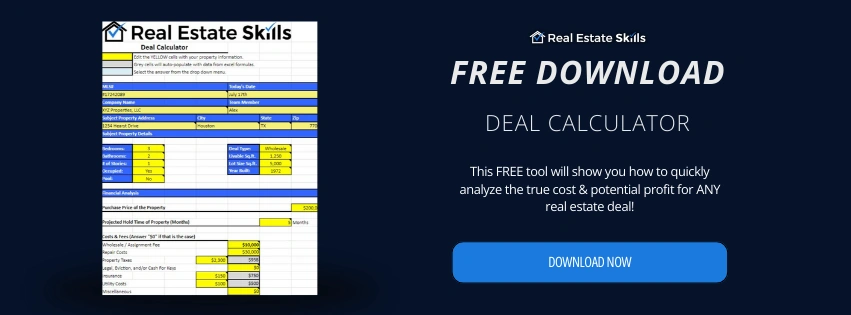
In a 2026 market where margins are razor-thin, a simple 70% calculation isn't enough to protect your capital. We have developed a professional-grade deal calculator that accounts for high-carry interest rates, material contingencies, and the true cost of technical friction. Download the exact tool we use to verify every Maximum Allowable Offer (MAO) and ensure your next investment is a guaranteed winner before you ever sign the contract.
Determining ARV With 2026 Accuracy
If your after-repair value is off by even 3%, your entire fix-and-flip formula collapses. In 2026, you cannot afford to be lazy with your real estate comps. The market is too flat, and buyers are too smart. Most "gurus" will tell you to look back six months for sales data, but in a stagnant market, six-month-old data is ancient history. It belongs in a museum, not in your spreadsheet.
You have to be surgical. Follow these steps to find a number that actually holds up at the closing table:
- Source 90-Day "Hyper-Comps" Only: Stop looking at what happened last summer. You need the last 90 days of closed sales within a tight half-mile radius. If you have to go further out to find a match, you aren't looking at a comp; you're looking at a different market. (And never cross major physical barriers like highways or school district lines—those boundaries dictate value more than square footage ever will).
- Ignore the Asking Price: Today's listing prices carry less weight than ever before. The relationships between listing prices and sales prices seem to continue to diverge. As a result, you'll want to call on any pending sales to get the real numbers.
- Apply the "Safety Haircut": Once you find your median ARV from three solid hyper-comps, shave 5% off the top immediately. If the deal doesn't work with that haircut, it’s not a deal. You need that buffer to account for the 2.2% growth ceiling. Better to be pleasantly surprised by a higher sale than stuck with a house you can't unload.
- Adjust for the 2026 Energy Premium: Buyer demand has shifted. Homes that are "EV-ready" or have updated energy-efficient windows and solar offsets are moving 20% faster and for a 4% premium. If your subject property is a drafty 1970s ranch and your "comp" is a LEED-certified modern renovation, subtract $15,000 from your ARV immediately. You aren't comparing apples to apples.
Watch: Advanced ARV & Hyper-Comp Strategies
If you want to avoid overpaying in a stagnant market, you need to watch this video to master the "hyper-local" data points that Zillow and Redfin often miss. Ryan reveals the exact adjustment math for technical friction points—like high-speed streets and school district boundaries—that can swing your house flip formula by tens of thousands of dollars.
Estimating Rehab With 2026 Material Realities
In today's marekt, and any market for that matter, your renovation budget is anything but static. If you're using outdated prices on materials and labor, you are asking for a world of hurt. Estimating rehab costs requires a "defensive" approach to the house flipping formula; only then can you account for regulatory shifts and high material volatility that can erase a 30% margin in weeks.
2026 Renovation Budgeting Guardrails
- The Tariff Tax: You must factor in the 50% Section 232 tariffs on imported steel and aluminum. This isn't just a "big building" problem—it hits your residential HVAC units, roofing flashing, and appliance packages directly.
- The Mandatory 15% Contingency: A 10% buffer is a relic of the past. Between labor shortages and mid-project material price spikes, a 15% contingency is now the bare minimum to keep a project from stalling.
- Cosmetic Renovation ($45 - $65 per sq/ft): This covers "paint and carpet" plus minor kitchen/bath refreshes. In 2026, the higher end of this range accounts for the premium on energy-efficient fixtures.
- Gut Renovation ($110 - $160 per sq/ft): If you are moving walls, replacing stacks, or upgrading the main panel, this is your reality. These costs reflect the increased permit fees and specialized labor required for current code compliance.
Watch: Step-by-Step Rehab Estimation Mastery
Watch this breakdown to see how a construction pro calculates the difference between a simple cosmetic refresh and a full-scale gut renovation. It explains the "deductive" budgeting method and highlights the specific high-ROI repairs that actually move the needle in a stagnant market.
The 2026 Regulatory Filter: FinCEN & Disclosure
This year, the most basic formula for flipping houses will face significant legal challenges. If for nothing else, there are new legalities that will impact rehabs on almost every level. You have to bake these rules and regulations in before you even think about pulling a permit or hiring a crew:
The March 1, 2026 FinCEN rule is the one that many investors won't see coming. Just know this: if you are buying a house through an LLC with all cash, you'll have the eyes of the IRS on you. The added bureaucracy can potentially extend the time it takes to flip a home, which will impact margins and simple fix-and-flip formulas.
The NAR settlement 2026 reality also means you have to be much more transparent about who is getting paid. When you’re calculating your ARV, you'd better know exactly what your local market expectations are for buyer-side commissions. In some Class A neighborhoods, buyers are still demanding that the seller cover their agent's fee. If you haven't baked that into your exit math, you're going to find yourself short thousands of dollars when it's time to sign the closing disclosure.
Buy Zones: Aggressive vs. Moderate vs. Hold
You can't just throw a dart at a map and expect to make money in a market with higher interest rates. Your success in 2026 comes down to your entry price. If you get the purchase price wrong, no amount of high-end finishes or clever staging will save your margin. Setting strict fix-and-flip buy zones is how you separate professional investors from amateurs who are currently losing their shirts on narrow spreads.
In this high-carry environment, you have to be cold-blooded during property analysis. You are looking for a safety net made of equity. If a deal doesn't hit your specific investment criteria, you walk away without a second thought. Here is how we are breaking down the buy zones for the current year:
I have seen too many inexperienced investors stretch their margins on their MAOs because they simply want a deal or are bored. That's the fastest way to go bankrupt in this industry. If you aren't seeing deals where the numbers work in your favor, you may be looking in the wrong places. Remember, when all is said and done, the math doesn't lie. In a market where inventory is finally starting to sit, you hold the leverage. Use it.
House Flipping FAQ: Mastering the 2026 Market
The fix and flip formula is more than just a calculation; it is a framework for navigating the legal and financial shifts of the current market. Use these expert answers to resolve the most common bottlenecks investors face today.
Final Thoughts on Our Fix-and-Flip Formula
Implementing the fix-and-flip formula in 2026 requires a lot more than a strong proclivity for math; it demands a defensive strategy that accounts for everything this year will throw at you. By following our formula for flipping houses, you can protect your margins against market friction and volatility.
Stop guessing what works in a stagnant housing market. Whether you are analyzing thin margins or calculating complex carry costs, our FREE Training walks you through how to find consistent deals and build profit through math—without wasting money on expensive marketing or bad acquisitions.
This FREE Training reveals the exact system our students use to master the formula and flip profitably in any economy. Watch it today—so you can stop wondering and start closing.
*Disclosure: Real Estate Skills is not a law firm, and the information contained here does not constitute legal advice. You should consult with an attorney before making any legal conclusions. The information presented here is educational in nature. All investments involve risks, and the past performance of an investment, industry, sector, and/or market does not guarantee future returns or results. Investors are responsible for any investment decision they make. Such decisions should be based on an evaluation of their financial situation, investment objectives, risk tolerance, and liquidity needs.

👉FREE Training
How To Consistently Wholesale, Flip Houses, & Invest In Rental Properties From The MLS
(Without Spending $1 On Marketing)

Alex Martinez, the founder of Real Estate Skills, is known for his strong, practical expertise in real estate, starting from a beginner with no family connections in the industry to completing over 50 real estate deals, including wholesale and flips, within his first year.
He has dedicated his career to providing cutting-edge education and resources for real estate professionals. He emphasizes the importance of self-taught knowledge through mentors, books, and hands-on experience.
His journey from earning a modest income to becoming a successful real estate entrepreneur and educator showcases his expertise and dedication to the field.

Ryan Zomorodi, co-founder and COO of Real Estate Skills, leverages his experience from a diverse background in real estate investment, construction management, and entrepreneurship to provide comprehensive education in the real estate sector.
His expertise is rooted in hands-on experience, extensive industry knowledge, and a commitment to empowering others through education.
Ryan's journey reflects a blend of practical experience and entrepreneurial success, contributing to his role in developing a platform that educates and supports aspiring real estate professionals.
Read Ryan's Full Bio >>
