
How To Calculate ROI On A Real Estate Flip: The 2026 Investor’s Guide
Feb 17, 2026
Key Takeaways: Calculate ROI Real Estate Flip
- The Opportunity: In 2026, targeting a 15-20% net ROI is the standard benchmark to outperform risk-free assets while buffering against a projected 0% to 2% national home price appreciation.
- The "Trap: Chasing 'Gross Profit' is a rookie mistake. In 2026, those hidden holding costs—specifically the 20% spike in vacant property riders and double-digit debt service—are exactly what turn a projected home run into a break-even headache.
- The Strategy: The pros win by mastering the math the hobbyists ignore. You need to dial in your "True-Cost" basis, then lean into the OBBBA tax breaks and Matter upgrades to force a faster exit and keep the tax man out of your pockets.
What You’ll Learn: Calculating a flip's return is no longer a simple back-of-the-napkin math problem. To survive the 2026 'Tight-Margin' era, you need to master the four specific cost buckets and leverage new OBBBA tax incentives that can effectively double your net yield. We aren't just looking at profit; we are looking at capital velocity—the speed at which your money works for you.
If you want to calculate roi real estate flip success in the 2026 market, you have to stop looking at the top-line spread and start looking at how much cash you actually move into the deal. We are in an environment where capital is expensive and appreciation has hit a wall. Real-world ROI isn't the number you brag about at a meetup; it is the net profit—every acquisition fee, renovation overage, and holding cost accounted for—divided by your actual out-of-pocket investment.
Buying right is only the first step. The real profit is won or lost during the carry. With hard money north of 12% and inventory finally climbing, there is a huge gap between a project that looks good on paper and one that actually hits your bank account. If you aren't tracking your true net against the clock, you are basically just volunteering for 100 hours of stress in exchange for a break-even check.
We use a rigorous cost-audit protocol to make sure the hidden killers don't eat the equity. In 2026, a simple 30-day bottleneck at the city permitting office isn't just a nuisance—it can shave 2% off your bottom line. If you aren't factoring in the daily interest drag on your debt service, you aren't really calculating a deal; you are just guessing.
Here is what we will cover:
- The 70% Rule 2.0: Managing Technical Friction
- The OBBBA 2026 Tax Multiplier & Bonus Depreciation
- Aggregating the Four 2026 Cost Buckets
- Capital Velocity vs. The IRR Trap
- High-ROI Tech: Matter-Standard Upgrades
- The Cash-for-Keys Buyout Threshold
- 5-Step Underwriting Protocol: Calculating 2026 ROI
- House Flipping ROI & 2026 Market FAQ
Stop guessing your ROI. In 2026's tight-margin market, "back-of-the-napkin" math will get you crushed. You need to know your exact net profit margin before you sign a contract. Our FREE Training reveals the tactical "True-Cost" framework we use to validate deal yield and guarantee profitability before we spend a dime.
Mastering the Numbers: How to Run the Math on Every Deal
Analyzing a flip requires more than just a gut feeling about the neighborhood. In this video, we break down the three critical numbers—ARV, Repairs, and MAO—that dictate whether your ROI will be a success or a cautionary tale.
Watch as we demonstrate the technical analysis required to calculate ROI accurately before you sign a contract.
The 70% Rule 2.0
Most people treat the 70% rule like it is written in stone, but the reality is that it's on the verge of being completely obsolete. It just doesn't hold up when you are borrowing money at 12 or 15 percent. Instead of blindly following an old formula, you need a market-specific weighted rule that actually accounts for the high interest and holding costs we are dealing with today. We call this the 70% Rule 2.0. It is based on the same core concept as the original, but it gives you the extra margin you need to survive in a high-rate environment.
Related Reading: The 70% Rule In House Flipping: The Ultimate Guide
It’s a tough realization, but a 70% deal today can actually leave you with less profit than an 80% deal did back when money was practically free. That’s where a lot of people get tripped up; they see that 70% number as a fixed safety net when it’s really just one part of the equation. We keep things grounded by using a metric we call Weighted Holding Drag. It’s just a straightforward way to track the daily interest burn and those utility spikes that show up the moment the hammers start swinging.
When you use the maximum allowable offer as your primary metric, you are essentially reverse-engineering your desired ROI. If your target is a 20% net return, you cannot simply look at the spread between the purchase price and the after-repair value. You must subtract the interest carry, the 2026 vacant property surcharges, and the disposition fees before you even consider the offer.
Related Reading: Free ARV Calculator: Instantly Estimate After-Repair Value
(ARV x 0.75) – Rehab & Holding = 2026 MAO
The math changes based on capital velocity. In low-velocity markets where homes sit for 90+ days, that 75% anchor needs to slide down to 65% to account for the interest rate drag. Conversely, in high-velocity "hot zones," you can successfully push to an 80% MAO if the renovation is purely cosmetic and the project is "matter-standard" compliant to ensure a fast exit. If you don't adjust for these technical friction points, your projected ROI is nothing more than a guess.
The OBBBA 2026 Tax Multiplier & Bonus Depreciation
There is a massive tax win in the One Big Beautiful Bill Act (OBBBA) that most people are completely missing. In plain English, the law brought back 100% bonus depreciation. Usually, the IRS makes you spread out your tax breaks for a renovation over decades, but now you can take the entire deduction the same year you finish the project. This is a huge lever when you calculate roi real estate flip results because it keeps more cash in your pocket right when you need it most.
The tricky part is that you cannot just dump all your receipts into one folder. You have to know which expenses are just simple repairs and which ones are capitalized improvements that qualify for the bonus. Most new investors miss out because they do not realize that things like structural systems or specific equipment now allow you to deduct those high hard money interest rates more effectively. The OBBBA changed the rules so you can add back things like depreciation to your income totals, which basically means you get to write off more of that expensive 12% or 15% interest you are paying. It is a massive shift that helps high-leverage investors stay profitable.
Net Profit + OBBBA Tax Savings / Total Investment = Tax-Adjusted ROI
This legislative shift, noted in IRS Notice 2026-11, is honestly what saves the deals that look like low-margin losers on paper. To make this work, we use a tactic called micro-cost segregation on every project. Rather than letting your renovation costs sit in a 27.5-year bucket where they do nothing for you today, you want to move those assets into 5-year and 15-year categories. This lets you take that 100% write-off that the OBBBA allows right now.
When you calculate roi real estate flip numbers, factor these tax savings back into your net yield. It is the difference between a mediocre 12% cash return and a 20% return after taxes are settled. If you ignore these 2026 rules, you are just leaving your profit on the table for the IRS to keep.
Aggregating the Four 2026 Cost Buckets
Real deal analysis is all about grouping your costs so nothing gets missed. To calculate roi real estate flip success, you have to look at the deal in four distinct buckets: buying the house, fixing it up, holding onto it, and finally selling it.
The biggest trap is treating those "holding costs" as a small detail. With interest rates pushing 14 percent right now, every day that house sits empty is a direct hit to your pocket. It is the difference between a rough estimate and a real-world budget. We use something we call a Four-Bucket Audit to make sure things like the 20 percent spike in insurance for vacant properties don't sneak past us. If you don't track these line items, your profit can vanish before the first hammer even swings. Let's take a look at those four "buckets" below:
Related Reading: How To Calculate ROI On Rental Property
The 2026 "True-Cost" Audit
- Acquisition (The Buy): This is more than just the price you negotiated. You have to include the closing costs, title insurance, the wholesaler’s fee, and any back taxes you had to pay to get the deed in your name.
- Renovation (The Rehab): This is where the hammers swing. It covers your labor and materials, obviously, but also the city permit fees and the 2026 smart home upgrades that help the house sell faster.
- Holding (The Carry): This is the money you pay just to keep the property. Every month it sits, you’re on the hook for loan interest, water and light bills, and that expensive insurance for empty buildings.
- Disposition (The Sell): This is what it costs to get your cash back out. You have to account for the agent's commission (usually 6%), the staging to make the place look perfect, and the final fees at the closing table.
You have to look at the after-repair value as your ceiling and those four buckets as the floor. The moment that the floor starts rising because of carrying cost slippage, your profit room just disappears. We have seen deals where the construction stayed exactly on budget, but the ROI still got cut in half. The investor just didn't realize that insurance for a vacant house can cost three times more than a standard policy. It is these kinds of hidden leaks that dry up your cash when you calculate roi real estate flip projects.
Advanced Underwriting: Calculating Costs Down to the Penny
In today's market, "paper-napkin" math is the fastest way to lose money. In this deep-dive walkthrough, we demonstrate how to use a professional deal calculator to audit every line item—from lender fees to agent commissions—to ensure your projected ROI is bulletproof.
Watch as we demonstrate the technical underwriting required to account for every hidden cost in your flip.
To avoid the "holding drag," we use this exact naming convention: The 1% daily margin shield. If your debt service plus insurance equals $150 per day, your project's value decreases by that amount every 24 hours. If your rehab takes 30 days longer than planned, you've just lost $4,500 in net ROI. Always pad your holding costs real estate estimates by 20% to account for the 2026 municipal backlog.
Precision Underwriting: Automating the 2026 ROI Calculation
To keep your profit margins safe, you have to stay ahead of "Variable Creep." When labor prices are shifting every week, and your interest costs are stacking up by the day, an old spreadsheet from a few years ago just isn't going to cut it. You need a setup that automatically tracks those four cost buckets so you aren't surprised by a shrinking bottom line. We have built this entire decision-making logic into our own calculator so you can stop guessing and start making offers with actual data-backed confidence.
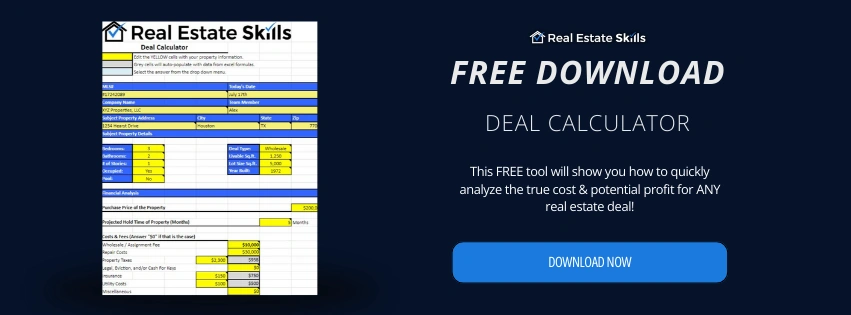
Precision Profitability: Know Your Net ROI Before You Buy.
In today’s tight-margin market, guessing is a liability. If you miss a single holding cost or miscalculate your debt service, your projected ROI evaporates. Stop relying on intuition and start using the same math the pros use. Download our Free Real Estate Deal Calculator to instantly aggregate all four cost buckets, automate your MAO, and verify your net profit margins with 100% technical accuracy before you ever sign a contract.
Capital Velocity & The "IRR Trap"
To really build wealth, you have to look past the total profit on a single deal and focus on how fast your money is moving. This is what we call capital velocity. Think about it this way: a project that pays you 15% in just four months is actually worth way more than a deal that pays 25% but takes an entire year to finish.
The reason is simple: if you can wrap up a flip in 120 days, you can "turn" that same pile of cash three times in a single year. That compounding effect builds your bank account much faster than getting stuck on one long project for twelve months. ROI tells you how much you made, but velocity tells you how quickly you’re getting rich.
The hardest part of professional flipping is resisting the "home run" deal that ties up your capital for a year. Most beginners fail here because they only look at the net profit check at the end of the project. In 2026, where the cost of capital is high, the internal rate of return (IRR) is the only metric that matters. If you have $100,000 to invest, you are better off doing three fast "cosmetic" flips with smaller margins than one massive "scrape and build" that takes 14 months of permitting and construction.
(Net Profit / Total Cash) x (365 / Days Held) = Annualized ROI (IRR)
We use a velocity-weighted audit to choose our deals. We would rather take a $30,000 profit on a 90-day turn than a $70,000 profit on a 300-day turn. Why? By day 300, the investor who prioritized velocity has already moved their capital into a third deal, likely netting $90,000 in the same timeframe with less exposure to market shifts. This is the annualized ROI advantage that allows professional operations to scale while solo-hustlers stay stuck on a single job site.
When you ignore capital velocity, you fall into the IRR trap. This happens when an investor over-renovates, adding "vanity features" that might increase the sale price but extend the holding costs by another 60 days.
Owning the "Institutional" Spread
To calculate roi real estate flip projects like an institutional fund, you must move beyond simple margins and analyze the deal through the lens of cash-on-cash (CoC) return and the debt service coverage ratio (DSCR). In the 2026 lending environment, where short-term bridge DSCR rates hover between 10.00% and 12.00%, your "spread" is only as good as your financing structure.
The hardest part of modern flipping is the gap between a property's potential and its actual risk-adjusted yield. Most beginners fail here because they ignore net present value (NPV), failing to discount future sale proceeds against today's high inflation and cost of capital. We utilize a debt-efficiency audit to ensure our projects maintain a DSCR of at least 1.25, even in a "bear case" scenario where the renovation timeline extends by 90 days.
Related Reading: 7 Best DSCR Lenders
2026 Financial Sensitivity Benchmarks
| Metric | Target Threshold | 2026 Market Reality |
|---|---|---|
| Cash-on-Cash (CoC) | 25% - 35% | Required to offset the current 4.5% "Risk-Free" Treasury rate. |
| Bridge DSCR | 1.20 Minimum | Rates for 1.10–1.25 DSCR deals currently average 8.25%–9.50%. |
| NPV Discount Rate | 12% Annualized | Accounts for 2026 construction inflation and opportunity cost. |
This is also why your insurance choice can make or break the deal. Most people just grab a standard HO3 policy, but those usually stop covering the property if it stays empty for more than 60 days. If a pipe bursts or there is a fire on day 61, you are completely on your own. That is why we always use a DP3 policy with a vacant property rider from day one. It is more expensive—the average price has jumped to about $4,202—but it is the only way to make sure a permit delay does not turn into a total disaster for your bottom line.
The Smart Rehab: High-ROI Tech (Matter/CES 2026)
Modern house flipping ROI is increasingly dependent on digital curb appeal. Integrating matter-standard smart home tech—specifically smart locks and AI-driven climate sensors—can reduce days on market by up to 14%, directly protecting ROI by minimizing the holding costs associated with stagnant inventory.
The hardest part of a 2026 renovation is choosing technology that increases valuation without creating tech fatigue for the buyer. Most beginners fail here because they install closed-loop systems that require proprietary hubs, which are becoming obsolete in the eyes of savvy buyers. In the post-CES 2026 market, demand has shifted entirely toward Matter-compliant ecosystems. This universal standard ensures that the smart home ROI 2026 potential is realized by allowing the home's devices to work seamlessly across Apple, Google, and Amazon platforms.
The Smart Upgrade ROI Checklist
- Matter Smart Locks (Kwikset Aura/Lockly): Replace traditional hardware with Lockly Visage or Kwikset Aura models. These provide keyless entry for contractors during the flip and serve as a high-visibility security feature for the buyer. Expected ROI is 3x the hardware cost through holding cost reduction.
- AI-Driven Humidity Sensors (Lutron): Install Lutron Woodbourne or similar AI sensors in bathrooms and basements. These prevent mold and humidity issues—a massive 2026 liability concern—by automatically triggering ventilation.
- Predictive Thermostats: Focus on units that offer Energy Star 2.0 ratings, which allow buyers to qualify for specific 2026 green-energy mortgage credits, making your flip more affordable at the same price point.
When you sit down to calculate roi real estate flip numbers for your rehab, we suggest setting aside what we call a Tech-Exit Buffer. Basically, you are taking about 1% of your repair budget and putting it specifically toward matter smart locks and sensors. It isn't just about the digital curb appeal, though that helps the listing photos pop. The real value is how it smooths out the inspection phase.
If a buyer is worried about basement moisture, you can just show them the logs from your AI sensors. It gives them the proof they need that the house is solid, which helps you hold your price and get to the closing table faster. In a year where buyers are hyper-focused on what a home will cost them to maintain long-term, having that data ready to go is a massive advantage.
The "Cash-for-Keys" Buyout Artifact
If you buy a house that still has tenants in it, you have to realize that a "cash for keys" deal is usually the only way to protect your profit. With the courts as backed up as they are in 2026, a legal dogfight can sink your timeline. We use a simple calculation called the Legal Friction Threshold to figure out exactly when paying an occupant to leave is cheaper than paying a lawyer and losing three months of rent.
Most people starting out hate the idea of a buyout because it feels like losing money. But if you look at the math, sitting on a property for 120 days while you wait for a court date is the real loss. When you calculate roi real estate flip margins, you have to look at how much your profit is shrinking every single day the house isn't being worked on. We use a Positional Surrender Audit to determine if writing a check today is the faster, more profitable path than waiting on the legal system.
(Daily Holding Cost x 90) + Legal Fees = Buyout Threshold
We use this exact threshold to make "boots-on-the-ground" decisions. If your daily debt service and insurance total $200, and an attorney costs $3,000 for a standard filing, your threshold is $21,000. Offering a tenant $5,000 to vacate in 14 days isn't "giving money away"—it is salvaging flip ROI by reclaiming three months of renovation time. To protect your project, always ensure the occupant signs a Surrender of Possession and Release of Liability before the funds are dispersed. This artifact ensures that the property is delivered vacant and broom-clean, allowing your rehab crew to start on day 15 instead of day 150.
How to Calculate ROI Real Estate Flip: The 5-Step Underwriting Protocol
In 2026, profitable flipping is a game of millimeters. Follow this technical protocol to ensure your net margins are protected before you commit capital.
- Step 1: Establish the "Matter-Standard" ARV: Don't just look at raw comps. Identify homes sold in the last 90 days that featured 2026 smart tech and Energy Star 2.0 upgrades to set a realistic ceiling for your specific market.
- Step 2: Aggregate the "Four-Bucket" Basis: Combine your acquisition costs, a contractor-verified renovation bid (plus a 15% contingency), projected holding costs (calculated at a 12-14% debt service), and your 8-10% disposition fees.
- Step 3: Calculate the Net Profit Spread: Subtract your total Four-Bucket Basis from your ARV. This is your raw profit. If this number doesn't represent at least 15% of the ARV, the "Technical Friction" of the 2026 market will likely eat your margin.
- Step 4: Factor the OBBBA Tax Offset: Apply the 100% bonus depreciation multiplier to your capitalized improvements. This "hidden" yield is often the difference between an average deal and a high-performance 20% ROI exit.
- Step 5: Run the Velocity Audit: Divide your net profit by your total out-of-pocket cash, then annualize it based on your projected days-to-close. Aim for a capital velocity that allows for at least two "turns" per calendar year.
House Flipping ROI & 2026 Market FAQ
Understanding how to calculate roi real estate flip projects requires a deep dive into the technical variables that define today's market. These frequently asked questions address the specific financial and legal hurdles investors face in 2026.
Final Thoughts on Calculating ROI on Flips
Look, at the end of the day, if you cannot get comfortable with the math, you are always going to be hesitant to pull the trigger on a deal. To calculate roi real estate flip success in a market like this means moving beyond the old shortcuts and actually understanding where every dollar is going—from the daily interest burn to the tax breaks that hit your bank account at the end of the year.
Stop guessing your ROI. In 2026's tight-margin market, "back-of-the-napkin" math will get you crushed. You need to know your exact net profit margin before you sign a contract. Our FREE Training reveals the tactical "True-Cost" framework we use to validate deal yield and guarantee profitability before we spend a dime.
*Disclosure: Real Estate Skills is not a law firm, and the information contained here does not constitute legal advice. You should consult with an attorney before making any legal conclusions. The information presented here is educational in nature. All investments involve risks, and the past performance of an investment, industry, sector, and/or market does not guarantee future returns or results. Investors are responsible for any investment decision they make. Such decisions should be based on an evaluation of their financial situation, investment objectives, risk tolerance, and liquidity needs.

👉FREE Training
How To Consistently Wholesale, Flip Houses, & Invest In Rental Properties From The MLS
(Without Spending $1 On Marketing)

Alex Martinez, the founder of Real Estate Skills, is known for his strong, practical expertise in real estate, starting from a beginner with no family connections in the industry to acquiring over 55 real estate deals, including wholesale and flips, within his first year.
He has dedicated his career to providing cutting-edge education and resources for real estate professionals. He emphasizes the importance of self-taught knowledge through mentors, books, and hands-on experience.
His journey from earning a modest income to becoming a successful real estate entrepreneur and educator showcases his expertise and dedication to the field.

Ryan Zomorodi, co-founder and COO of Real Estate Skills, leverages his experience from a diverse background in real estate investment, construction management, and entrepreneurship to provide comprehensive education in the real estate sector.
His expertise is rooted in hands-on experience, extensive industry knowledge, and a commitment to empowering others through education.
Ryan's journey reflects a blend of practical experience and entrepreneurial success, contributing to his role in developing a platform that educates and supports aspiring real estate professionals.
Read Ryan's Full Bio >>
