
7 Best Bridge Loan Lenders For Real Estate Investors (2026)
Jul 17, 2026

Written by
Alex Martinez — Founder & CEO, Real Estate Skills. Has wholesaled and flipped houses for over a decade, personally acquiring 33+ residential investment properties and using bridge and hard money financing to fund deals.
Reviewed by
Ryan Zomorodi — Co-Founder & COO, Real Estate Skills. Has personally borrowed millions from hard money and private lenders across a dozen-plus states; reviewed and verified the lender terms and financing guidance in this guide.
Publication history: Originally published February 26, 2024. Updated July 2026 with a reframed focus on residential investor bridge loans, a full lender comparison table, current verified rates and terms for all seven lenders, a “how to choose” framework, a worked deal example, and an expanded FAQ. Lender terms and financing guidance verified by Ryan Zomorodi, Co-Founder & COO of Real Estate Skills.
The best bridge loan lenders for residential real estate investors in 2026 are Kiavi, Easy Street Capital, New Silver, Park Place Finance, Nationwide Mortgage, Stormfield Capital, and FK Capital Fund. These are asset-based lenders that fund fix-and-flip and short-term deals on the strength of the property, not your paycheck — with rates starting around 7.75%, leverage up to 90–95% of cost, and closings in as fast as a few days.
Here's the situation almost every new investor hits. You find a deal — a distressed house you can buy under market, fix, and flip for a real profit. Then reality lands: you don't have the cash to buy it and fund the renovation, and the clock on your contract is running. This is where deals die. People walk away from $30,000, $40,000, sometimes $50,000 in profit because they couldn't fund the purchase. Not because they couldn't find the deal — because they didn't have the money lined up.
The fix is a bridge loan, and money for these deals is far more available than most beginners think. You don't need a pile of your own cash sitting in the bank. Investors doing deal after deal aren't spending their own millions — they're borrowing from lenders who fund on the deal itself, then repaying when the property sells or refinances. The whole game is knowing which lenders to call and what they actually offer.
That's what this guide is. Below are seven bridge loan lenders our team and our students have used or vetted for residential investment deals — fix-and-flips, short-term holds, and value-add projects on 1–4 unit properties. For each one, you'll get the real numbers: rates, loan amounts, leverage, credit floor, and how fast they close, plus who each lender is genuinely the best fit for. First, a quick word on what a bridge loan actually is in the investor world — because it's not the same product your neighbor used to buy a house before selling theirs.
One important distinction up front: “bridge loan” means two different things depending on who's asking. If you're a homeowner trying to buy a new house before your current one sells, that's a residential bridge loan tied to your home equity and income — a different product with different lenders. This guide is about the other kind: investor bridge loans, also called hard money or fix-and-flip loans, which fund investment property based on the deal's numbers rather than your personal finances. Everything below is written for that investor use case.
Best Bridge Loan Lenders Compared (2026)
The seven best bridge loan lenders for residential investors in 2026 are Kiavi, Easy Street Capital, New Silver, Park Place Finance, Nationwide Mortgage, Stormfield Capital, and FK Capital Fund. They differ most on leverage, credit floor, and closing speed — so the right one depends on your deal, your credit, and how much cash you want to keep in your pocket.
Here's how all seven compare at a glance. These are starting rates and maximum leverage figures published on each lender's own product pages as of 2026 — best-case pricing for strong borrowers and clean deals, not what every applicant receives. Your actual rate, leverage, and terms depend on the deal, your experience, and your credit. Use this to shortlist, then read the section on each lender below for who it's really best for.
| Lender | Starting Rate | Loan Amount | Max Leverage | Min FICO | Time To Close | Best For |
|---|---|---|---|---|---|---|
| Kiavi | From 7.75% | $100K–$5M | 95% LTC / 80% ARV | 640 | ~7–10 days | High-leverage clean flips |
| Easy Street Capital | From 8.90% | ~$75K–$5M+ | ~90% LTC / 100% rehab | 620 | As fast as 48 hrs | First-time & lower-credit flippers |
| New Silver | From 8.5% | $100K–$5M | Up to 95% LTC | 650 | Instant terms; days | Instant quotes & multiple products |
| Park Place Finance | From 9.99% | $100K–$2.5M | 90% LTC / 75% LTV | 640 | 3–5 days | Fast, certain closings; no experience |
| Nationwide Mortgage | From ~7% | $150K–$3M+ | 85% LTV / 70% ARV | 650 | ~7 days | Unusual property types & structures |
| Stormfield Capital | From 8.99% | ~$150K–$5M+ | Up to ~70% LTV | 650 | Days | Complex deals; human underwriting |
| FK Capital Fund | From 8.99% | From $50K | Up to 70% LTV | None stated | Fast | Small deals; California only |
No single lender wins for everyone — the right one depends on your deal size, your credit, how fast you need to close, and how much cash you want to keep in your pocket. Below, each lender gets a full breakdown so you can match one to your situation.
What Is A Bridge Loan In Real Estate Investing?
For real estate investors, a bridge loan is short-term financing — usually 6 to 24 months — that funds the purchase and renovation of an investment property based on the deal's numbers rather than your income. Also called hard money or fix-and-flip loans, they close in days and are repaid when you sell or refinance.
A bridge loan does exactly what the name says: it bridges the gap between buying a property now and your longer-term outcome — selling it after a flip, or refinancing into a permanent loan once it's fixed up and rented. Instead of waiting weeks for a bank, you get capital fast, use it to acquire and renovate, then pay the loan back in a lump sum at the end.
What makes these loans different from a bank mortgage is what the lender cares about. A traditional mortgage lender underwrites you — your W-2 income, your tax returns, your debt-to-income ratio. A bridge lender underwrites the deal. They want to know what the property is worth now, what you're paying for it, what the renovation costs, and what it'll be worth fixed up — a number investors call the ARV, or after-repair value (the property's projected value once all the work is done). If the numbers work, they lend. If they don't, they pass. Your credit and cash still matter, but they usually matter far less than they would at a bank.
That's why these loans exist in the first place. Many of the properties investors target — distressed, dated, sometimes barely habitable — won't qualify for conventional financing at all. A bank won't touch a house with no working kitchen. A bridge lender will, because they're betting on what the house becomes, not what it is today.
You'll hear three terms used loosely for roughly the same thing: bridge loan, hard money loan, and fix-and-flip loan. There are shades of difference, but in practice they overlap heavily — all short-term, asset-based, investor-focused financing. Kiavi, for instance, files its product under “bridge / fix-and-flip.” Don't get hung up on the label; focus on the terms.
Read Also: What Is A Hard Money Loan?
How Do Bridge Loan Lenders Actually Work?
Bridge loan lenders fund a percentage of your deal — commonly 80–95% of the total cost — and require you to bring the rest as a down payment. They price the loan with an interest rate plus upfront points, underwrite the property's value and your exit plan, and get repaid when you sell or refinance.
Bridge lenders are businesses, and they make money two ways: an annual interest rate on what you borrow, and an origination fee charged as “points” up front — one point equals one percent of the loan amount. Borrow $200,000 at two points, and that's $4,000 due at closing just to get the loan. On top of that, you pay interest monthly (or it accrues) for as long as you hold the loan. Understanding both numbers together — rate and points — is how you actually compare lenders, and we'll come back to that.
Here's the part that trips up beginners: a bridge lender won't fund 100% of your deal. They want you to have skin in the game, so they lend a percentage and you cover the rest. That percentage is usually expressed as loan-to-cost (LTC) — the share of your total project cost (purchase price plus rehab) the lender will finance. Most bridge lenders on this list go up to somewhere between 80% and 95% LTC.
A quick example makes it concrete. Say a property costs $400,000 to buy and needs $40,000 in repairs — $440,000 in total cost. A lender offering 90% LTC funds $396,000 of that, and you bring the remaining $44,000 to closing. Many lenders will finance 100% of the rehab portion specifically, and size the rest against the ARV — but the core idea holds: the lender funds most of it, you fund a slice, and your slice is smaller the higher the leverage (though higher leverage usually costs a bit more in rate or points).
Lenders also cap the loan against the after-repair value (ARV) — often up to 70–80% of what the property will be worth once renovated. This protects them: even if the project goes sideways, the loan stays well under the finished value. So two ceilings govern your loan size — a percentage of your cost, and a percentage of the ARV — and the lender lends up to whichever limit you hit first.
When Should A Real Estate Investor Use A Bridge Loan?
Use a bridge loan when you need to move faster than a bank allows, when the property is too distressed for conventional financing, or when you'd rather leverage a lender's capital than tie up your own. It's the standard tool for fix-and-flips, short-term holds, and value-add projects.
The clearest case is speed. A motivated seller or a competitive deal won't wait 45 days for bank underwriting. A bridge lender closing in a week lets you compete like a cash buyer and lock up a property before someone else does. On a time-sensitive deal, closing fast can be worth more than shaving a point off the rate.
The second case is the property itself. Distressed homes that need real work usually can't get a conventional loan — the condition disqualifies them. Bridge financing is often the only way to fund the purchase and the renovation together.
The third case is leverage, and it's the one seasoned investors think about most. Even if you have the cash, using a lender's money keeps your own capital free — for the next deal, for reserves, for a rainy day. Investors call this OPM, “other people's money.” The logic is simple: if your own cash can earn a higher return deployed across multiple deals or reinvested in your business than the interest a bridge loan costs, borrowing is the smarter move. That's the difference between good debt and bad debt — good debt is money borrowed to make more money, where the return beats the cost of the loan. A bridge loan on a solid flip is about as clean an example of good debt as there is in real estate.
One more time, because it's the most common mix-up: if you're a homeowner trying to buy your next house before your current one sells, that's a residential bridge loan underwritten on your home equity and income — a different product, from different lenders (often banks and mortgage companies). Everything in this guide is about investor bridge loans for buying and renovating investment property. If you're flipping or holding, you're in the right place.
Kiavi — Best Overall For High-Leverage Fix-And-Flip Deals
Kiavi is the best all-around bridge lender for residential investors in 2026, offering rates from 7.75%, loans from $100K to $5M, and industry-leading leverage up to 95% loan-to-cost and 80% ARV with 100% of rehab financed. Closings run as fast as 7–10 days with no income verification.
Kiavi, formerly LendingHome, is a California-based digital lender and one of the largest private lenders to residential real estate investors in the country, with well over $20 billion in loans funded. They lend in nearly every state on 1–4 unit properties, condos, PUDs, and manufactured homes — non-owner-occupied only. If you're a fix-and-flipper, Kiavi is usually the first lender worth a quote, and it's the one we point most beginners to.
What sets Kiavi apart is the technology. The entire process runs through their platform: you enter the deal, they run a soft credit pull (no hit to your score), and their pricing engine returns real terms in minutes. There are no pay stubs, no W-2s, no tax returns, and no application fee. For an investor who wants to know fast whether a deal pencils out, that speed is the whole value.
Here's what Kiavi's bridge loan program looks like as of 2026. Rates start as low as 7.75% for the strongest borrowers on the cleanest deals — your actual rate depends on your experience, credit, and the deal. Loans run from $100,000 up to $5 million, with total borrower exposure up to $8 million. Leverage is where Kiavi shines: up to 95% of loan-to-cost and up to 80% of ARV, with 100% of your rehab budget financed through draws. Terms come in 12, 18, and 24 months, interest-only, with no prepayment penalty, and the minimum credit score is 640. Closings can happen in as few as 7 to 10 business days — fast enough to compete with cash buyers. Every figure here is best-case; confirm current terms on Kiavi's site before you count on them.
The reason Kiavi tops this list is that high leverage plus fast closing solves the exact problem that kills beginner deals: not having enough cash to buy and renovate. But there's a tradeoff worth understanding, and it's easiest to see in a real quote.
When Ryan ran an actual San Diego fix-and-flip through Kiavi's application — a roughly $550,000 purchase with a $65,000 rehab and a $750,000 ARV — the deal qualified for Kiavi's top 95% LTC / 80% ARV tier. At that maximum-leverage option, Kiavi quoted about 10.45% on a 12-month loan, plus a 0.25% origination bump for the higher leverage. But when he dialed the loan amount down — borrowing less, bringing more of his own cash — the rate dropped to 8.25% on a 12-month term. Same deal, same lender: more leverage costs more, less leverage costs less. That's the core decision Kiavi puts in your hands. If you're short on cash, take the leverage and pay a bit more. If you've got capital to deploy, put more in and cut your interest cost.
Those are real quotes from one specific deal and borrower on one day — not a rate you're guaranteed. Rates vary with the deal, your credit, and the market.
Watch: How To Get A Hard Money Loan In 2026
Ryan Zomorodi walks through a real Kiavi application from start to finish — including how the leverage and rate options actually change as you adjust the numbers on a live deal.

📓 From The Field
Kiavi is a lender our team has actually used, not just researched. Alex and his partners have borrowed from Kiavi on their own deals, and as of this writing many of our students are using Kiavi's capital to fund active flips. That firsthand track record — high leverage, a genuinely fast digital process, and reliable funding — is why Kiavi is our default first-call recommendation for residential fix-and-flip financing. As always, terms vary by borrower and deal, so run your own numbers.
Read Also: Kiavi Lending & Funding Review
Easy Street Capital — Best For First-Time And Lower-Credit Flippers
Easy Street Capital is the best bridge lender for beginners and lower-credit investors, with a 620 FICO floor — among the lowest in this group — rates from 8.90%, and closings in as little as 48 hours. Its EasyFix product funds up to ~90% of total cost with 100% rehab draws and no appraisal on most files.
Easy Street Capital is a private lender built for speed, with more than $2 billion originated and a focus on residential investment deals. Its bridge-and-flip product, EasyFix, is designed to get you funded fast: streamlined underwriting, no formal appraisal on most files, and clear terms upfront. If Kiavi is the polished tech platform, Easy Street is the lender that leans hardest into closing quickly and working with investors who don't have a long track record yet.
That's what makes it the standout pick for first-timers. Easy Street prices on the deal's numbers — purchase, rehab, and resale — more than on your résumé, and its credit floor is one of the most forgiving in the market. For a beginner with a decent deal but limited flips behind them, that combination opens a door that a stricter lender might close.
Here's the EasyFix program as of 2026. Rates start at 8.90% — again, a best-case floor for top-tier borrowers, not a universal quote. Loans run from roughly $75,000 up to $5 million and beyond, with leverage up to about 90% of total cost and 100% of the rehab funded through draws. The minimum FICO is 620, terms run 12 to 24 months, and there's a flat $1,995 document fee plus 0 to 2 points. The headline feature is speed: Easy Street advertises approvals in under 24 hours and closings in as fast as 48 hours, contingent on everyone being ready. They lend on residential investment property (not owner-occupied) across most of the country, with a handful of state exclusions, so confirm your state and current terms before applying.
One thing to know going in, because it's the kind of detail that matters more than a rate: Easy Street typically requires a deposit when you move forward, and some borrowers have reported losing non-refundable deposits when deals fell through — including files that were declined late in underwriting. That's not a reason to avoid them; it's a reason to get your deposit terms in writing, with the refund conditions spelled out explicitly, before you wire anything. That's good practice with any hard money lender, but it's worth naming here. Handled that way, Easy Street's speed and low credit floor make it one of the best options for a beginner's first deal.
Read Also: Easy Street Capital Review
New Silver — Best For Instant Terms And Multiple Loan Products
New Silver is the best bridge lender for investors who want speed and options, offering an instant online term sheet and proof-of-funds letter, rates from 8.5%, and leverage up to 95% loan-to-cost. Loans run $100K to $5M across fix-and-flip, rental, and ground-up products, with a 650 minimum FICO.
New Silver, founded in 2018, is a technology-driven private lender serving residential real estate investors. What makes it stand out isn't one loan — it's the range. New Silver runs a full menu of investor products under one roof: fix-and-flip bridge loans, 30-year DSCR rental loans, and ground-up construction financing. If you're the kind of investor who flips one property, holds the next, and builds the one after that, being able to do it all with a single lender you already know is a real convenience.
The other draw is speed of information. New Silver's platform generates an instant term sheet and a proof-of-funds letter in minutes — and that proof-of-funds letter is worth more than it sounds. When you're making offers, showing a seller you have financing lined up makes your offer stronger and more credible than one without it. For an investor moving fast on deals, having that letter ready on demand is a genuine edge.
Here are New Silver's fix-and-flip bridge terms as of 2026, per their own current figures. Rates start from 8.5%, with leverage up to 95% of loan-to-cost — both improved from where they sat a year ago. Loans run from $100,000 to $5 million on 1–4 unit residential properties, condos, and townhomes, with terms up to 24 months and an origination fee starting around 1.875%. The minimum FICO is 650, and they reward repeat borrowers with discounts on rate and fees. Like the others here, these are best-case figures — your actual terms depend on the deal, your credit, and your experience, and New Silver's underwriting can raise the bar for investors with fewer completed projects.
New Silver is the pick when you value flexibility and self-serve speed. The instant term sheet lets you price a deal yourself before you ever talk to a loan officer, the proof-of-funds letter strengthens your offers, and the multi-product lineup means you're not shopping for a new lender every time your strategy shifts. It's a strong all-arounder — a close companion to Kiavi for the tech-forward investor who wants options.
Park Place Finance — Best For Fast, Certain Closings With No Experience Required
Park Place Finance is a direct lender built for speed and certainty, closing in as few as 3–5 days with same-day approvals and no experience required. It funds fix-and-flip and bridge loans from $100K to $2.5M on 1–4 unit residential investment property, with rates from 9.99% and a 640 minimum FICO.
Park Place Finance, founded in 2006 and based in Austin, Texas, is a direct private lender that has funded over 4,000 loans totaling more than $1 billion — all from its own balance sheet. That “direct” part matters: because Park Place lends its own capital with an in-house underwriting team, it can approve and close fast, and it can say yes with certainty rather than shopping your file elsewhere. Same-day approvals and an average 3-to-5-day close are its signature.
The verified terms as of 2026: fix-and-flip loans up to 90% loan-to-cost, bridge loans up to 75% loan-to-value, loan amounts from $100,000 to $2.5 million, rates starting around 9.99%, and a 640 minimum FICO — with no prior experience required on its flip and bridge programs. It lends nationwide (except a few states like Alaska, North and South Dakota) on 1–4 unit residential investment property only. One thing to budget for: Park Place charges document-prep, legal, and appraisal fees that can add up, so factor those into your total cost, not just the rate. Park Place is the pick when certainty and closing speed matter more than squeezing out the lowest rate — especially for a newer investor who needs a lender that will actually fund on time.
Nationwide Mortgage — Best For Unusual Property Types And Flexible Structures
Nationwide Mortgage is the best bridge lender for unconventional deals, financing property types most lenders won't touch — from mixed-use and storage to churches and land — with flexible vesting options. Its asset-based hard money bridge loans start around 7% with leverage up to 85% LTV, closing in about 7 days.
Nationwide Mortgage, established in 1998 and based in San Jose, California, has originated over $5 billion in loans and takes a genuinely asset-based approach: they underwrite the property's value and your exit, not your income. Where Nationwide earns its spot on this list is breadth. Most bridge lenders here stick to 1–4 unit residential. Nationwide will look at the deals others pass on — mixed-use developments, storage facilities, mismanaged rentals, assisted living, even churches and raw land. If your deal doesn't fit a standard box, this is the lender to call.
The verified figures: rates as low as roughly 7% on their rehab product, loan amounts from about $150,000 up into the millions, leverage up to 85% LTV and 70% ARV, a 650 minimum FICO on that program, and closings in around 7 days — with no-point pricing available on some loans. They also offer flexible vesting, meaning you can hold the loan in the structure that fits you: an LLC, a corporation, or a trust. Nationwide is the pick when your property type or your borrowing structure is the thing standing between you and financing.
Stormfield Capital — Best For Complex Deals Needing A Real Underwriter
Stormfield Capital is the best bridge lender for complex or higher-stakes deals, pricing each loan through human underwriting rather than an automated engine and servicing loans in-house. A direct balance-sheet lender, it funds residential bridge and fix-and-flip loans from ~$150K to $5M+ with rates from 8.99% and closings in days.
Stormfield Capital is a direct balance-sheet lender that has deployed over $2 billion across residential and commercial bridge loans. What distinguishes it from the digital lenders on this list is how it underwrites: a real person evaluates each deal, rather than a pricing algorithm spitting out a tier. For a straightforward cosmetic flip, that's overkill — but for a value-add project, an unusual exit, or a deal with moving parts, having an underwriter who can actually think through the business plan is worth a lot. Stormfield also services its loans in-house, so there's no third-party handoff after closing.
The verified terms as of 2026: rates from 8.99%, loans from roughly $150,000 to $5 million and up, leverage up to about 70% LTV, a 650 minimum FICO, and fast closings driven by that hands-on underwriting. It lends on single-family, condo, townhome, 2–4 unit, and ADU properties for business-purpose (LLC or corporate) borrowers, with a strong presence in the Northeast. Stormfield's own recent funded deals show the range — an experienced investor bridging a Chicago flip at 61% LTV, a larger New York property at 54% — the kind of real, conservatively-leveraged deals that human underwriting tends to produce. Choose Stormfield when your deal is complex enough that you want a lender who'll underwrite it like a partner, not a form.
FK Capital Fund — Best For Small Deals And California Investors
FK Capital Fund is the best bridge lender for small deals, with loans starting at just $50,000 — the lowest minimum in this group. A direct California bridge lender, it offers rates from 8.99%, up to 70% LTV, terms as long as 36 months, and 1–2 points, but lends only on property located in California.
FK Capital Fund, based in San Clemente, California, is a direct bridge and private-money lender with a background in real estate development, investing, and law. Its niche is the smaller deal: while most lenders here start at $100,000 or more, FK Capital will lend from as little as $50,000, which makes it a real option for beginner and small-scale investors who'd otherwise be below other lenders' minimums.
The verified terms from FK Capital's own materials as of 2026: standard bridge loans up to about 70% loan-to-value, note rates starting around 8.99% on first trust deeds, points typically 1 to 2 (with par pricing sometimes available), loan amounts from $50,000, and terms up to 36 months — longer than most bridge lenders offer. There's no hard credit-score minimum; they underwrite the deal and the investor profile. The one critical limitation to be clear about: FK Capital lends exclusively on property located in California. If your deal is anywhere else, this isn't your lender. But if you're a California investor — especially on a smaller or longer-horizon project — FK Capital's low minimum and flexible terms make it worth a call.
How To Choose The Best Bridge Loan Lender For Your Deal
Choose a bridge lender by weighing five things against your specific deal: the interest rate, the points (origination fee), the leverage (how much cash you bring), the closing speed, and the credit floor. The lowest rate rarely wins outright — on a short flip, points and speed often matter more than the rate itself.
Most beginners pick a lender by scanning for the lowest advertised rate. That's the wrong instinct, and it costs people deals. The rate is one of five variables, and on a short-term loan it's often not even the most important. Here's how an experienced investor actually weighs a bridge lender.
Rate versus points. The advertised rate is the annual interest you pay on the money. Points are the upfront origination fee — one point equals one percent of the loan, due at closing. The trap is comparing lenders on rate alone. On a short hold, points dominate. Two points on a $400,000 loan is $8,000 — and if you only hold that loan for six months, that $8,000 works out to an effective 4% annualized cost on top of the stated rate. The shorter your flip, the more points matter relative to the rate. Always compare the total cost of the money — rate plus points plus fees — not just the headline number.
Leverage versus cost. Higher leverage means the lender funds more of your deal and you bring less cash — but it almost always costs more, in a higher rate, more points, or both. This is the single most useful tradeoff to understand, and it's the one Ryan's real Kiavi quote showed earlier: the same deal priced at roughly 10.45% at maximum leverage versus 8.25% when he put more of his own cash in. Neither is “right.” If you're short on capital or want to keep cash free for other deals, pay for the leverage. If you have cash to deploy and want to minimize interest, put more in and take the lower rate. Choose based on what your cash is worth to you elsewhere.
Speed. On a competitive deal, a lender who closes in a week can be worth more than one who's a point cheaper but takes three. Closing fast lets you compete with cash buyers and lock up a property before someone else does. When the alternative is losing the deal entirely, a slightly higher rate is cheap. Match the lender's real closing timeline to how fast your deal actually needs to move.
Credit floor and experience. Lenders set a minimum FICO and often price by how many flips you've completed. If you're a first-timer or your credit sits in the low 600s, that narrows the field — which is exactly why the credit floor is a selection factor, not an afterthought. A lender with a 620 floor and no experience requirement is a different tool than one that wants a 700 and three completed flips.
Property and geography. Finally, make sure the lender actually lends on your property type, in your state. A California-only lender or one that won't touch mixed-use is a non-starter no matter how good the terms look.
Put simply: the best lender is the one whose terms fit your deal — your cash position, your timeline, your credit, your property. That's why this guide gives you seven, not one.
A Real Bridge Loan Example: What Actually Hits Your Bank Account
On a typical fix-and-flip, a bridge loan funds most of your purchase and rehab while you bring a down payment and pay points plus monthly interest. On a $400,000 purchase with $40,000 in rehab at 90% loan-to-cost, you'd bring about $44,000 to close and carry the interest until you sell.
Numbers make this concrete. Let's walk a realistic fix-and-flip from financing to payout. These are illustrative figures to show how the money moves — not a quote from any specific lender.
Say you find a property to buy for $400,000 that needs $40,000 in renovations. Your total project cost is $440,000. You take a bridge loan at 90% loan-to-cost, so the lender funds $396,000 — with your purchase covered and 100% of the $40,000 rehab financed through draws as the work gets done. You bring the remaining 10%, roughly $44,000, to closing as your down payment.
💡 The Deal, By The Numbers
- Purchase price: $400,000; rehab budget: $40,000; total project cost: $440,000.
- Bridge loan at 90% LTC funds $396,000 (purchase + 100% of rehab via draws).
- Your down payment to close: about $44,000 (the remaining 10%).
- Cost of the money: 2 points on $396,000 = about $7,920 upfront, plus interest at ~10% while you hold the loan.
- Sell the renovated house at its ARV of $525,000; the title company pays off the loan at closing.
- Your all-in cash and cost: roughly $67,000–$72,000 (down payment + points + interest carry) to control a $440,000 project.
Now the cost of the money. Assume the lender charges 2 points and a 10% annual interest rate. The 2 points on your $396,000 loan is about $7,920, due upfront at closing. The interest runs on the drawn balance while you hold the loan — at 10% annually, that's roughly $3,300 a month on the full balance, though early on you're only paying interest on the funds actually drawn, so your real carry is lower until the rehab is complete. If you finish the flip and sell in six months, your interest carry lands in the ballpark of $15,000 to $20,000, depending on how fast the rehab funds are drawn.
Here's the payoff. Say the renovated house sells for $525,000 — its after-repair value. At closing on the sale, the title company pays off your bridge loan (the $396,000 principal plus any remaining interest), and what's left after your selling costs and the money you put in is your profit. Your out-of-pocket to make this deal happen was your $44,000 down payment plus about $7,920 in points plus your interest carry — call it roughly $67,000 to $72,000 in total cash and cost. In return, you controlled a $440,000 project and captured the spread between your all-in cost and the $525,000 sale. That's the whole point of a bridge loan: it lets you do a deal many times larger than the cash you actually have, and you repay the borrowed money the moment the property sells.
Two honest notes on this. First, these numbers are simplified to show the mechanics — real deals include closing costs on both ends, carrying costs like insurance and utilities, and selling costs, all of which eat into profit, so always underwrite conservatively. Second, not every flip goes to plan; if the rehab runs over or the sale takes longer, your interest carry grows, which is exactly why the inspection of your own numbers matters more than the lender's advertised rate.
Stop Guessing. Know If Your Deal Pencils Out Before You Call A Lender.
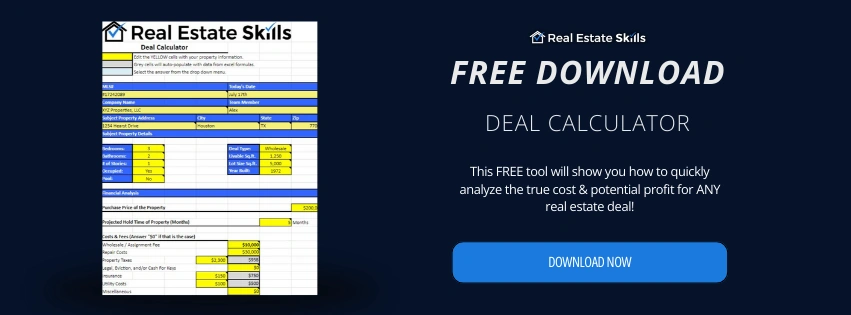
A bridge loan only works on a deal that works. If your numbers are off by even a few percent — rehab, leverage, carrying costs — your profit disappears, no matter how good your lender is. Don't risk it on back-of-the-napkin math. Download our Free Deal Calculator to run your purchase price, rehab budget, and after-repair value, factor in financing and closing costs, and see your real spread with total confidence before you ever apply.
You Know The Lenders. Now Learn To Find Deals Worth Funding.
A bridge loan is only as good as the deal you put it on. The investors who actually profit follow a proven process from day one — finding discounted properties, locking them up, and funding them with the lenders on this list. Our FREE Training walks you through the entire system, the same one thousands of our students use. Watch it today, then go put these lenders to work.
Watch The FREE Training →Best Bridge Loan Lenders FAQs
Final Thoughts: Which Bridge Loan Lender Is Best For You?
There's no single best bridge loan lender — there's the best one for your deal. That's the honest answer, and it's why this guide gives you seven instead of crowning one. The right choice comes down to your cash position, your credit, how fast you need to close, and what you're buying.
If you want the strongest all-around combination of leverage, speed, and rate, start with Kiavi — it's the lender our own team uses and the one we point most flippers to first. If you're new or your credit sits in the low 600s, Easy Street Capital and Park Place Finance both lend to first-timers and close fast. If you want to price deals yourself and run different strategies through one lender, New Silver's instant terms and multi-product lineup fit. If your deal is unusual — an odd property type, a complex value-add, a small loan, or a California-only project — Nationwide Mortgage, Stormfield Capital, and FK Capital Fund each cover ground the others don't. Match the lender to the deal, not the other way around.
And remember what actually separates investors who close from those who don't: it isn't access to the cheapest rate. It's understanding the money. The investors who win know that points can cost more than interest on a short flip, that higher leverage is a tradeoff and not a free lunch, and that closing three days faster can be worth more than a lower rate when a deal is on the line. Money for these deals is abundant — the skill is knowing which lender to call and how to read what they're offering.
So here's your next step. Take a deal you're actually looking at — or a property you're eyeing — and get real quotes from two or three of these lenders. Most of them, Kiavi and New Silver included, will give you a term sheet and a proof-of-funds letter online in minutes, with no hard credit pull and no obligation. Run the same deal through a couple of them, compare the total cost of the money side by side (rate plus points plus fees), and you'll see immediately which lender fits. That's how you go from reading about bridge loans to actually funding your next deal.
Financing Is Half The Deal. Here's The Other Half.
Knowing which lender to call means nothing without a deal to fund. The investors who close consistently don't guess their way to their first flip — they follow a proven system to find deals, analyze them, and fund them. Our FREE Training shows you exactly how, without expensive marketing or learning the hard way. Watch it now, then go get your next deal funded.
Watch The FREE Training →
About The Author
Founder & CEO, Real Estate Skills
Alex Martinez is the Founder and CEO of Real Estate Skills. With more than a decade of investing experience and 33+ residential properties acquired, he has personally wholesaled and flipped houses across the country — using bridge and hard money financing to fund deals. Through Real Estate Skills, Alex and his team have helped thousands of students learn how to find deals, fund them with the right lenders, and close profitable real estate transactions.
Real Estate Skills is not a law firm or a financial advisor, and the information in this article is provided for educational purposes only — it does not constitute legal, tax, or financial advice. Bridge loan rates, terms, and lender requirements vary by lender and state and change frequently; every figure here is a starting or best-case estimate that should be confirmed directly with the lender before you apply. All real estate investing carries risk, and past results do not guarantee future outcomes. Always consult a licensed professional and confirm current loan terms before entering into any financing agreement.

👉FREE Training
How To Consistently Wholesale, Flip Houses, & Invest In Rental Properties From The MLS
(Without Spending $1 On Marketing)

Alex Martinez, the founder of Real Estate Skills, is known for his strong, practical expertise in real estate, starting from a beginner with no family connections in the industry to completing over 50 real estate deals, including wholesale and flips, within his first year.
He has dedicated his career to providing cutting-edge education and resources for real estate professionals. He emphasizes the importance of self-taught knowledge through mentors, books, and hands-on experience.
His journey from earning a modest income to becoming a successful real estate entrepreneur and educator showcases his expertise and dedication to the field.

Ryan Zomorodi, co-founder and COO of Real Estate Skills, leverages his experience from a diverse background in real estate investment, construction management, and entrepreneurship to provide comprehensive education in the real estate sector.
His expertise is rooted in hands-on experience, extensive industry knowledge, and a commitment to empowering others through education.
Ryan's journey reflects a blend of practical experience and entrepreneurial success, contributing to his role in developing a platform that educates and supports aspiring real estate professionals.
Read Ryan's Full Bio >>
